In Google’s Gemini platform, 89% of Vietnamese prompts, 87% of Thai prompts, and 84% of Indonesian prompts are now submitted in native languages, according to Q1 2026 data from six Southeast Asian markets. The shift away from English marks the first time a major Western AI tool has been used predominantly in local languages across the region.
The numbers arrive before any broad economic impact data exists. But the usage pattern suggests a structural reorientation of who can participate in the AI economy—and which platform mediates that participation.
A tea farmer in Lao Cai province, Vietnam, can now draft an export pitch in polished English without ever learning the language. He uses Gemini to convert his Vietnamese product descriptions into market-ready text, bypassing the intermediaries who once controlled access to overseas buyers. His experience is not yet common, but the data from Google’s own platform shows it is the direction the region is moving. In Vietnam, 89% of Gemini prompts are in Vietnamese. The thrum of AI interaction across Thailand and Indonesia is increasingly in Thai and Indonesian, at 87% and 84% respectively. The technology long trained predominantly on English text is finally serving the languages most people in Southeast Asia actually use. The question is whether that translates into economic agency, or simply hands a new gatekeeper the keys to the village.
A linguistic reversal across three of the region’s largest markets
Google’s internal Gemini Southeast Asia 2026 report, covering Indonesia, Malaysia, the Philippines, Singapore, Thailand, and Vietnam in the first quarter, shows the deepest native-language adoption in Vietnam. Beyond the aggregate numbers, the Vietnamese use case is notably broad: 29% of prompts fall into casual conversation, 17% into content creation, and 5% into mathematics, while programming claims just 4%—a reminder that AI’s utility is being shaped by everyday needs, not just technical tasks.
Thailand and Indonesia follow a similar arc, though the mix varies. Sapna Chadha, Google’s Vice President for Southeast Asia and South Asia, sees a pattern of culturally specific embedding. “People here are integrating AI into daily life in uniquely local ways,” she said, pointing to use cases that differ by country even when the technology is identical.
Malaysia offers a sharp counterpoint. English still dominates professional and coding work, yet Malay-language text prompts have doubled in early 2026 compared with the previous period. One in five Malaysian users now generates images via Gemini—the highest visual-AI adoption in the region. The pattern suggests not wholesale language shift but task-dependent switching, a more nuanced behavior that pure percentage metrics can miss.
Indonesia’s Vice Minister of Communication and Digital, Nezar Patria, highlighted a related discrepancy. According to Google’s data, his country ranks as a top-five global user of ChatGPT for coding, data analysis, and education, signaling intense corporate and developer uptake. Yet overall mass consumer adoption of AI tools remains limited. A 2026 Kantar ASEAN Intelligence survey found 62% of Indonesian companies classed as AI first movers, far ahead of household adoption. The gap underscores a risk: the most promising native-language AI uptake could concentrate among already-connected urban users, leaving the rural inclusion story unproven. The data tracks language choice, not economic outcomes.
The chain of transformations that makes this possible is easier to see than describe.
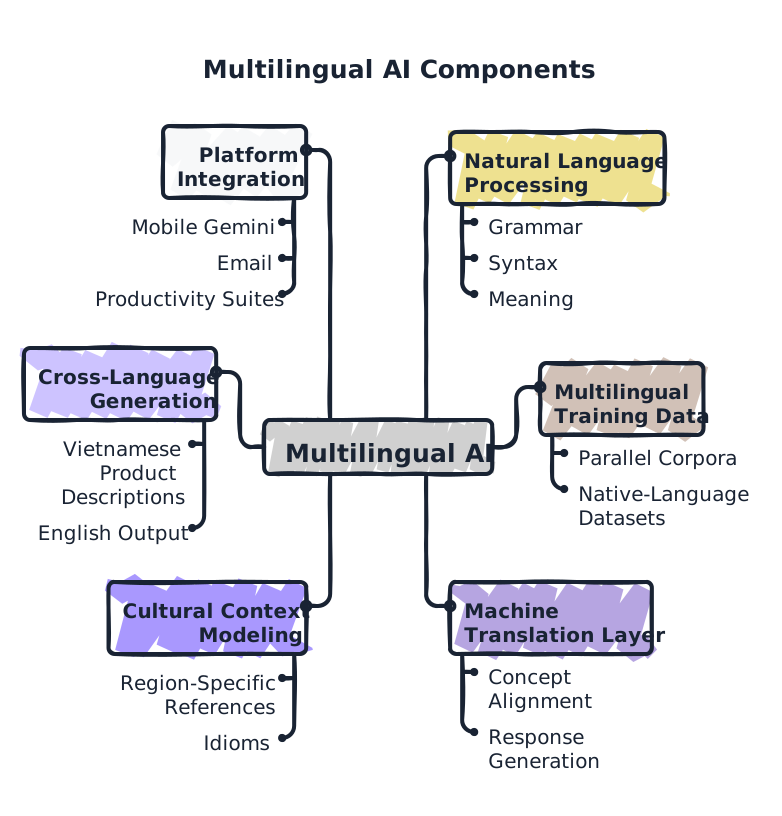
The infrastructure that excluded most Southeast Asians is now being rewritten
For decades, English functioned as the de facto operating system of Southeast Asia’s digital economy. E-commerce platforms, banking apps, and government portals were built in English first, if not exclusively. That filtered out rural populations, non-English-speaking smallholders, and informal workers—precisely the people who had the most to gain from digital access. The same assumption ran through early AI: large language models were trained predominantly on English text, with other languages treated as secondary fine-tuning layers.
Google’s Gemini patterns suggest that assumption is dissolving. The competition to own native-language AI is accelerating across the region, with stakes that extend far beyond interface preference. Google is integrating Gemini directly into Android, YouTube, and Workspace, tying daily-language interactions to a sprawling ecosystem. OpenAI and Anthropic lead on frontier capability but still lack robust official support for many Southeast Asian languages. Regional platforms like Naver in Korea show the power of binding models to proprietary local-language content. Winning this race means owning the language layer through which hundreds of millions of people will learn, trade, and access services.
The same capability that lets a farmer bypass middlemen also concentrates transaction data, usage behavior, and economic patterns inside one platform. The next ASEAN ministers’ meeting on digital governance, expected in late 2026, is the first opportunity to confront that concentration. Whether it addresses it, or simply notes the metrics, will determine if this linguistic opening widens into durable economic access—or narrows again behind a different gate.
Beyond the headline
The Bigger Picture
Native-language AI usage in Southeast Asia reverses a decades-long pattern: digital platforms demanded that users adapt to English. The new data suggests platforms are now bending toward users. That tilt shifts who can benefit from AI—rural entrepreneurs and small service providers can engage directly in their own languages, cutting down the traditional gap between urban, English-proficient elites and everyone else.
The Reach
Google’s success in capturing native-language interactions in Vietnam, Thailand, and Indonesia positions it not just as a tool but as infrastructure for local commerce and education. Western exporters and service firms will increasingly encounter AI-mediated customer journeys in Thai or Vietnamese, forcing them to rethink English-first product designs. The real reach is in how trade flows begin to reorganize around language-native platforms.
What Isn’t Being Said
The excitement around inclusive AI often overlooks the accumulation of granular economic and social data by one or two platforms. As Gemini becomes the mediation layer for rural trade and local services, Google gains insight into regional economies at a resolution no government statistical agency can match. The unresolved questions are who sets access pricing, how competing models will interoperate, and what happens if a platform’s policies or an outage suddenly reshape livelihoods.
The decisions that Western firms now face
As native-language AI reshapes economic access across Southeast Asia, four distinct sets of actors outside the region are confronting choices that were abstract a year ago.
- Western AI/Tech Investor with APAC Exposure
You need to audit portfolio companies’ localization depth. The SEA-HELM benchmark, which ranks large language models across seven Southeast Asian languages, now serves as the region’s report card; firms not topping it are already falling behind in actual usage. Reallocate toward startups building vertical applications on multilingual stacks—education, agritech, and micro-commerce tools that depend on accurate local-language output, not just frontier model benchmarks.
- Western Export-Oriented Business with Southeast Asia Markets
Direct engagement with local producers is moving from vision to viable. Google’s Gemini enables cross-language generation where a Vietnamese product description is rendered directly into marketplace-ready English. Map which of your current intermediary relationships could be compressed by AI-native exporters, and start piloting direct-source channels that use this capability before your competitors do.
- Western Supply Chain Manager Sourcing from Southeast Asia
AI-powered direct trade could alter the competitive landscape for smallholder suppliers. Monitor Google’s upcoming updates for any expansion of transaction-oriented features within Gemini’s localized interface. Begin modeling how a 10–15% shift in smallholder exports moving through multilingual AI platforms would affect your existing contract structures and pricing leverage.
- Western Digital Product Manager for Southeast Asian Markets
English-only product roadmaps are now a liability. The data shows high casual-conversation and content-creation usage in local languages; your interface must feel native. Prioritize Vietnamese, Thai, and Indonesian language support with culturally relevant content templates. Treat localization not as a feature tier but as the core product for the region; launch in a local language first, then add English as an option.
Explainer
- Gemini
- Google’s multimodal AI assistant, which processes text, images, and code across web and mobile applications. It is deeply integrated with Android, YouTube, and Google Workspace, giving it a distribution advantage in Southeast Asian markets where Android dominates. Gemini’s multilingual performance relies on training across parallel corpora and native-language datasets, enabling it to handle Vietnamese, Thai, Indonesian, and Malay with far better cultural grounding than earlier models.
- SEA-HELM
- The Southeast Asia Holistic Evaluation of Language Models, a benchmark that assesses large language model performance across Burmese, Filipino, Indonesian, Malay, Tamil, Thai, and Vietnamese. It ranks models on language understanding and generation tasks tailored to each country’s linguistic nuances. The benchmark has become a reference point for measuring whether a Western AI product truly works for the region’s populations rather than only for its English-proficient minority.
- Multilingual AI
- AI systems that can understand and generate content in many languages with comparable quality, not simply translate between them. They rely on neural alignment techniques that map meaning across languages, helping the model handle idioms, slang, and cultural references that literal translation misses. A key challenge is avoiding English bias so that a Thai-language request for a payment plan yields the same quality of answer as an English one.
RELATED STORIES