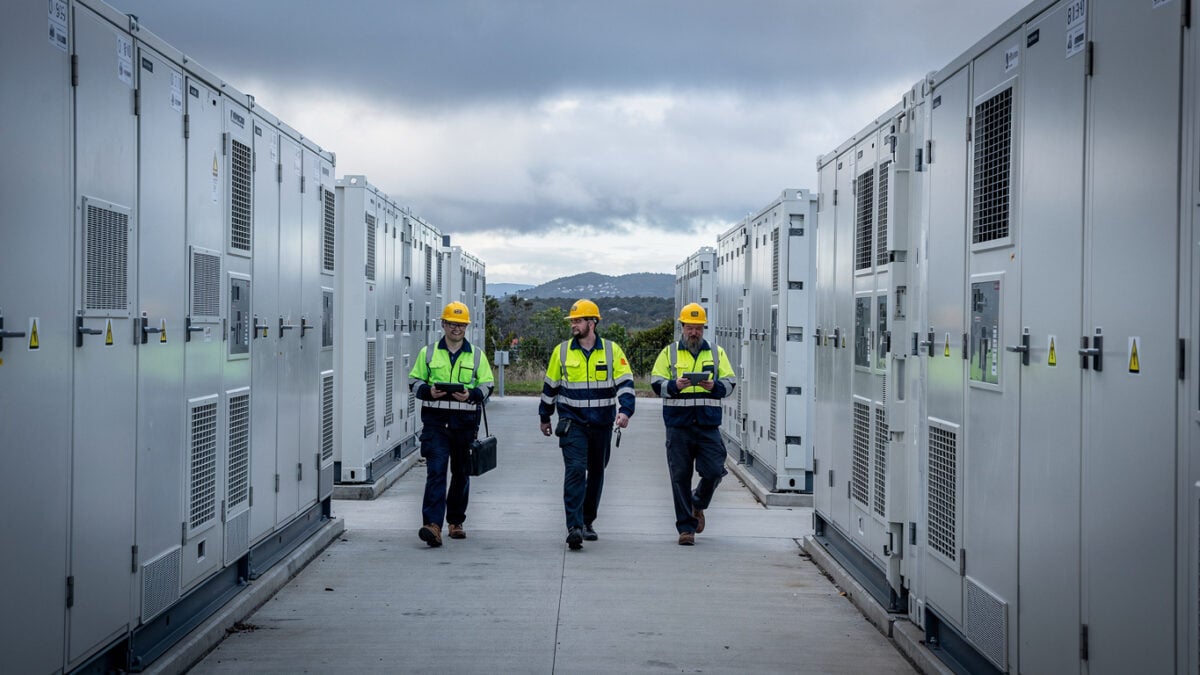
The Australian Energy Regulator has remade two revenue determinations for the Waratah Super Battery, letting the New South Wales system trade in the National Electricity Market when it is not needed for grid security. A share of that trading income is now applied against the charges consumers pay, under an amended agreement reached with the network operator and the state’s project body.
How much billpayers actually save is not yet known. The regulator will publish an aggregated schedule of payments around June 2027.
Here is what the announcement leaves out. A grid battery is normally paid to wait. Its contract buys readiness, not electricity.
The money arrives whether or not the thing ever switches on.
Waratah Super Battery now does both. It holds a 700MW reserve the network operator can call on command, and in the hours it is not needed it can sell power into the wholesale market. Some of what it earns is meant to end up on household bills as a smaller charge.
Nobody reopens a signed contract to add a clause like that without a reason. The Australian Energy Regulator has rewritten the battery’s revenue terms at Budgewoi, on the New South Wales central coast, from late 2026.
Waratah spent most of its first year at a fraction of its rated output, after a transformer failed and a second was shut down as a precaution. Its owner collected far less than it had counted on. Whether the new clause closes that gap for the company, or for the households who paid for the asset, is the question the next set of numbers will settle.
The security duty stays; the earning rules changed
Two revenue determinations were remade, not one. Grid-security service was priced in December 2022, paired generation in March 2024. In August 2026, Transgrid asked the regulator to remake the second so it matched amended terms in the System Integrity Protection Scheme agreement, which its own summary records. The AER agreed, and rewrote the payment schedule and the revenue adjustment mechanisms with it.
What changes is what the battery may do in the gaps. When its security duties are not being called, it can trade in the National Electricity Market. The reserve obligation does not shrink. Akaysha Energy, the developer and owner, says the arrangement improves the use of critical infrastructure without compromising system security, according to Paul Curnow, its chief commercial officer and managing director.
The money runs backwards from the meter. Trading income is applied against the amounts payable to Akaysha, so lower payments mean lower costs recovered through the network charges NSW households and businesses pay.
EnergyCo, the state body that ran the procurement, describes the system as rated at 850MW and 1,680MWh — one of the largest batteries in the world, it says.
At full output, that is enough to serve up to 340,000 NSW homes at peak demand.
The steps below follow the trading money from the market to the meter.
For now, New South Wales leans hard on this single asset.
| Entity | Current rule | New rule | Effective date |
|---|---|---|---|
| SIPS Battery Service | Paid only for availability | May trade when security duties are idle; income shared against consumer costs | Late 2026 |
| Paired Generation Service | Fixed payment schedule | Schedule adjusted; revenue adjustment mechanisms amended | Late 2026 |
| Payment schedule publication | Published line by line | Aggregated across both determinations and published separately | Each June |
| Scheme Financial Vehicle | Recovers project costs via network providers and retail charges | Unchanged; trading upside nets against amounts payable | Late 2026 |
| Source: Australian Energy Regulator; EnergyCo | |||
The bill pays first, the upside arrives later
Exactly who carries the cost was never in doubt. The Scheme Financial Vehicle recovers the project’s outlays from distribution network service providers, which pass them into retail network charges.
Households pay first.
The trading upside is netted off afterwards, so the new clause does not add a stream to the public side. It hands part of one back.
A NSW household never sees this as a contract clause. It sees a line on a quarterly bill that should shrink once the trading clause begins to work.
That is why the next publication matters more than this one. The AER no longer lists the payment schedule line by line. It publishes an aggregate each June, folding in annual adjustments made up to March — including any for a delayed start to commercial operation. That number is expected around June 2027; until it lands, the size of any consumer benefit is an intention, not a figure.
None of this sits outside the rules. The state’s Electricity Infrastructure Investment Act 2020 put the battery on the grid, and its Priority Network Infrastructure Project tag is what gives a regulator power over its revenue at all.
What remains open is whether the model travels. The same framework governs the next priority project, and the regulator has now shown it will reopen a signed security contract mid-life when the need case shifts.
Which brings the question back to where it started. The battery was paid to wait, and is now paid to wait less. Who collects for the idle hours is the part the paperwork has not settled.
Beyond the headline
The bigger picture
The structural shift here is in how regulated storage gets paid — away from availability alone and toward availability plus optionality. That looks like a contract detail. It matters more as coal retirements make flexible assets on the grid worth more, and as regulators look for ways to fund the next one without adding to bills outright.
The precedent
The instrument this departs from is the AER’s revenue determination guideline for NSW contestable network projects, which treats a signed service contract as the basis for a fixed payment path. Remaking it mid-life adds a second variable — market income — into a framework built for one. The next priority storage project will be negotiated knowing that.
Our take
Indoneo’s view is that Australia should expect more hybrid storage contracts like Waratah, not fewer. Once a battery can trade while holding a regulated security role, the upside is too useful to leave on the table. The model’s real test is whether the trading income reaches a bill at all.
The number still owed to billpayers
The question now is not whether the mechanism exists, but who can act on it before the next set of figures lands.
- Western institutional investor in Australian grid-scale storage
Reassess the return model for Australian storage assets: does the merchant trading upside cover the share handed back to consumers? Check whether this hybrid template is written into any asset in your pipeline, because the regulator has shown it will apply one mid-life.
- NSW household or small business electricity consumer
You will not see a line item for this. Watch the AER’s aggregated payment figure around June 2027 and the annual network tariff decisions that follow it, which is where a trimmed service charge, if there is one, would appear.
- Australian energy policy professional or regulator
The AER has demonstrated it can remake a signed security contract after the fact. Decide whether that power belongs in the revenue determination guideline for NSW contestable network projects before the next priority project is contracted.
- Developer or financier of grid-scale batteries outside Australia
Structure merchant-trading and revenue-sharing terms upfront, or accept that a regulator may add them for you. In markets retiring coal, the terms you sign are no longer necessarily the terms you keep.
Explainer
- System Integrity Protection Scheme
- A scheme that pays a generator or battery to stay available rather than for the power it produces. It lets a network operator push more electricity through existing lines instead of building new ones. Australia’s control system for the scheme watches 36 transmission lines in real time.
- National Electricity Market
- The wholesale market that links generators and buyers across Australia’s eastern states. It covers Queensland, New South Wales, Victoria, South Australia, Tasmania and the Australian Capital Territory. Batteries earn from it by buying power when it is cheap and selling when prices rise, often within a single day.
- Electricity Infrastructure Investment Act 2020
- A New South Wales law that set up the state’s electricity infrastructure roadmap. It gives the energy minister power to direct network operators to build priority projects and the regulator power to set their revenue. It also created the Scheme Financial Vehicle that recovers project costs from consumers.
- Scheme Financial Vehicle
- The state entity that holds and recovers the cost of New South Wales’s priority electricity infrastructure. It collects from distribution network service providers, which pass those costs into retail network charges. Its outlays sit among the fixed costs on a household bill that no tariff change can remove quickly.
- Priority Network Infrastructure Project
- A designation under New South Wales law for grid projects judged essential to the state’s energy transition. Directed projects follow a regulated revenue path set by the Australian Energy Regulator rather than a purely commercial contract. The Waratah battery is one of the assets designated this way, which is why its revenue terms sit with a regulator.
RELATED STORIES