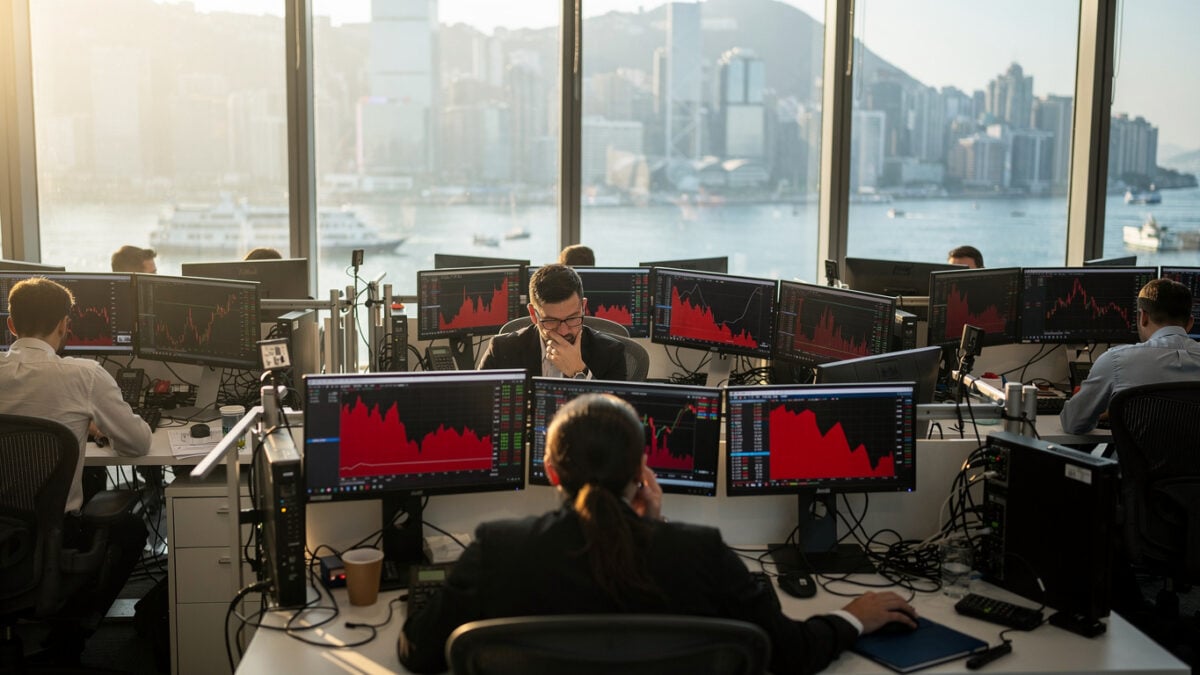
Z.ai, the Beijing-based AI developer formerly known as Zhipu AI, disclosed on September 13, 2026 a dual financing plan targeting roughly US$5 billion. The package includes a HK$15.7 billion share placement of 21.97 million new H shares at HK$714 each and a 20.14 billion yuan zero-coupon convertible bond maturing in September 2027.
The fundraising arrives as lock-up periods from earlier sales expire and the company advances a Shanghai STAR Market listing. Yet the stock has plunged 73% from its June intraday high, raising doubts about whether capital alone can sustain its AI ambitions.
Z.ai’s stock has cratered since late June, even as the Beijing-based AI developer lined up another multibillion-dollar fundraising. The company disclosed on September 13 a share placement and convertible-bond sale that together target roughly US$5 billion, landing just as lock-up periods from earlier sales expired and a planned Shanghai listing moved forward.
The market’s verdict is already in: the shares have given back nearly all the gains from their January IPO, despite the fresh capital. The disconnect between the money flowing in and the price falling out signals a deeper question — whether Z.ai can convert billions in compute spending into a durable position in the global AI race, or whether it is simply funding an expensive treadmill.
A $5 billion raise that couldn’t stop the slide
Z.ai is issuing 21.97 million new H shares.
The offer price of HK$714 represents a 10% discount to Friday’s close.
Gross proceeds will reach HK$15.7 billion, roughly US$2 billion.
The discount tells its own story.
The concurrent zero-coupon convertible bond carries a principal of 20.14 billion yuan (US$3 billion). It matures in September 2027 and converts at a premium to the placement price. Settled in U.S. dollars, the structure lets Z.ai lock in long-dated funding. Bondholders get a path to equity if the shares recover.
Cornerstone investors from the January IPO held 25.68 million shares under a six-month lock-up that ended around July 8. That freed a large block of stock just as sentiment was turning.
In July, Z.ai raised HK$31.4 billion through a placement of 19.78 million shares.
The shares were sold at HK$1,588 each.
The 60-day lock-up lapsed in early September.
The window was closing.
The company is also pushing toward a listing on Shanghai’s STAR Market. Its board approved a plan on June 1 to raise up to 15 billion yuan.
Eighty percent of the proceeds are earmarked for foundation-model R&D.
Public tutoring-status updates show the sponsorship has moved to a “review completed” stage. The CSRC has not yet accepted the formal application.
The breakdown below shows what makes a model “frontier” — and why the price tag runs into the billions.
| Entity | Current rule | Z.ai’s proposed allocation | Effective date |
|---|---|---|---|
| Shanghai STAR Market listing | A-share issuance must complete CSRC registration and STAR Market review; proceeds earmarked for strategic digital infrastructure. | Offering of up to 15 billion yuan, with 80% to foundation-model R&D, 13% to MaaS platform, 7% to working capital. | Pending regulatory acceptance |
| Hong Kong share placement | Discounted placements allowed under HKEX rules, with lock-up periods for cornerstone investors. | Placement of 21.97 million new H shares at HK$714 (10% discount), raising HK$15.7 billion, with lock-up expiry in early September 2026. | September 13, 2026 (disclosure) |
| Hong Kong convertible bonds | Zero-coupon convertible bonds permitted, with redemption allowed if shares trade above 130% of conversion price for 20 of 30 days. | 20.14 billion yuan principal, maturing September 2027, conversion price HK$892.50, settled in USD. | September 2026 (issuance) |
| Source: Hong Kong Exchanges and Clearing filings, Shanghai Stock Exchange disclosures | |||
Kane Wu, who covers Asia Pacific capital markets for Reuters, notes that Chinese AI developers are racing to secure funding for costly computing infrastructure and talent. Dealroom’s research team ranks the post-IPO fundraise among the largest enterprise software equity raises in China. That signals investors are still willing to back foundation-model players despite the price correction. The appetite for AI paper, even at a discount, remains intact.
Li Mingming, a markets reporter tracking STAR Market listings, points out that the planned offering would channel the bulk of proceeds directly into large-model R&D, using mainland listing rules to fund capital-intensive AI infrastructure. Meanwhile, public tutoring-status updates from Shanghai’s Sci-Tech Innovation Board show procedural progress but also that key steps — CSRC registration and formal exchange acceptance — remain outstanding.
The real question is whether the billions Z.ai is raising buy it a seat at the frontier-model table eighteen months from now — or merely fund another round of compute spending that leaves it no closer to closing the gap with OpenAI or Google. The honest caveat: the STAR Market application has not been accepted, and the timeline for a mainland listing remains uncertain. If regulators delay, Z.ai will have to lean even harder on Hong Kong’s markets, where investors have already shown they are willing to sell.
The brutal math of building a frontier model
Z.ai competes in a global race where the cost of entry keeps rising. Frontier-model leaders — OpenAI, Anthropic, Google DeepMind — spend billions annually on compute and talent, and they monetize through integrated platforms. In China, Baidu’s Ernie, Alibaba’s Qwen, and Tencent’s Hunyuan are chasing the same goal, while newer entrants like Moonshot and MiniMax add to the capital scramble. Z.ai’s repeated fundraisings are not a sign of strength; they are a requirement to stay in the game.
Hong Kong’s tech segment has turned volatile in 2026. The Hang Seng TECH Index is down by a double-digit percentage year-to-date, and flows into China-focused AI ETFs have been choppy — net inflows around major fundraisings, outflows after sharp price swings. Trading volumes in Z.ai’s stock spiked around the early September lock-up expiries, indicating that new supply and profit-taking are already reshaping the shareholder base.
The forward signal to watch is whether Shanghai regulators formally accept Zhipu AI’s STAR Market application in the coming quarters. If they do, it confirms mainland comfort with aggressive AI capital raising and gives Z.ai access to a deeper pool of domestic investors. If they don’t, the company will have to return to Hong Kong’s markets — and to investors who have already priced in the risk that even billions may not be enough.
Beyond the headline
The Money Trail
Z.ai’s fundraise is less about a single company than about who bankrolls China’s foundation-model ambitions. Discounted equity and near-zero-yield convertibles effectively transfer future upside from public shareholders to a mix of institutional buyers and bondholders willing to underwrite multi-billion-dollar compute spending. The bigger question is whether mainland investors, via a future STAR Market listing, will ultimately shoulder more of this capital burden than offshore markets.
The Timing
This raise lands precisely as multiple lock-ups expire and China’s AI equity rally cools, forcing Z.ai to secure long-dated financing before sentiment deteriorates further. Launching a zero-coupon convertible while share prices are still well above IPO levels buys time to execute its model roadmap. If regulators green-light the Shanghai listing soon, the window for large-scale AI fundraising could narrow as macro conditions and global GPU bottlenecks intensify competition for capital.
The Reach
One non-obvious ripple is for Western asset managers using Hong Kong tech indices as a proxy for China’s digital economy. Z.ai’s sharp price swings and repeated capital raises can distort benchmark weights and risk profiles, affecting portfolio construction in London or New York. As more Chinese frontier-model firms list or raise follow-on capital, passive and quasi-passive funds will be pulled deeper into China’s AI race, whether or not they actively choose single-stock exposure.
What Z.ai’s slide means for your portfolio
With Z.ai’s stock in freefall and more shares set to hit the market as lock-ups expire, Western investors with exposure to Hong Kong tech face three immediate decisions.
- Western Investor with Hong Kong Tech Exposure
Evaluate the dilution impact of the new share placement on your holdings. Monitor the official Z.AI CO., LTD. quote page on the Hong Kong Exchanges and Clearing website for placement completion and subsequent price moves over the next three to six months. Consider whether the increased free float improves liquidity or merely adds selling pressure.
- Western Semiconductor Procurement Manager
Z.ai’s multi-billion-dollar fundraising directly signals sustained demand for high-end GPUs and AI computing infrastructure. Anticipate potential further tightening in the supply of advanced AI chips and adjust your procurement forecasts accordingly. The capital raised will flow into compute clusters, intensifying competition for already constrained components.
- US-based AI Venture Capitalist
Analyze Z.ai’s financing terms — a 10% discount on equity and a zero-coupon convertible — as a benchmark for valuation in the capital-intensive frontier-model space. The market’s negative reaction despite the raise suggests that even large funding rounds may not guarantee competitive positioning. Use this to stress-test your own portfolio companies’ capital needs and exit timelines.
- Western Policy Analyst on China’s Tech Ambitions
Track Shanghai STAR Market listing announcements and AI-sector policy signals through the Shanghai Stock Exchange’s English-language news and disclosure pages. The dual offshore-onshore fundraising strategy illustrates how China is building a domestic capital pipeline for strategic AI development, reducing reliance on Western funding. Assess whether this accelerates China’s technological self-sufficiency in AI and what it means for global tech competition.
Explainer
- STAR Market
- The Shanghai Stock Exchange’s Sci-Tech Innovation Board, launched in 2019, allows pre-revenue tech companies to list with lighter profitability requirements. It has become a key venue for China’s semiconductor, biotech, and AI firms to raise domestic capital. Z.ai’s planned listing would tap a market that has already hosted some of the country’s largest tech IPOs.
- Zero-coupon convertible bond
- A bond that pays no periodic interest and can be converted into a predetermined number of the issuer’s shares. Investors accept no coupon in exchange for the potential upside if the stock price rises above the conversion price. Z.ai’s bond matures in 2027 and is settled in U.S. dollars, reducing currency risk for offshore buyers.
- Shares of companies incorporated in mainland China that are listed on the Hong Kong Stock Exchange. They are denominated in Hong Kong dollars and traded by international investors, providing a way to gain exposure to Chinese firms without direct access to mainland exchanges. Z.ai’s placement of new H shares dilutes existing holders but also increases the free float.
- Lock-up period
- A contractual restriction preventing major shareholders, such as cornerstone investors or company insiders, from selling their shares for a set time after an IPO or placement. The expiry of lock-ups often leads to increased selling pressure as holders seek to realize gains. Z.ai faced two such expiries in mid-2026, prompting its preemptive fundraising.
- CSRC
- The China Securities Regulatory Commission, the main financial regulator overseeing China’s securities and futures markets. It approves IPOs, reviews listing applications, and enforces disclosure rules. For Z.ai’s STAR Market listing, CSRC registration is a mandatory step before the Shanghai Stock Exchange can formally accept the application.
- Frontier AI model
- A large-scale neural network trained at the limits of current hardware, data, and algorithms to perform a wide range of cognitive tasks. Training one can cost hundreds of millions of dollars and requires thousands of GPUs running for weeks. These models underpin advanced applications like autonomous coding agents and scientific simulations, and only a handful of firms globally can afford to build them.
RELATED STORIES


