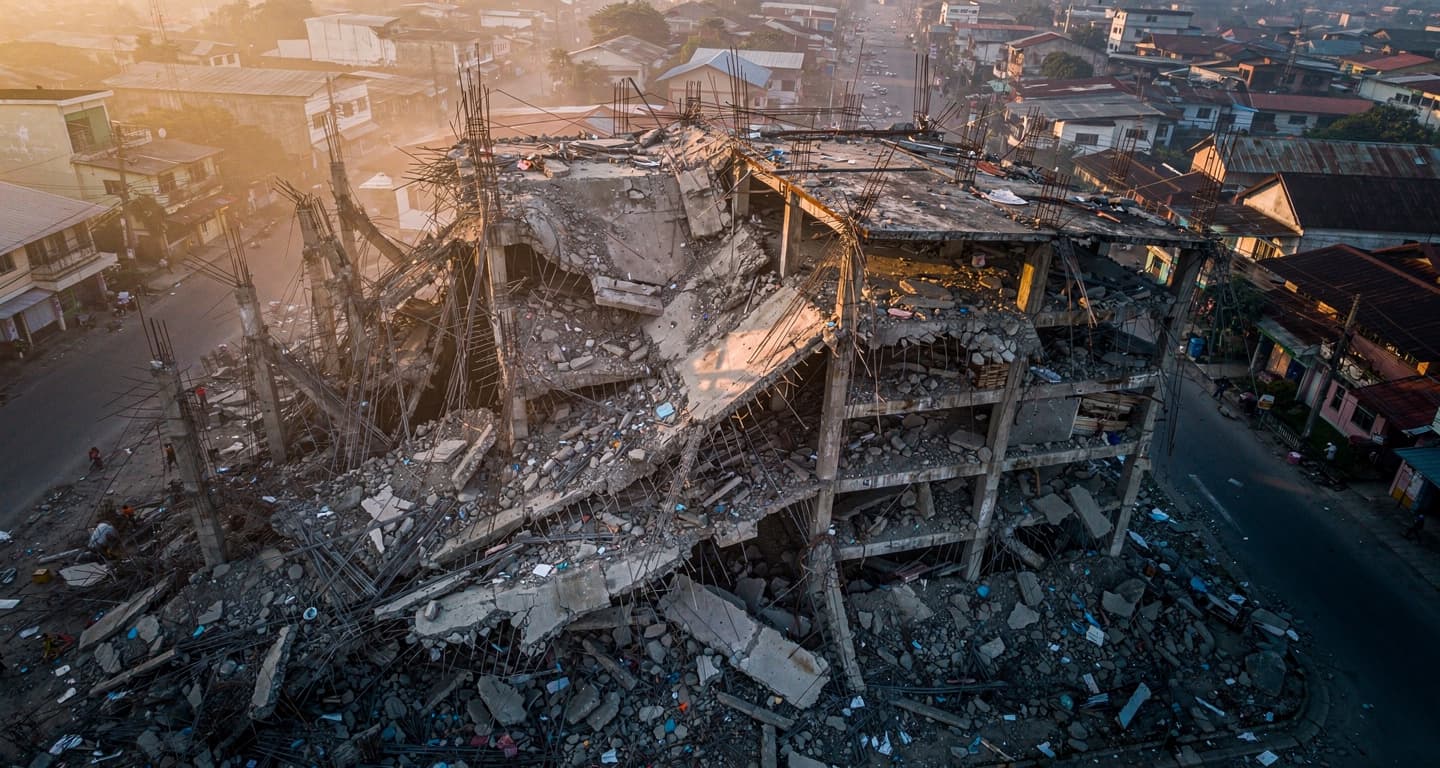
A four-story commercial building under construction collapsed on May 26, 2026, in Angeles City, Pampanga, killing at least four workers and leaving 16 others officially listed as missing. Philippine authorities declared rescue operations over on the evening of May 27 — roughly 48 hours after the collapse — with heavy machinery and hand-cutting crews still working through steel scaffolding and concrete debris along Friendship Highway in Barangay Anunas.
The building owner and contractor now face potential criminal charges under the Revised Penal Code and the National Building Code of the Philippines. Whether prosecutors act decisively will determine if this disaster reshapes construction enforcement or fades into the country’s long record of unresolved accountability.
The last survivor pulled from the rubble in Angeles City was a dog. His owner — one of the construction workers — remains among the 16 people still unaccounted for after a four-story commercial structure collapsed on May 26, 2026, on Friendship Highway, a stretch popular with foreign visitors in Pampanga province. By Monday evening, the Philippine government had called off the search for survivors, even as families refused to accept it: Rosenda de la Cruz, whose husband Porfirio was found alive but died of his injuries before she could reach him, said she would not have closure until the building’s owner faced justice.
That demand — accountability, not just recovery — is the real test this disaster presents to Philippine authorities. The Department of Public Works and Highways (DPWH) has announced a full structural audit. The Department of Labor and Employment (DOLE) is conducting a parallel labor-safety investigation. Angeles City officials have suspended all work on the project. What happens next in the prosecutor’s office, not on the construction site, will determine whether this collapse is a turning point or another entry in a ledger that never closes.
What the investigation must answer
The collapsed structure was part of a commercial complex being built along Friendship Highway in Barangay Anunas. DOLE confirmed that the contractor had at least 40 workers on shift when the building came down, a figure that has complicated efforts to account for everyone on site. The discrepancy between confirmed dead and those still missing reflects the difficulty of tracking informal labour arrangements common across Philippine construction sites.
DPWH Acting Secretary Ruben Reinoso confirmed that the department’s Bureau of Construction will audit whether the approved structural plans and actual construction methods complied with Presidential Decree No. 1096 — the National Building Code of the Philippines — including whether permits were properly issued and inspected by local building officials in Angeles City. Jose “Ping” De Jesus, chair of the Philippine Constructors Association, said the collapse exposed chronic enforcement gaps in local permitting and demanded stricter monitoring of contractors and on-site engineers nationwide.
Under Republic Act No. 6541, local building officials hold the authority to issue violations, suspend work orders, and refer cases for criminal prosecution. That referral power is now the mechanism families are watching most closely.
| Country | Fatal construction accidents | Non-fatal injuries / violations | Source |
|---|---|---|---|
| Philippines | 60 deaths | 2,570 non-fatal injuries; 187 violations (Central Luzon) | DOLE OSHC, February 2026 |
| Indonesia | 11 fatal accidents | Not separately reported | National Construction Safety Committee, 2025 |
| Vietnam | Not separately reported | 169 serious violations inspected | Ministry of Construction, 2025 |
| Malaysia | 23 fatal accidents | Not separately reported | DOSH, 2025 |
A familiar pattern, and why this time could be different
The Philippines recorded 60 construction-related workplace deaths and 2,570 non-fatal injuries in 2025, according to DOLE’s Occupational Safety and Health Center data published in February 2026. DOLE’s Central Luzon office alone cited 187 construction safety violations during site inspections that year. Metro Manila logged five major partial building or scaffolding collapses under active local government investigation across 2025. The Angeles City collapse did not occur in a vacuum — it occurred in a province already producing enforcement statistics that should have prompted earlier action.
The mechanism that could make this case different is the convergence of two parallel investigations. The DPWH technical report — expected within weeks — feeds directly into the city prosecutor’s decision on criminal charges. A broad referral, naming the building owner, contractor, and supervising engineers, would be unusual. Most post-collapse prosecutions in the Philippines have historically produced narrow findings, modest fines, and years of procedural delay. The pattern across the region — visible in Indonesia’s tightening of high-rise inspections and Malaysia’s Occupational Safety and Health (Amendment) Act 2022 — suggests that sustained regional pressure can eventually force more rigorous enforcement, but rarely quickly. The scale of accountability here is what distinguishes a genuine turning point from a televised site visit.
Beyond the headline
The Bigger Picture
This collapse highlights a structural tension in Southeast Asia’s urban boom: local governments aggressively court investment and fast-track projects, but lack the inspection capacity and political will to police builders tied to jobs and tax revenue. As cities compete for malls, condos, and hotels, enforcement of safety codes often lags far behind the pace and scale of construction.
The Response Gap
Public statements promise full investigations and justice, yet families typically face years of slow-moving cases, modest compensation, and limited sanctions for executives or officials. The gap between televised site visits and the eventual legal outcomes is what determines whether contractors treat such disasters as rare exceptions or manageable business risks.
The Reach
For Western construction and engineering firms operating in Southeast Asia, the case raises reputational and legal exposure: partnering with local contractors who cut corners can import liability into home jurisdictions, especially where shareholders and regulators scrutinise overseas health-and-safety records. Choosing compliant partners and demanding documented safety audits becomes a commercial necessity, not just due diligence rhetoric.
What the Angeles City collapse means for you
With criminal and administrative investigations now running in parallel and a DPWH technical report expected within weeks, the next phase of this story will play out in prosecutor’s offices and government ministries — not on the construction site.
-
Western businesses operating or investing in the Philippines
If your firm has construction, real estate, or infrastructure exposure in the Philippines, the DPWH audit and any subsequent contractor blacklisting decisions are the numbers to watch. Suppliers and joint-venture partners who have previously worked with the contractor involved should be reviewing their own compliance documentation now. The Philippine Constructors Association and DPWH’s Bureau of Construction are the primary institutional contacts for current contractor accreditation status.
-
Foreign workers and expatriates in Angeles City and Pampanga
The collapse site on Friendship Highway in Barangay Anunas remains under work suspension. If you are renting or operating commercial premises in Angeles City or across Pampanga, you can request copies of building permits and occupancy certificates from the local city engineering office and verify fire safety inspection certificates from the Bureau of Fire Protection. For older or heavily modified buildings, ask landlords for recent structural assessments — the National Building Code requires these to be on record.
-
Families of workers affected by the collapse
Workers formally employed on the site may be eligible for benefits through the Social Security System and the Employees’ Compensation Commission — claims can be filed directly with the ECC at ecc.gov.ph. Separate civil damages actions against the building owner and contractor can be pursued through the Regional Trial Court once the prosecutor’s investigation concludes. Angeles City’s social welfare office can provide funeral and emergency assistance in the interim.
-
Investors tracking Southeast Asian construction and property markets
The Angeles City case is one data point in a regional enforcement story that connects to broader questions about the reliability of Philippine commercial real estate as an asset class. The accountability gap documented here — 60 construction deaths in 2025, 187 violations in Central Luzon alone, and a history of narrow prosecutions — is the kind of systemic risk that rarely appears in project prospectuses but surfaces reliably in due diligence. The pattern is not unique to the Philippines, as the SriLankan Airlines case illustrated when accountability for a major institutional failure collapsed under the weight of political exposure.
FAQ
How can building owners and contractors be held criminally liable after a construction collapse in the Philippines?
Under the Revised Penal Code, building owners, contractors, and supervising engineers can face charges of reckless imprudence resulting in homicide or physical injuries. Cases begin when the city or provincial prosecutor files an information in the Regional Trial Court, typically after technical reports from DPWH and local building officials are submitted alongside witness statements. Civil damages claims from victims’ families proceed on a separate track and can be filed concurrently.
What compensation can families of workers killed or missing in the Angeles City collapse claim?
Families of formally employed workers can file for death, disability, and funeral benefits through the Employees’ Compensation Commission (ecc.gov.ph) and the Social Security System. DOLE can issue compliance orders covering unpaid wages and benefits. Separate civil damages suits against the building owner and contractor are available through the Regional Trial Court. Angeles City’s local social welfare office can provide immediate emergency and funeral assistance while longer processes unfold.
How can tenants or businesses verify that a commercial building in the Philippines meets safety standards?
Request a copy of the building permit and certificate of occupancy from the local city or municipal engineering office — both should confirm compliance with Presidential Decree No. 1096, the National Building Code. For commercial leases, ask landlords to produce current fire safety inspection certificates from the Bureau of Fire Protection and, for older or structurally modified buildings, a recent independent structural assessment. These documents should be on file and available on request.
What is the DPWH’s specific role in investigating the collapse, and when will findings be released?
The DPWH’s Bureau of Construction conducts a technical audit to determine whether the approved structural plans matched actual construction and whether the local building official properly issued and monitored permits under the National Building Code. Acting Secretary Ruben Reinoso confirmed the audit is under way. The technical report is expected within weeks and will feed directly into the city prosecutor’s decision on whether to file criminal charges against the owner, contractor, and supervising engineers.
RELATED STORIES