On July 20, 2026, AZ-COM Maruwa Holdings — Amazon Japan’s last-mile delivery partner — announced it will pay 2,300 truck drivers and subcontractors in JPYC, a yen-pegged stablecoin issued by a non-bank fintech. The switch replaces bank transfers that can take up to 60 days, offering same-evening settlement.
Japan’s Payment Services Act allowed that move. The United States missed its own July 18 deadline for stablecoin rules — leaving no comparable corporate deployment. The gap is widening from a regulatory delay into a market reality.
The United States missed its own deadline. On July 18, six federal agencies were to finalize rules for payment stablecoins. None did. The proposed GENIUS Act framework, even if completed, would confine issuance to banks or heavily capitalized non-banks — a path that has produced no equivalent real-world corporate payroll.
Japan did not wait. When AZ-COM Maruwa Holdings announced on July 20 that it would pay 2,300 independent truck drivers and subcontractors in a yen stablecoin called JPYC, it was not a pilot. It was a logistics company replacing 30-day bank transfers with near-instant settlement. The issuer, JPYC Inc., is a non-bank fintech licensed under Japan’s Payment Services Act. That framework has been in place since June 2023. The contrast is not a technological one — it is a regulatory one.
A non-bank yen stablecoin at corporate scale
According to reports from Nikkei Asia and crypto finance outlets, AZ-COM Maruwa is exploring a ¥1 billion investment in JPYC Inc. — a sum that roughly equals the stablecoin’s entire prior issuance, which stood between ¥1 billion and ¥1.3 billion before the deal. If completed, it effectively doubles the supply. That single figure shifts the story from a payment trial to a strategic alignment.
For a Western reader, this is the equivalent of a U.S. trucking firm paying drivers in a regulated digital dollar token issued by a non-bank startup. That scenario is impossible under current U.S. proposals. The gap is easier seen than described.
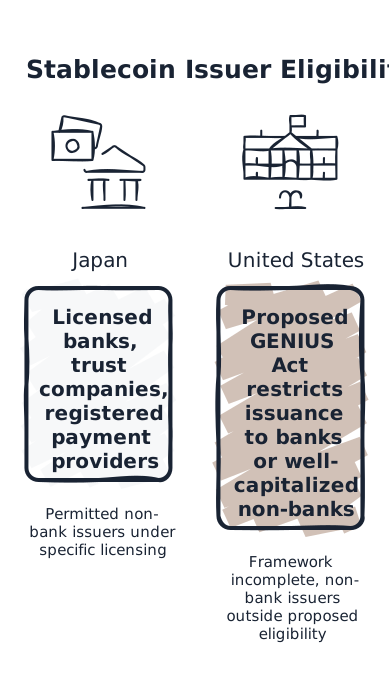
| Factor | Japan | United States |
|---|---|---|
| Issuer eligibility | Licensed banks, trust companies, and registered payment providers can issue yen stablecoins as prepaid payment instruments. | Proposed GENIUS Act would restrict issuance to banks or well-capitalized non-banks; framework incomplete as of July 2026. |
| Regulatory framework | Payment Services Act (amended 2023), supervised by the Financial Services Agency with reserve and redemption rules. | Multiple federal agencies share oversight; stablecoin-specific legislation not finalized. |
| Non-bank issuers | Permitted under funds-transfer and payment-provider licensing (e.g., JPYC Inc.). | Purpose-built fintech issuers remain outside proposed eligibility until rules are settled. |
| Deployment status | Live corporate B2B rollout planned by AZ-COM Maruwa; retail pilot at Lawson convenience store in August 2026. | No comparable large-scale corporate stablecoin payroll; activity concentrated in crypto trading and limited pilots. |
| Source: Japan Financial Services Agency; public summaries of the GENIUS Act; crypto and finance reporting. | ||
JPYC Inc. launched on October 27, 2025 as Japan’s first regulated yen-pegged stablecoin. It is backed 1:1 by bank deposits and Japanese government bonds in segregated accounts. The token runs on public blockchains — Ethereum, Avalanche, and Polygon — so transaction costs vary. On Polygon, a transfer costs less than $0.05. That is crucial for high-volume, low-margin contractor payments.
“We will continue to advance the integration of logistics and commercial payment flows,” said Noritaka Okabe, founder and CEO of JPYC Inc. The integration is already tangible: AZ-COM plans for its 2,300 contractors to receive near-instant settlement instead of waiting 30 to 60 days. For small operators who pay for fuel and maintenance upfront, that cash-flow shift is material.
The rollout has limits. JPYC’s license carries a ¥1 million daily redemption cap per user. That may pinch high-volume drivers. Rural off-ramps in prefectures like Aomori and Hokkaido remain thin. On-chain settlement is fast, but converting tokens to cash still depends on local banking access. AZ-COM has not specified whether contractors will use custodial wallets or how tax reporting will work. The National Tax Agency treats stablecoin payments as ordinary income at face value, but tailored accounting software for small logistics firms is not yet available at scale.
The competitive response is already gathering. Japan’s three megabanks — MUFG, SMBC, and Mizuho — signed a memorandum of understanding on June 10, 2026 to jointly develop a yen stablecoin under “Project Pax.” They target ¥1 trillion in B2B settlement volume by 2028, roughly 55 times JPYC’s current market cap. The market is splitting into a dual-track race before the first corporate payment even goes live.
Why Japan’s rules produced a real-world test while America’s stalled
Japan’s Payment Services Act, enforced by the Financial Services Agency, classifies fiat-backed stablecoins as prepaid payment instruments. That designation lets non-bank entities issue and operate them under a funds-transfer license, provided they hold full reserves and meet redemption rules. The law took effect in June 2023 and is the direct reason JPYC Inc. could launch in October 2025 and now has a major corporate client planning to adopt it.
In contrast, the European Union’s MiCA regime and Singapore’s frameworks lean toward bank-type or major-institution issuance. They prioritize investor protection, and neither has produced a non-bank stablecoin used for routine corporate payrolls at this scale. The U.S. GENIUS Act draft would push even further in that direction — but with no final rules, the door remains shut to purpose-built fintech issuers.
The forward signal is clear: if AZ-COM formally announces a go‑live date and contractor onboarding begins, Japan’s non-bank model graduates from intent to live operations. If it does not, regulators and corporates may lean more heavily toward the megabanks’ Project Pax alternative. The data from Japan’s experiment — on contractor retention, treasury operations, and reserve management — will be documented months before U.S. rules are settled. Early norms are being written in Tokyo, not Washington.
Beyond the headline
The Bigger Picture
Japan’s stablecoin framework is not about trading. It is turning digital money into industrial infrastructure for sectors that rely on subcontractors. By letting a non-bank issuer serve a nationwide delivery network, regulators are running a real-world stress test: can programmable yen smooth the cash-flow bottlenecks that have long squeezed small operators? That test will matter more than any one company, because it could become a template for other advanced economies to digitize their working-capital rails.
The Reach
Japan’s megabanks — MUFG, SMBC, Mizuho — have their own plan. Project Pax, signed in June 2026, aims for a bank-issued yen stablecoin with ¥1 trillion in settlement volume by 2028. The dual track means the market will decide whether future settlement layers are controlled by banks or by non-bank fintechs. For Western financial groups, the answer will shape whether cross-border integration mirrors today’s correspondent banking or opens to new competitors.
The Timing
The rollout is happening just as US lawmakers missed their July 18 deadline, widening a regulatory timing gap. Japan’s framework is already being exercised at corporate scale while American rules are still draft text. That sequencing means the first case studies of how digital yen affects contractor retention, treasury operations, and reserve management will likely be documented in Japan, shaping global norms before US policy is settled.
The decisions the US-Japan regulatory gap creates
With the U.S. stablecoin rules still unresolved and Japan’s model producing its first large-scale corporate use, the divergence forces distinct choices on different actors.
-
US-based stablecoin policy analyst
You need to track how Japan’s Financial Services Agency handles the AZ-COM rollout — especially the redemption cap and rural off-ramp issues. That data will inform U.S. legislative debates on issuer eligibility. Monitor the FSA’s English-language site for updates on EPI operational rules and any stress-test reports that emerge.
-
Western investor in Japanese logistics or fintech
AZ-COM Maruwa (TSE: 9090) and JPYC Inc. are the direct exposures, but the signal is broader. If a second logistics firm follows within 12 months, listed payment processors and logistics IT providers could reprice. Watch for AZ-COM’s formal investment announcement and any contractor onboarding timeline — those will indicate the speed of adoption.
-
Global supply chain finance manager
Instant settlement on a public blockchain is replicable. Assess whether a regulated stablecoin could reduce your own days-payable-outstanding with small suppliers in Japan. Start by mapping how many of your contractors are paid through 30‑day bank cycles, and compare those to JPYC’s deployment roadmap. A pilot with a non-bank issuer may become feasible once the AZ-COM case proves operational.
-
Western business owner with Japanese contractors
If you pay truckers, delivery drivers, or small suppliers in Japan, investigate whether JPYC can replace slow bank transfers. Reach out to JPYC Inc. through their official site for onboarding requirements. Check with your tax advisor on how receiving stablecoin income would affect your contractors’ Japanese tax filings, and whether your own cross‑border payment flows can bypass legacy rails.
FAQ
How are JPYC payments taxed for foreign residents in Japan?
Foreign residents are generally taxed on Japan-sourced income. JPYC receipts are treated as ordinary business income at face value, like cash yen. Contractors must declare them and may owe consumption and income taxes. Home-country tax rules may also treat the income as foreign earnings, so dual reporting is likely necessary. Professional advice is essential.
How do contractors turn JPYC into spendable cash?
They need access to a regulated off-ramp like JPYC EX, which requires identity verification through Japan’s My Number system. A daily redemption cap of ¥1 million per user applies. Rural contractors without nearby banking partners may need to rely on digital transfers into existing accounts, which could slow access to cash for immediate expenses.
Can expats easily move JPYC funds abroad?
Moving funds abroad requires converting JPYC to yen, then to the target currency through standard banking channels. Standard FX spreads and cross‑border reporting thresholds apply. Some international exchanges support yen-linked stablecoins, but users must verify regulatory status and fees before using them for regular remittances.
Explainer
- JPYC
- JPYC is a yen-pegged stablecoin issued by JPYC Inc., a Tokyo-based fintech. It is backed 1:1 by yen deposits and Japanese government bonds. JPYC operates on public blockchains and is used by AZ-COM Maruwa to pay 2,300 logistics contractors, replacing slow bank transfers with near-instant settlement on Polygon for less than $0.05 per transaction.
- Financial Services Agency (FSA)
- The Financial Services Agency is Japan’s financial regulator, overseeing banking, securities, and insurance. It enforces the Payment Services Act and licensed JPYC Inc. in August 2025 as a Type II fund-transfer service provider. The FSA’s rules require full reserves and daily redemption caps for stablecoin issuers.
- Payment Services Act
- Japan’s Payment Services Act was amended in June 2023 to create a framework for fiat-backed stablecoins. It classifies yen-pegged tokens as prepaid payment instruments, allowing licensed non-bank entities to issue them. The law mandates full reserve backing and redemption rights, enabling corporate deployments like AZ-COM Maruwa’s.
- GENIUS Act
- The GENIUS Act is a U.S. legislative proposal that would create a federal regulatory framework for stablecoins. It would restrict issuance to banks or well-capitalized non-banks. The bill set a July 18, 2026 deadline for six agencies to finalize rules, but no agency met it, leaving the framework incomplete.
- Stablecoin
- A stablecoin is a digital token designed to maintain a stable value relative to a reference asset, typically a fiat currency such as the yen or dollar. Regulated yen stablecoins like JPYC are backed 1:1 by cash and government bonds. They enable fast, low-cost payments on blockchains without the price swings of unpegged crypto-assets.
RELATED STORIES