In 2026, Japan launched the Global South–Japan Tech Talent Internship (GS‑JTI) offering a 2,000‑yen daily allowance, airfare, and visa support to STEM students from ASEAN countries, while South Korea widened high‑tech visa pathways and proposed a K‑Core visa for intermediate technical workers, with rollout through the 2030s. Vietnam simultaneously approved a digital industry plan targeting US$300 billion by 2030, and Indonesia began offering lifetime residency for those with family ties.
But early migration research reveals a pattern that could unravel these efforts. Many Southeast Asian professionals treat East Asian positions as springboards to the West, not final destinations, raising the prospect that governments are subsidising training that ultimately feeds Western firms.
Firman Budianto, a migration researcher at Indonesia’s BRIN, has found evidence of a stubborn pattern. Southeast Asian engineers who take jobs in Japan and South Korea often treat these positions as intermediate steps toward Western employment. That finding sits uncomfortably against the billions now flowing into scholarship, visa, and industry programmes across East Asia, all predicated on the notion that talent can be permanently anchored. The question is not whether these schemes will attract people—early numbers suggest they will—but whether they can keep them long enough to build the domestic AI and semiconductor ecosystems that governments want. If Budianto’s research points toward a deeper truth, the current rush may be training a workforce for Silicon Valley, not Seoul or Tokyo.
Two competing visions, one finite pool of engineers
Japan’s Ministry of Economy, Trade and Industry (METI) is putting the most detailed offer on the table. Its GS‑JTI programme, run with Deloitte Tohmatsu Venture Support and Tech Japan, connects STEM students and recent graduates from Global South countries—excluding China—with internships at Japanese and Japan‑affiliated firms. In‑person interns get a daily allowance, round‑trip tickets, accommodation, and visa assistance. The government’s long‑stated ambition is to develop 100,000 highly skilled digital professionals across the region within five years.
The policy patchwork across East and Southeast Asia is best seen in a side‑by‑side comparison.
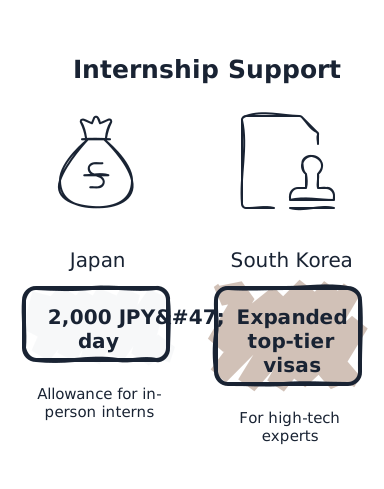
South Korea is racing in parallel. On 3 March 2026 it announced a broader immigration strategy that expands top‑tier visa benefits for high‑tech experts and introduces a K‑Core visa focused on intermediate technical workers. Domestic technical colleges will be authorised to train international students and funnel them into manufacturing and other shortage sectors. Noh Yongseok, First Vice Minister of SMEs and Startups, frames related initiatives like the Global Startup Project and K‑Founders Fund as a way to “build a self‑sustaining cycle” linking overseas Korean founders’ capital and experience to new entrepreneurs. Kim Dongshin, co‑founder and CEO of Sendbird, sees the K‑Founders Fund as a vehicle to “provide stable support for Korean startups to enter the global market.”
ASEAN states are pushing back with cash and residency. Vietnam’s national digital technology programme, approved in May 2026, aims to cultivate a domestic workforce of 7,000 highly specialised AI experts and 50,000 advanced semiconductor engineers by 2030, targeting a US$300 billion sector valuation. Indonesia’s Global Citizenship visa, launched in January 2026, grants lifetime residency to anyone with blood or family connections, while Malaysia and Thailand offer five‑year tax exemptions for returning professionals. The table below distills the key policy moves.
| Entity | Current rule | New rule | Effective date |
|---|---|---|---|
| Japan | MEXT scholarships and bilateral frameworks, e.g. 100,000‑professional target | GS‑JTI internships with living allowance, airfare, and visa support | 2026 |
| South Korea | Existing top‑tier visas for high‑tech experts | Expanded high‑tech visa and K‑Core visa, with training pipeline through technical colleges | Announced March 2026; phased through 2030s |
| Vietnam | No formal retention programme targeting returning expats | National Digital Technology Industry Development Programme, cultivating 7,000 AI experts and 50,000 semiconductor engineers | May 2026 |
| Indonesia | No specific residency incentive for foreign talent | Global Citizenship visa offering lifetime residency for blood/family ties | January 2026 |
| Malaysia / Thailand | Limited tax incentives for returning nationals | Five‑year tax exemption for returning professionals | 2025‑2026 |
| Source: Government announcements and research cited in this article | |||
Samsung, Vietnam’s single largest foreign investor with US$23 billion deployed, operates a dedicated Samsung Talent Programme to recruit electronics and IT specialists from top Vietnamese universities. It will allocate 17 billion dong to scholarship funds through 2028. Dao Ngoc Chien, director of Vietnam’s NAFOSTED, frames joint semiconductor research with Japan as central to building domestic capacity and training young engineers. Ishikawa Isamu, Japan’s Deputy Ambassador to Vietnam, calls the semiconductor partnership proof of a deepening Comprehensive Strategic Partnership between the two countries. Yet the scale of the ambition leaves a gap: budgets and visa quotas are still small enough that a modest outflow to the West could drain the intended pipeline.
Policy mechanisms and the risk of talent leakage
Governments across East and Southeast Asia are deploying scholarships, visa pathways, and corporate partnerships to anchor talent. Japan’s GS‑JTI offers living allowances and visa support to STEM students from Global South countries. South Korea ties expanded high‑tech visas to employment guarantees and integrates technical colleges into recruitment pipelines. Vietnam and Indonesia are countering with tax breaks and residency incentives aimed at returning professionals. Yet the underlying assumption—that talent, once lured, will stay—does not square with migration research. Budianto’s findings suggest that many Southeast Asian professionals leverage East Asian positions as intermediate steps toward Western employment, treating the region’s job markets as training grounds rather than final destinations.
The talent war is not just about filling jobs. It is about anchoring the next generation of chip fabrication, AI model development, and digital infrastructure inside national borders. South Korea anchors memory manufacturing and is reinforcing a full‑stack AI and chip ecosystem. Taiwan remains the world’s leading contract foundry hub, and Japan is spending heavily to rebuild semiconductor capacity. ASEAN countries, in turn, are positioning as complementary talent and research nodes. Vietnam is emerging in software, outsourcing, and joint semiconductor projects, but lacks the domestic R&D funding to compete directly on chip design.
Regulatory philosophy plays a role. Japan and South Korea route talent attraction through immigration and industrial policy, not sweeping AI rules. That contrasts with the EU’s horizontal AI Act and the fragmented sectoral rules in the United States. For expat tech professionals already in Southeast Asia, the new policies create a mixed picture. Japan’s GS‑JTI is limited to nationals of OECD DAC‑listed countries—excluding China and most Western passport holders—so the pathway is narrow. South Korea’s expanded visas link benefits to specific technical skills, and domestic incentives in ASEAN often prioritise nationals or regional partners. A Western developer in Ho Chi Minh City cannot simply walk through the same door that a fresh graduate from Hanoi can. Meanwhile, China is embedding its own governance model into ASEAN through structures like the AI Industry Innovation Center in Beijing, raising the stakes for Tokyo and Seoul to bind talent to their own ecosystems before it is absorbed by other powers. The regional AI standards race is already rewriting the rules.
That returns the story to Budianto’s finding. Rigid seniority hierarchies in Japanese and Korean corporations, combined with the persistent lure of Western salaries and research environments, push many of the same engineers governments are courting to treat their positions as waypoints. The first intake numbers from the GS‑JTI and K‑Core programmes, expected in late 2026, will reveal whether the cycle can be broken—or whether the training belt is simply building a workforce for another continent. The fine print of the internship programme makes no promise of permanent settlement.
Beyond the headline
The bigger picture
The contest over Southeast Asian engineers reflects a shift from competing purely on hardware capacity to competing on human capital networks that span universities, immigration systems, and corporate pipelines. Japan and South Korea are redesigning routes from ASEAN campuses into their labs and fabs. A transnational training belt is quietly forming, one that could rival traditional US‑ and Europe‑centred pathways for early‑career STEM talent.
The money trail
Behind the policy language sits a clear capital logic. Public subsidies and corporate funding are being deployed to secure future labour for AI‑ and chip‑intensive industries that will underpin national growth. Programmes like Japan’s internships and Korea’s diaspora‑focused startup funds use state‑backed money to anchor engineers and founders into specific ecosystems, shaping where venture funding, research budgets, and high‑margin manufacturing investment will flow over the next decade.
What isn’t being said
The quiet assumption in most national strategies is that talent, once lured, will stay. That assumption doesn’t square with the evidence that many professionals treat East Asia as a transit lounge, not a final stop. If the pull of Western employment proves stronger than the incentives on offer, governments risk pouring public money into training that ultimately strengthens competitors on another continent.
Four groups with skin in the game
With Japan’s internship matching opening and South Korea’s visa changes rolling out, the practical implications are already material.
- Southeast Asian STEM student considering East Asian opportunities
Check the eligibility criteria on the official GS‑JTI site: you must be a current student or recent graduate (within three years) in IT, AI, or semiconductors, from a Global South country excluding China, and willing to pursue employment with a Japanese company. For South Korea, watch for announcements from the Ministry of Justice on K‑Core visa application windows and required skill certifications.
- Western tech firm HR manager with APAC hiring needs
Revisit your early‑career compensation and research offerings for Southeast Asian hires. Japan’s internships and Korea’s expanded visa pathways are funnelling young engineers into local ecosystems early, before they enter your pipeline. If intake numbers scale rapidly in late 2026, competition for entry‑level AI and semiconductor talent could intensify faster than anticipated.
- Western expat tech professional in Southeast Asia
Track country‑specific visa eligibility shifts carefully. Japan’s GS‑JTI is closed to Western passport holders; South Korea’s high‑tech visas tie to specific skills and employer sponsorship. ASEAN domestic incentives often prioritise nationals. Before planning a move, verify how each programme distinguishes between Global South and Western applicants, and whether existing work permits remain the safer long‑term option.
- ASEAN government official focused on tech talent retention
Assess the real impact of current tax breaks and research partnerships. Vietnam’s joint semiconductor projects with Japan and Malaysia’s returning‑expat tax exemptions show regional experimentation, but Budianto’s research suggests hierarchy barriers and Western pull still dominate. Linking scholarships to multi‑year service obligations and deepening local R&D consortia could raise the cost of leaving.
FAQ
Who is eligible for Japan’s Global South–Japan Tech Talent Internship?
Applicants must be nationals of an OECD DAC‑listed country (excluding China), reside outside Japan, and be current students or recent graduates (within three years) in STEM fields such as IT, AI, and semiconductors. A willingness to pursue employment at Japanese companies after the internship is required.
What support do interns receive in Japan?
In‑person interns get a daily living allowance of 2,000 yen, round‑trip airfare, accommodation, internship insurance, overseas travel insurance, visa acquisition support, Wi‑Fi, and a 24/7 hotline. The programme does not guarantee employment, and cancellations after placement are generally not permitted.
How are South Korea’s new high‑tech visas structured?
South Korea’s 2026 immigration strategy expands top‑tier visa benefits for high‑tech experts and introduces a K‑Core visa for intermediate technical workers. Domestic technical colleges will train international students and link them with employers in manufacturing and other shortage sectors, with rollout phased through the 2030s.
Explainer
- GS‑JTI
- Global South–Japan Tech Talent Internship, launched in 2026 by Japan’s Ministry of Economy, Trade and Industry. The programme matches STEM students from OECD DAC‑listed countries (excluding China) with internships at Japanese and Japan‑affiliated firms. It provides a daily living allowance, airfare, accommodation, and visa support, but does not guarantee permanent employment.
- K‑Core visa
- A proposed South Korean visa category for foreign workers with intermediate technical skills, part of the March 2026 immigration strategy. It integrates domestic technical colleges to train international students and then channel them into manufacturing and other shortage sectors, with full rollout expected through the 2030s to counter demographic decline.
- METI
- Japan’s Ministry of Economy, Trade and Industry. It oversees industrial and trade policy, including the GS‑JTI programme. In the talent competition, METI is using public funding to connect Japanese companies with overseas STEM students, aiming to diversify recruitment and strengthen Japan’s high‑tech workforce.
- MEXT
- Japan’s Ministry of Education, Culture, Sports, Science and Technology, and the country’s oldest scholarship scheme—established in 1954—that supports about 10,000 international students annually. It remains a backbone of Japan’s talent attraction strategy alongside newer, more targeted programmes like GS‑JTI.
- BRIN
- Indonesia’s National Research and Innovation Agency, formed in 2021 to consolidate the country’s science and technology research. Its migration researchers, such as Firman Budianto, study the patterns of Southeast Asian professionals moving through East Asian and Western job markets, providing data that is critical to understanding the region’s talent flows.
RELATED STORIES