Boeing’s 2026 Pilot & Technician Outlook projects 2,425,000 new aviation professionals needed globally through 2045. Asia-Pacific—covering Eurasia, China, and Southeast Asia—accounts for more than half of that demand, with skill profiles shifting sharply toward digital and competency-based roles.
The forecast signals a structural shift in where aviation expertise is produced. Training infrastructure in the region must scale quickly, or worker shortages will hit route expansions and fares harder than many expect.
More than half the world’s new aviation workers in the next two decades will be needed in Asia-Pacific. That is the figure inside Boeing’s latest 20-year workforce forecast, and it reshapes the global map of airline staffing. The real story is not the headline total. It is where those jobs will sit—and what it takes to fill them.
Over 2.4 million aviation professionals must be recruited: 674,000 pilots, 728,000 maintenance technicians, and more than 1 million cabin crew members. A large portion will train not in traditional Western hubs, but in Singapore, Shanghai, and Dubai. These cities are building the simulator centers and competency-based programs that turn a raw recruit into a pilot who can fly a digital cockpit. The shift demands more than expansion. It demands a new kind of worker, and the clock is running.
By 2045, the global fleet will nearly double. Passengers will feel the pressure if the training pipeline does not keep pace. Fares, frequency, and service quality all hang on how fast Asia-Pacific can produce the people to keep its aircraft in the air.
The hiring map of aviation is redrawn
Boeing’s 2026 Pilot & Technician Outlook, released at the Farnborough Airshow on July 18, 2026, puts the global demand at 2,425,000 new professionals through 2045. Pilots make up 674,000 of those roles. The rest split between 728,000 maintenance technicians and more than a million cabin crew—all numbers the company expects the industry to hit if fleet growth follows its commercial forecast.
Eurasia leads the regional breakdown with 571,000 projected new hires, followed by North America (438,000), China (425,000), Southeast Asia (258,000), and the Middle East (236,000). The distribution is not even. The chart below shows where the demand concentrates.
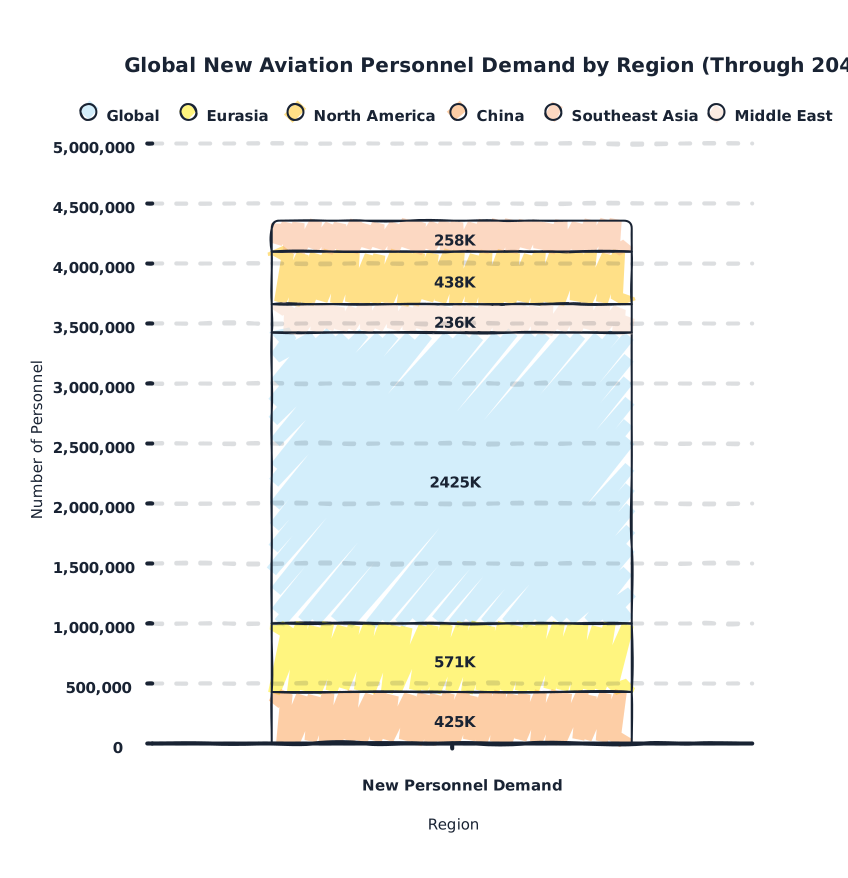
The figures are not a neutral projection. Chris Broom, Boeing’s vice president for commercial training solutions, says the shift toward digital fleets changes what training must deliver. “Immersive technologies will enhance training, supporting Competency‑Based Training and Assessment,” he said. The comment points to the second engine driving demand: skill requirements are changing fast, and the old model of ticking hours in a cockpit is giving way to outcome-based standards.
Several Asia-Pacific regulators are already moving. Singapore’s Civil Aviation Authority and Hong Kong’s Civil Aviation Department have begun integrating simulator‑based training, evidence‑based training, and Competency‑Based Training and Assessment (CBTA) elements into licensing. That means local academies can adopt digital tools at scale, and incoming pilots must be ready for them.
The forces pulling aviation jobs east
What is happening is not simply a shift in geography. The aircraft entering fleets now are fundamentally different. Boeing’s own data show less than 10% of previous‑generation aircraft will remain in service by 2045. New‑generation models will account for about 92% of the global fleet. They require technicians who can work with data systems and pilots trained on immersive platforms—skills the legacy training pipelines were not built to produce.
Aging workforces in North America and Europe add urgency. Industry analysts note that pilot shortages first appeared in North America and Europe, but are now spreading to Asia‑Pacific as fleets expand. The region’s answer has been to lean into digital training and CBTA from the start, rather than retrofitting old models. The result is a training and recruitment race that rewards speed and regulatory flexibility.
The race matters for passengers. If training capacity lags, airlines will compete more fiercely for qualified crew, and that cost filters into fares. Routes may grow slower than expected, and service quality can suffer. The next ICAO and IATA workforce assessments, expected within 6–12 months, will show whether the pipeline is closing the gap—or widening it.
Beyond the headline
The Bigger Picture
Boeing’s outlook reveals a structural shift in where aviation expertise is produced. As Asia‑Pacific’s fleets grow and regulators embrace digital, competency‑based training, the region is becoming a primary source of pilots, engineers, and cabin crew. That weakens the historical dominance of North American and European training ecosystems. The know‑how that defined Western aviation is relocating.
The Reach
Boeing Global Services sits at the intersection of aircraft sales, digital platforms, and training. Its push for lifecycle management and immersive learning tools does not stop at individual airlines. It shapes how emerging markets design their training infrastructure. The non‑obvious implication: standards influencing global safety and skills may increasingly be defined through APAC‑focused service contracts, not Western boardrooms.
The Money Trail
The spending does not flow evenly. Trillions of dollars will move into maintenance, training, data services, and lifecycle management, not just new jets. Eurasia, China, and Southeast Asia, as large workforce demand centers, become magnets for that money. Countries that build attractive regulatory regimes and training clusters will attract Western capital underwriting academies, simulators, and MRO capacity where long‑term utilization looks strongest.
What this means for your next move
With Asia-Pacific poised to absorb more than half of aviation’s future workforce, four groups face decisions now.
- Western aviation professional considering APAC relocation
Carriers in China, Southeast Asia, and the Middle East are ramping recruitment but increasingly favor candidates with advanced simulator, data‑systems, and CBTA familiarity. Check local tax rules and housing costs in Singapore or Hong Kong—and factor in license conversion exams that can add weeks to a move. The demand is real, but the on-the-ground details decide whether the package works.
- Western investor in aviation services or training companies
Look at APAC‑exposed airlines, MRO groups like ST Engineering, and simulator firms that supply CBTA‑aligned courses. Many trade on US and European exchanges. The near‑term risk is supply‑chain delays capping earnings, but the long‑term services spending underpins the investment case. Review ICAO and IATA reports for independent shortage signals before committing.
- European or North American aviation training provider
Demand is moving east. Partnerships with academies in China, Southeast Asia, or Eurasia offer faster access to the growth than building from scratch. Focus on digital and competency‑based solutions—regulators in Singapore and Hong Kong are already integrating them, and that trend will spread. The window is open now, before local competitors lock in airline contracts.
- Western airline executive with APAC routes
Your future crews are competing for talent with well‑funded regional carriers. Developing international recruitment pipelines and partnering with training academies early will matter. The cost of inaction is not abstract: it shows up in unfilled rosters, reduced frequencies, and higher pilot pay that hits margins on long‑haul routes.
FAQ
Cross-border license conversion for pilots
Pilots moving from North America or Europe to Asia‑Pacific generally need local license validation or conversion. That can involve additional exams, simulator checks, and medical assessments under host‑country rules. Processing times vary by regulator and airline. Some carriers offer structured bridging courses to align pilots with regional procedures and CBTA standards. Factor this into relocation timelines and training costs.
Typical training pathways for new aviation entrants
Entry‑level pilots typically progress through integrated or modular training programs at accredited flight schools, accumulating required flight hours before airline screening. Maintenance technicians usually complete technical diplomas plus type‑specific courses. Asia‑Pacific carriers increasingly partner with local academies to offer cadet schemes that bundle training, aircraft type ratings, and job placement, often with service‑bond obligations that affect mobility.
Investment access to aviation services growth
Western investors can use sector‑focused equity indices, aviation‑themed ETFs, or direct holdings in listed airlines, MROs, and training providers with substantial Asia‑Pacific revenue. Many of these instruments trade on US and European exchanges. Check fund prospectuses for regional allocation details and consider volatility linked to fuel prices, regulation, and geopolitical risks.
Explainer
- CBTA
- Competency-Based Training and Assessment, an approach that measures a pilot or technician’s ability to perform tasks to a defined standard rather than simply logging hours. It is being adopted by regulators including ICAO and EASA to align training with modern aircraft complexity. Asia‑Pacific hubs like Singapore are embedding CBTA into licensing, accelerating the shift away from rote experience-based models.
- MRO
- Maintenance, Repair, and Overhaul—the segment of aviation services that keeps aircraft airworthy through scheduled and unscheduled work. The global MRO market is expanding alongside fleet growth, with particular demand in Asia as new-generation aircraft require specialized digital diagnostics. Companies like ST Engineering in Singapore are major players in this space.
- IATA
- The International Air Transport Association, a trade group representing about 320 airlines worldwide. It sets commercial standards for ticketing, safety, and operations, and publishes regular market forecasts. IATA has warned that pilot and skilled worker shortages are becoming a constraint, especially in fast-growing Asia‑Pacific markets.
- ICAO
- The International Civil Aviation Organization, a UN agency that establishes global standards for aviation safety, security, and efficiency. Its competency-based training frameworks are the backbone of regulatory shifts now being implemented by national authorities. ICAO data show Asia‑Pacific’s share of global passenger traffic has been rising steadily since 2019.
RELATED STORIES