Manus announced on August 11, 2026 that it will resume independent operations, complying with a Chinese regulatory order to unwind its $2 billion sale to Meta Platforms. The National Development and Reform Commission (NDRC) issued the directive in April 2026, citing national security concerns and foreign investment rules.
The forced reversal dismantles a deal that closed on December 29, 2025. It is the first time Beijing has retroactively unwound a completed cross-border AI acquisition — and the mechanism it used does not depend on where the target company was incorporated.
China can reach through an offshore corporate structure and unwind a completed acquisition. It just proved it. The forced reversal of Meta’s purchase of Manus — an AI agent startup that had moved from China to Singapore before the deal — establishes a regulatory capability most foreign acquirers assumed did not exist. The company’s legal home was outside China. The talent, the technology, and the state’s claim to both were not.
Manus said on August 11 it would resume independent operations. The separation requires deleting user data generated after the acquisition closed, cutting Meta personnel from internal systems, and unwinding eight months of integration work. The mechanics are logistical. What they demonstrate is structural: an offshore incorporation strategy, widely used by Chinese-founded AI startups to attract foreign capital without triggering direct regulatory friction, no longer works as advertised.
A deal undone by the state that was not supposed to have a say
Meta acquired Manus on December 29, 2025 for roughly $2 billion. The plan, reported by CNBC, was to integrate Manus’s AI agent capabilities across consumer and enterprise products through a subscription model. By April 2026, the NDRC had ordered the transaction reversed.
The regulator’s position was blunt: moving a company’s legal address to Singapore does not remove it from Chinese oversight when the underlying technology and talent originated in China. Critics have labeled the practice Singapore washing. The NDRC’s April directive treated it as a jurisdictional irrelevance.
The sequence below maps how a $2 billion deal came apart in under eight months.
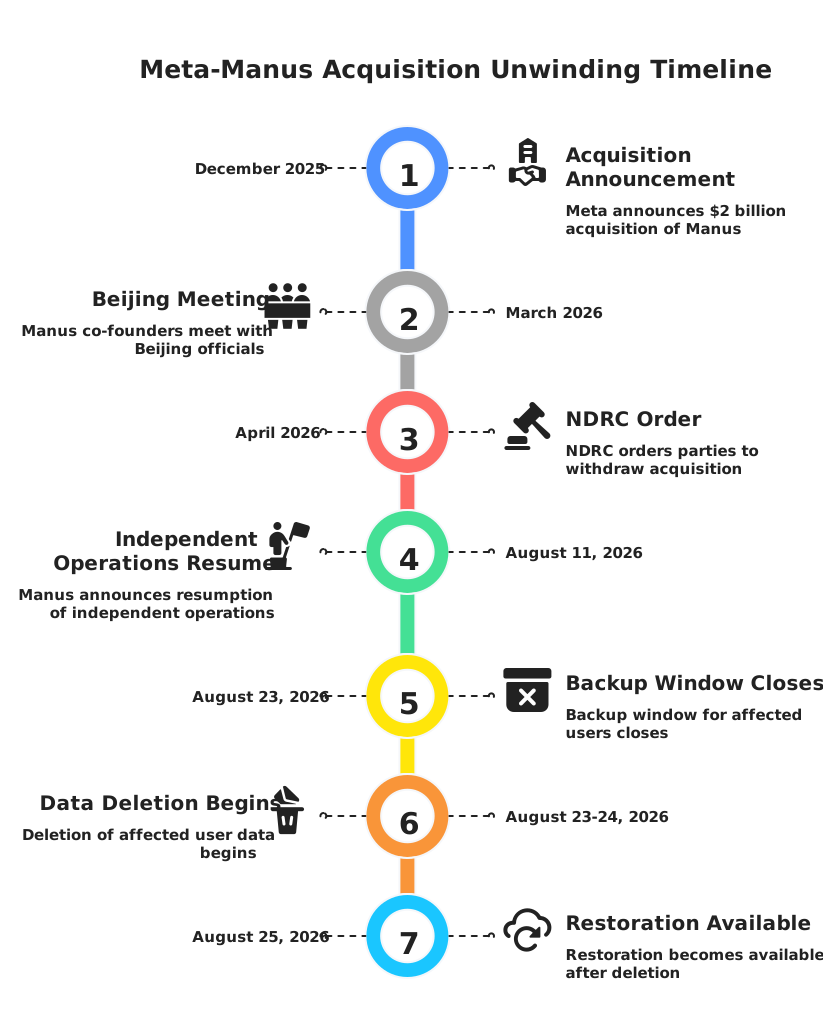
In March 2026, before the NDRC directive became public, Manus co-founders Xiao Hong and Ji Yichao were summoned to Beijing to appear before Chinese officials. Both have faced travel restrictions since, as reported by Reuters and the Financial Times. Xiao Hong, Ji Yichao, and co-founder Zhang Tao subsequently pursued outside investors to finance a buyback at the original $2 billion valuation, with a Hong Kong IPO floated as a longer-term option. Those discussions remained preliminary, with no final commitments.
Reuters reported in July 2026 that Tencent was in talks to become Manus’s largest shareholder. If completed, observers say the unwind would become something closer to a China-led recapitalization than a clean breakup — but that outcome is not settled.
| Entity | Current rule | New rule | Effective date |
|---|---|---|---|
| NDRC | Offshore incorporation could shield deals from review | Retroactive unwinding regardless of offshore status | April 2026 |
| Manus | Operated as a Meta subsidiary | Independent operations required | August 11, 2026 |
| Manus co-founders | Free international movement | Travel restrictions imposed | March 2026 |
| Source: Company statements, Reuters, Financial Times reporting | |||
“This is part of our separation from Meta; we must take this step to comply with regulatory requirements in specific parts of the world,” Manus said in a company statement.
The regulatory machinery behind the reversal
China’s foreign-investment review framework gave the NDRC the authority to block the Meta deal on national-security grounds and order both parties to withdraw. Compared with the CFIUS process in the United States — which reviews deals before they close — or the European Union’s merger-control and foreign-subsidy rules, China’s approach here is distinct in one dimension: it applied retroactively. The deal was done. The regulator unwound it anyway.
Wendy Chang of the Mercator Institute for China Studies said the case signals that “attempts to bypass national regulation will not be tolerated.” Sherlock Xia, a partner at law firm Yenlex, said the decision made clear that shedding a Chinese identity by relocating overseas was no longer viable. Max Liu, an AI industry analyst, said Beijing viewed the sale as setting a bad precedent for transferring Chinese tech assets to a U.S. buyer.
Meta told Reuters the transaction complied with applicable law and that it expected a resolution. The resolution it got was a forced divestiture.
The immediate consequence for dealmaking is a new variable in every cross-border AI acquisition involving Chinese founders or Chinese-developed intellectual property. Due diligence can no longer stop at corporate structure. It must now price in the probability that a regulator in Beijing will assert jurisdiction — and that it can do so long after closing. The next twelve to eighteen months of AI M&A will be shaped by how seriously acquirers take that probability, and whether any other deals are already in the pipeline vulnerable to the same mechanism.
Beyond the headline
The power behind it
The decisive actor is not the buyer but the home regulator, which can still reach a company after it has moved its legal center abroad. For cross-border AI M&A, this shifts control dynamics: both founders and acquirers must assume the originating state can reassert authority long after a deal closes.
The money trail
The unwind turns corporate structure into a financing risk. Investors who priced Manus as a scale-up asset absorbed a forced reversal. Future buyers are likely to demand deeper discounts or stronger legal protections when a startup’s origin country can nullify the transaction.
The reach
Meta is the most exposed actor because the unwind interrupts a planned AI integration path. The mechanism is regulatory reversal. Platform companies acquiring foreign-origin AI assets now face a specific hurdle: the seller’s home jurisdiction can claw the asset back, which may force them to slow acquisition-led AI expansion.
What the Manus reversal changes for anyone buying or using AI
With the precedent now set, three groups face immediate decisions.
- Western AI investor with China-linked portfolio
You need to re-examine due diligence on every portfolio company with Chinese founders, regardless of where it is incorporated. The Manus case shows that offshore structure offers no immunity. Ask whether the underlying IP, core team, or training data originated in China — and model for regulatory reversal as a going-forward risk, not a theoretical one.
- Western tech executive pursuing AI M&A in APAC
Acquisition strategy for any AI target with Chinese roots now requires a new layer of legal analysis: can the NDRC or another Chinese agency assert jurisdiction, even post-close? Factor in heightened national-security scrutiny and structure deals with the assumption that retreat is possible — because Beijing just demonstrated it is.
- Policy professional tracking US-China tech rivalry
This case is a data point in the weaponization of regulatory frameworks. China used foreign-investment rules to reclaim an AI asset from a U.S. acquirer. Track whether other Chinese-origin startups that moved to Singapore or elsewhere face similar scrutiny — and whether Washington responds with its own retroactive review mechanisms through CFIUS.
FAQ
What data is being deleted and when?
Manus will delete user data created on or after December 29, 2025 — the date the Meta acquisition closed — for customers in certain jurisdictions. A backup window is open until 7:59 p.m. EDT on August 22, 2026. Deletion runs August 23–24, with restoration available from August 25 onward. No charges apply during the backup period.
Who is affected by the data deletion?
The deletion applies only to certain users, not all Manus accounts. Reporting from CNBC and the South China Morning Post indicates the company is segmenting the process by jurisdiction or account category. Unaffected users may continue using the service without disruption.
What should I do if my workflows depend on Manus?
If you need prior chats, generated reports, or task logs after the separation, export them before the August 23 deadline. Restoration after August 25 may not fully recreate every working context. The practical safeguard is to back up any active Manus records now.
Explainer
- NDRC
- The National Development and Reform Commission is China’s top economic planning agency, responsible for reviewing foreign investments on national-security grounds. It has broad authority to block or unwind transactions involving sensitive sectors, including artificial intelligence. Its April 2026 directive on the Manus deal marked the first time it retroactively reversed a completed cross-border tech acquisition.
- Singapore washing
- A term used to describe the practice of Chinese-founded technology companies incorporating in Singapore to attract foreign investment while appearing to distance themselves from Chinese regulatory reach. The strategy aims to present the company as a Singaporean entity for legal and dealmaking purposes. The NDRC’s Manus ruling signaled that the tactic no longer shields a company when its foundational technology and key personnel remain linked to China.
- CFIUS
- The Committee on Foreign Investment in the United States is an interagency body that reviews foreign acquisitions of U.S. companies for national-security risks. Unlike China’s NDRC action in the Manus case, CFIUS typically reviews deals before they close and can impose conditions or recommend the president block them. The Manus reversal raises the question of whether the U.S. might develop its own retroactive review capability in response to similar regulatory moves by Beijing.
- Manus
- An AI agent startup originally founded in China that later relocated its headquarters to Singapore. The company builds autonomous AI agents capable of executing multi-step tasks on behalf of users. Meta acquired Manus for approximately $2 billion in December 2025, only to be forced to unwind the purchase eight months later by Chinese regulators.
- AI agent
- An artificial intelligence system designed to perform tasks autonomously on behalf of a user, such as booking travel, managing schedules, or conducting research across multiple platforms. Unlike a standard chatbot, an AI agent can take action across different software environments. Meta’s planned integration of Manus was built around turning agent capabilities into a subscription product across its consumer and enterprise offerings.
RELATED STORIES