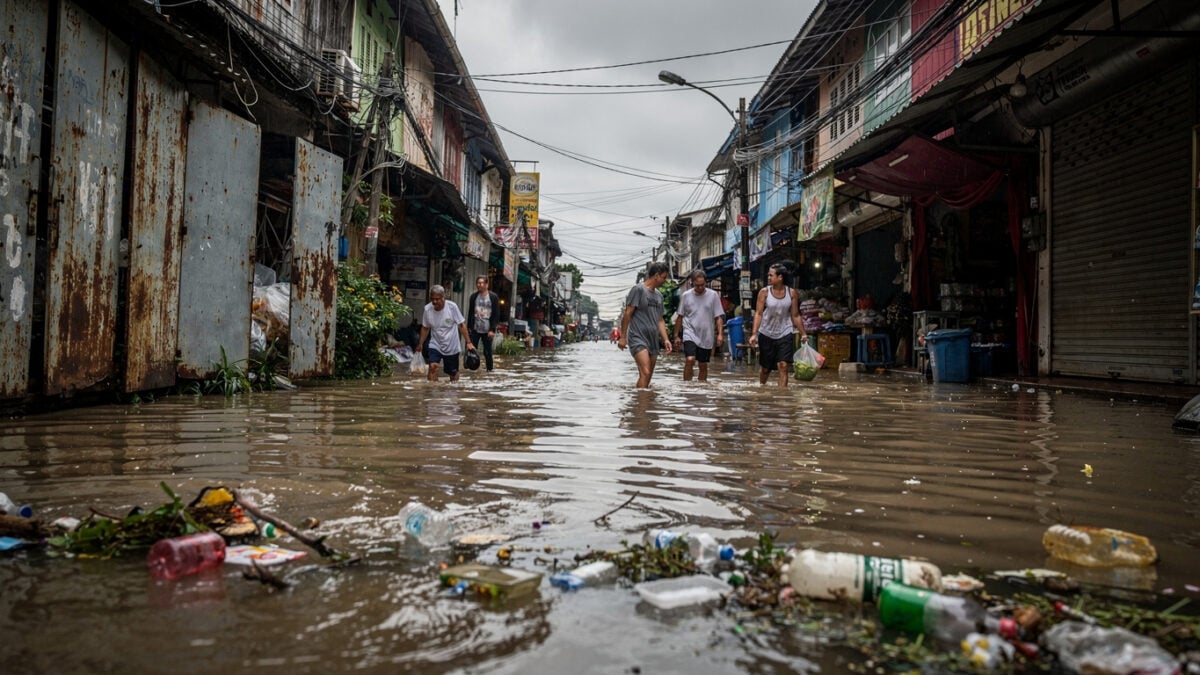
Bangkok’s 50 districts are under a flood disaster declaration after nearly 48 hours of intense monsoon rain overwhelmed the city’s drainage network. The Bangkok Metropolitan Administration said pumping stations are operating at their maximum combined capacity of 1,200 cubic metres per second. Some locations recorded more than 330 millimetres of rain, according to the Thai Meteorological Department.
Governor Chadchart Sittipunt estimated that draining the water could take two to three days if no further heavy rain falls. Prime Minister Anutin Charnvirakul, coordinating the response from London, planned to return Sunday.
“There should be no ‘this is a matter for the Governor of Bangkok’.” That was the instruction Prime Minister Anutin Charnvirakul issued from London on Saturday, directing ministries, provincial governors and disaster agencies to treat Bangkok’s flood emergency as a national operation. The declaration covering all fifty districts had been made, but the water was still rising, and the city’s pumps, running at full capacity, were unable to keep pace with the runoff. Governor Chadchart Sittipunt said the main weather system had moved toward Myanmar but drainage remained constrained: water flowing into surrounding canals was replacing what was being pumped out. He estimated that main roads could take two to three days to improve—if no further heavy rain arrived. The forecast was not promising.
The drainage timeline that depends on the sky
Chadchart explained the physics: even as pumps removed water, new flow from saturated canals was refilling the basin. The eastern and outlying districts remained under the greatest pressure, with many major roads still impassable on Sunday morning. The emergency was now a race between pumping capacity and the next thunderstorm.
The Thai Meteorological Department warned through September 27 of heavy to very heavy rain across Bangkok and surrounding provinces, with flash-flood and runoff risks near waterways. The city’s canal levels stayed high, and the BMA continued pumping and shelter operations.
In Pra Kanong district, a mixed commercial and residential area along Sukhumvit Road, floodwaters carried garbage through narrow alleys. Narin Wernthaisong, a resident, said: “In all the years I’ve lived here I’ve never seen flooding this bad.”
Thousands of households were affected and people were evacuated to shelters, according to reports by AFP and The Guardian. The disaster declaration unlocked emergency spending and coordination, but the immediate test was physical: whether pumps could lower water levels before more rain fell.
The water was still moving, but so was the government’s response structure. The next few hours would decide which moved faster.
An urban basin that cannot drain itself
Bangkok sits in a low-lying delta where rapid urbanisation has paved over natural floodplains. The roughly 300 millimetres of rain that fell in 48 hours was not unprecedented, but the city’s drainage network, designed for a different climate, could not move it out fast enough. The event underscored a structural pattern: the basin that gives Bangkok its shape also traps its water.
Western businesses with operations in the city—international hotels, airlines, retailers—depend on the same road and drainage networks as residents. When floodwater closes Sukhumvit Road, it disrupts staff access and supply chains, not just commutes. The citywide emergency interrupted normal commerce without closing the airport.
Thailand’s immediate policy response was operational: the all-district declaration, the coordinated national command, pre-positioned equipment and a dedicated flood press centre. These were not structural fixes, but they were designed to shorten the time between failure and recovery.
The prime minister’s directive had already forced coordination across agencies. But coordination cannot pump water. The next thunderstorm, if it comes, will test whether Bangkok’s emergency architecture can hold longer than its drains.
Beyond the headline
The Bigger Picture
Bangkok’s vulnerability is not determined by rainfall alone; it is determined by whether water can move through a dense, interconnected urban basin faster than new runoff enters it. That makes the emergency a test of coordination across city boundaries, canals, roads and upstream flows—not simply a measure of pump capacity.
The Response Gap
The response has expanded faster than the city can restore normal access: emergency shelters, pumps and coordinated command are active, yet residential communities may remain wet after major roads clear. The measurable gap is between removing water from transport corridors and making homes, neighbourhood services and local commerce usable again.
The Reach
Bangkok’s hotel sector depends on ground transport to move visitors between airports, accommodation and commercial districts; widespread standing water therefore turns a municipal drainage bottleneck into a disruption risk for international travel itineraries.
What the next few days demand
With floodwaters receding unevenly and the drainage timeline dependent on weather, travellers, businesses and residents in Bangkok face immediate decisions.
- Western tourist with Bangkok travel plans
Check Thailand’s official Meteorological Department forecast and heavy-rain warnings before travelling through Bangkok during the September 27–29 drainage period. Confirm road access and transfer times with your hotel; normal travel times are unreliable. Monitor BMA district updates for your planned route, as conditions differ sharply between central roads and outer districts.
- Foreign business operator with Bangkok offices
Activate business continuity plans for staff travel, deliveries and temporary remote work through the two-to-three-day drainage window. Contact Thailand’s Department of Disaster Prevention and Mitigation for official assistance information if facilities are affected. Review BMA district flood updates for site-specific impacts on your offices and supply chains.
- Expat resident in Bangkok’s affected districts
Follow BMA announcements for your district—eastern and canal-side areas face prolonged inundation. Prepare for possible evacuation or extended home confinement, and secure essential supplies. Residential communities may take up to two weeks to dry, according to the governor’s estimate, so plan for a longer disruption than the main-road clearance timeline suggests.
- International freight and logistics manager with Thai operations
Reroute shipments around flooded districts using real-time traffic and road-closure data. Communicate potential delivery delays to clients and assess cost implications. The disruption may extend beyond the drainage window if further rain falls, so build contingency into your scheduling.
FAQ
How to distinguish road clearance from home recovery
Bangkok’s two-to-three-day estimate applies primarily to improving roads and removing accumulated water if heavy rain stops. Governor Chadchart Sittipunt also indicated that some residential communities could take around two weeks to dry because surrounding canal water continues flowing back into drains. Verify your district and route instead of assuming citywide clearance is uniform.
Where conditions remain most difficult
Sunday updates identified eastern and outer Bangkok, including Lat Krabang, Nong Chok, Min Buri, Bang Kapi, On Nut and Ramkhamhaeng, as areas requiring continued attention. Canal-side locations near Saen Saep, Prem Prachakon and Prawet canals were also singled out. Conditions differ sharply between central roads, outer communities and canal corridors.
What official weather information means for plans
The Thai Meteorological Department’s warning through September 27 covered Bangkok and surrounding provinces, highlighting risks from heavy rain, flash floods and runoff near waterways. A weakening forecast does not eliminate flood risk: accumulated water may continue moving through canals after rainfall declines, so use both weather warnings and local BMA updates when planning routes.
Explainer
- Bangkok Metropolitan Administration (BMA)
- The city government of Bangkok, responsible for flood drainage, road maintenance and public services. It operates the pumping network at 1,200 cubic metres per second and coordinates disaster response within the capital. Its decisions shape how quickly water leaves the city after heavy rain.
- Thai Meteorological Department (TMD)
- Thailand’s national weather agency, which issues forecasts, heavy-rain warnings and flash-flood alerts. Its September 27 warning for Bangkok and surrounding provinces guided the emergency response. TMD data helps determine when drainage operations can shift from emergency pumping to road clearance.
- Disaster declaration
- A legal designation under Thai law that allows authorities to mobilise emergency operations, assistance and spending across affected areas. In Bangkok, the declaration covered all 50 districts, enabling the BMA to coordinate shelters, pumps and public warnings. It is a procedural trigger that unlocks resources rather than a guarantee of recovery.
RELATED STORIES


