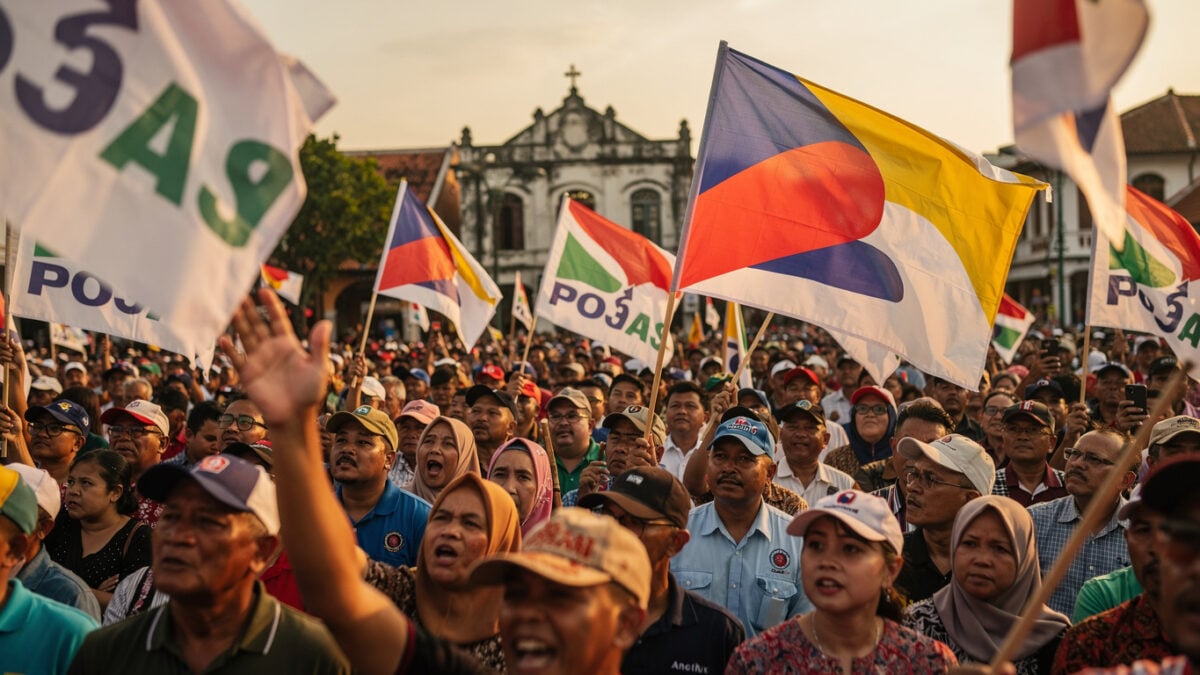
Malaysia’s Melaka state assembly was dissolved on 23 September 2026, triggering a snap election that must be held within 60 days. The vote will be an early test for Prime Minister Anwar Ibrahim’s unity coalition after back-to-back state-level defeats to its federal partner, the United Malays National Organisation.
The contest will reveal whether the coalition can reverse its losses or whether internal fractures are deepening. The Election Commission will soon set the nomination and polling dates.
The unity government in Putrajaya has held together for nearly four years on a single premise. The parties inside it fear the other choice more than they distrust each other. The Melaka state election will test whether that premise still holds.
Anwar Ibrahim’s Pakatan Harapan alliance has lost back-to-back state contests to Umno, its federal partner. A third loss would not topple the government. It would confirm that the alliance is a convenience of parliament, not a voting alliance.
A coalition that cannot campaign together
The legal trigger is Article 19 of the Melaka State Constitution. Clause (2) permits the assembly’s dissolution; clause (4) mandates a general election within 60 days.
The Election Commission will convene a special meeting to set the writ, candidate filing and polling dates. Chairman Ramlan Harun announced in a statement on 22 September that a state election will be held within 60 days of the dissolution, and that the commission would convene a special meeting soon to decide on the election date.
“A state election will be held within 60 days of the dissolution of the state assembly,” he said.
The decisive variable is not the election date but the alliance’s internal talks. Azmi Hassan, a senior fellow at the Nusantara Academy for Strategic Research, said the key question is “who UMNO picks to work with in the election.” He assessed that Pakatan Harapan is more keen to work with Umno than Umno is to work with Pakatan Harapan.
Adib Zalkapli of Viewfinder Global Affairs noted that Barisan Nasional could face pressure to give up safe Melaka seats. The pressure would come if it wants to preserve broader partnership with Perikatan Nasional ahead of a future general election.
Oh Ei Sun, principal adviser at the Pacific Research Centre of Malaysia, expects Barisan Nasional to retain Melaka by most seats. He argued that a commanding state victory would be unlikely to trigger an early federal election because the national vote is already fairly close. That assessment assumes the coalition’s internal fractures do not widen further—a condition the Melaka campaign will test directly.
Sivamurugan Pandian of Universiti Sains Malaysia warned that a Barisan Nasional–Perikatan Nasional arrangement could strengthen Malay support and make it harder for Pakatan Harapan to recover. He urged Pakatan Harapan to focus more strongly on local issues.
The internal feud is not new. It has been the background condition of Anwar’s government since its formation. Melaka will show whether it has become the foreground.
The coalition’s fragility is a regional concern
The direct Western consequence is not a likely change of government but the bargaining setting around Malaysia’s existing government. A weakened Anwar alliance could make financial, anti-corruption and fiscal measures slower to agree on. That would make planning harder for US, EU, British and Australian companies using Malaysia for production or services.
For a Western manufacturer with a plant in Melaka, the election is not about seat counts but about whether the next state government will speed up or slow down the approvals that keep production lines moving.
Singapore watches most closely because Malaysia’s steadiness affects cross-border business, transport and labor flows. A less cohesive federal alliance would encourage Singapore to keep practical ties active while avoiding assumptions about rapid Malaysian policy change. Indonesia would monitor whether the result strengthens Malaysia’s power on trade and maritime alignment. Thailand and Brunei value steadiness in Malaysia’s ASEAN-facing policy work.
The Melaka result will not bring down the government. But it will set the terms for the next national contest, and for whether the unity alliance can survive beyond the math that created it. UMNO’s leverage before the Melaka vote has already exposed the fractures; the election will measure how deep they run.
Beyond the headline
The Bigger Picture
Melaka exposes a structural problem in Malaysia’s unity government: federal cooperation does not automatically translate into local electoral coordination. Parties can share cabinet responsibility while still competing for the same constituencies, leaving state contests to reveal whether the coalition is an alliance of voters or merely an alliance of parliamentary arithmetic.
The Power Behind It
The real power sits with the party presidents who decide which constituencies their candidates contest. Umno’s president can either protect the party’s safe seats or trade them for a broader pact with Perikatan Nasional. That single decision will shape whether Pakatan Harapan faces a united opposition or a fractured field.
The Timing
Melaka is the first electoral test since the parties began sketching the coalition map for the next general election. The seat deals and partnership choices made here will become templates for the national contest, locking in alliances and red lines that will be hard to reverse later.
The election’s practical consequences
With the election likely to be held by late November, the outcome will shape Malaysia’s political stability and policy environment for months.
- Western investor with Malaysian portfolio exposure
You should watch whether a strong Barisan Nasional performance leads to policy continuity or a more assertive Umno that slows economic reforms. A fragmented result could delay fiscal measures, affecting Malaysian equities and the ringgit. Monitor the Election Commission’s website for the official timetable to gauge the timeline for political clarity.
- Western business operator with Malaysian manufacturing or services base
If the coalition weakens, expect slower decision-making on regulatory approvals and infrastructure projects. You may need to build longer lead times into your operational planning. Check the Smartraveller advisory for any local disruptions during the campaign period.
- Diplomat or policy professional focused on Southeast Asia
Analyze the seat distribution to assess whether Anwar’s government retains enough cohesion to pursue its current foreign policy, including balanced ties with the US and China. A weaker mandate could embolden domestic actors to push for more nationalist economic policies.
- Australian traveler considering a trip to Melaka
Before traveling to Melaka, consult the Australian government’s Smartraveller Malaysia page for updated safety advice. Campaign rallies can cause local traffic disruptions and occasional gatherings; avoid large political events and monitor local news.
Explainer
- Pakatan Harapan
- The coalition led by Anwar Ibrahim that forms the core of Malaysia’s unity government. It includes the People’s Justice Party, the Democratic Action Party, and the National Trust Party. It has governed at the federal level since November 2022 but has struggled in recent state elections.
- Umno
- The United Malays National Organisation, Malaysia’s dominant Malay party for decades. It is now a federal partner in Anwar’s unity government but has defeated Pakatan Harapan in recent state contests, raising questions about coalition cohesion.
- Barisan Nasional
- The broader coalition led by Umno, which also includes the Malaysian Chinese Association and the Malaysian Indian Congress. It has governed Melaka for most of the past decade and is expected to retain control in the upcoming vote.
- Caretaker government
- A temporary administration that runs the state after the assembly is dissolved until a new government is formed. It cannot make major policy decisions but ensures public services continue during the election period.
- Article 19
- The clause in the Melaka State Constitution that governs the dissolution of the assembly and mandates a general election within 60 days. It provides the legal basis for the snap election and the caretaker period.
RELATED STORIES