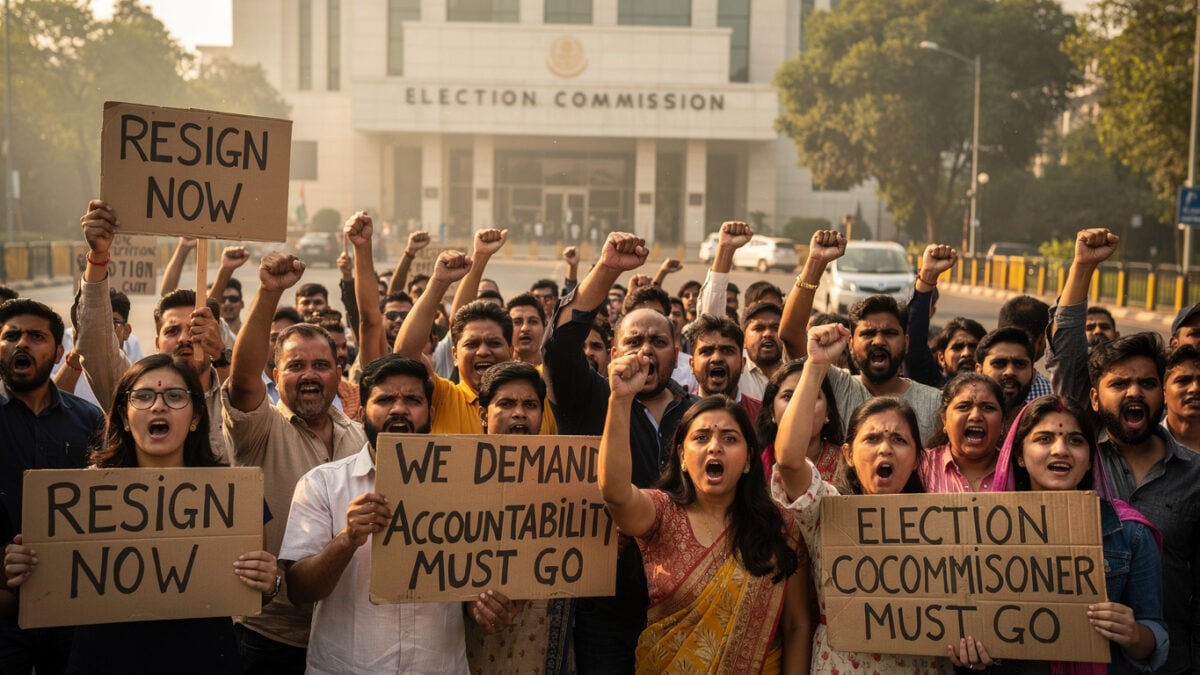
India’s Supreme Court declared on October 5 that it had never approved a modified version of Form 6, the statutory voter enrolment application, directly contradicting the Election Commission‘s earlier claim. The court demanded a transparent response from the government, the commission, and Chief Election Commissioner Gyanesh Kumar, as a third day of mass protests demanding Kumar’s resignation swept New Delhi and Mumbai.
The protests, led by opposition figures and a Gen Z political group, allege that a voter-roll revision known as the Special Intensive Revision removed millions of eligible voters to benefit the ruling BJP. The commission says it only removed duplicate, deceased, or ineligible entries.
Electoral commissions in large democracies rarely have their own statements contradicted by the highest court in the same week. India’s Election Commission managed it on October 5, when the Supreme Court said it had not approved any modification to Form 6 — the statutory application for voter enrolment — after the commission had publicly claimed otherwise. The correction landed as a third day of protests demanding the resignation of Chief Election Commissioner Gyanesh Kumar filled streets in Mumbai and New Delhi. The protesters, including opposition leaders and a Gen Z-led party, allege that a voter-roll revision removed millions of eligible voters to benefit Prime Minister Narendra Modi’s Bharatiya Janata Party. The commission insists it only removed duplicate, deceased, or ineligible entries. The court’s intervention shifts the dispute from a political charge to a constitutional question about who controls the gateway to the vote.
The court’s correction and the commission’s internal dissent
Chief Justice Surya Kant was unambiguous. “Modified Form 6 has not been approved by us, let us be very clear,” he said on October 5, after the Election Commission had cited a supposed judicial endorsement for an additional declaration attached to the enrolment form. The court sought a clear response from the government, the commission, and Kumar himself.
The commission’s September 26 position had been that the declaration was upheld by the Supreme Court. The October 5 clarification made that claim untenable. Justice Ujjal Bhuyan went further, calling a process that disenfranchises citizens intrinsically arbitrary and requiring scrutiny of the safeguards used before deletion.
Court filings cited at least 14 written objections by Election Commissioners Sukhbir Singh Sandhu and Vivek Joshi between November 2025 and August 2026, even though the commission maintains its decisions were unanimous. The same filings referred to 16.10 lakh appeals in West Bengal alone.
Protesters and opposition parties claim that approximately 130 million names have been removed from voter lists since the Special Intensive Revision began. The figure is not independently confirmed by any official breakdown; the commission has not released a category-by-category account.
The sequence below shows how the dispute moved from an administrative order to a constitutional standoff.
| Date | Event | Significance |
|---|---|---|
| June 24, 2025 | ECI issued Special Intensive Revision order for Bihar | Starting point of the contested revision process |
| Nov 2025–Aug 2026 | Election Commissioners recorded objections to SIR decisions on at least 14 occasions | Reveals internal dissent within the commission |
| May 27, 2026 | Supreme Court upheld Bihar SIR legality but limited ECI to electoral eligibility | Set precedent that revision is permissible but not for citizenship determination |
| Sept 26, 2026 | ECI claimed Form 6 declaration had been upheld by Supreme Court | Claim later contradicted by court on Oct 5 |
| Oct 2, 2026 | Opposition and youth groups began protest campaign demanding Kumar’s resignation | Street-level escalation |
| Oct 5, 2026 | Supreme Court issued notices and clarified no approval of modified Form 6 | Judicial intervention directly challenges ECI’s narrative |
| Oct 10, 2026 | Cockroach Janta Party announced Jantar Mantar rally if Kumar hasn’t resigned | Next mobilisation test |
| Source: Supreme Court of India, Election Commission of India, court filings, and protest organisers | ||
The administrative gateway becomes the battleground
The protests and court orders mark a deeper shift in how electoral conflict is fought. For decades, disputes centred on ballot boxes and counting day. Now the fight has moved upstream, to the administrative records that decide who gets a ballot in the first place. When eligibility lists become politically contested, an election’s legitimacy can be weakened months before polling day, even without proof of direct vote manipulation.
The government’s public explanation identifies four deletion categories: deceased electors, permanent movers, duplicate entries, and people untraceable after repeated visits. But without a verified category-by-category account, both the commission’s defence and the opposition’s largest claims remain incomplete.
Former Supreme Court judge Rohinton Fali Nariman has argued that election-administration failures represent a constitutional danger and questioned a system in which the government has decisive influence over commissioner appointments. His critique points to a structural vulnerability that predates the current protests.
The Supreme Court’s next steps will determine whether the dispute moves toward institutional remedy or deeper confrontation. If the court orders disclosure of records or corrective safeguards, the pressure on Kumar may ease. If the responses reject the allegations without records, the October 10 rally and opposition campaign are likely to intensify.
For Western governments that treat India as both a strategic partner and a democratic counterweight to China, a prolonged credibility crisis complicates public messaging on democratic standards. Multinational companies face added reputational and compliance risk when local partners or government-facing projects are assessed against uncertain institutional reliability.
Beyond the headline
The Power Behind It
The immediate institutional lever is not the protest crowd but the Election Commission’s control over the records that determine who can vote and how exclusions are reviewed. That makes transparency, restoration procedures and the commission’s internal decision-making more consequential than resignation slogans alone.
The Bigger Picture
The dispute exposes a shift in electoral conflict from counting ballots to controlling the administrative gateway before voting begins. When eligibility records become politically contested, the legitimacy of an election can be weakened months before polling day, even without proof that votes were directly manipulated.
What Isn’t Being Said
The public argument focuses on the headline deletion figure, but the harder question is whether excluded citizens received usable notice, a hearing and an effective route back onto the roll. Without a verified category-by-category account, both the ECI’s defence and the opposition’s largest claims remain incomplete.
The stakes for diplomats, executives, and investors
With the Supreme Court’s October 5 clarification raising the legal stakes and street protests set to continue, different audiences face distinct decisions.
- Western diplomat or policy advisor focused on India
You need to assess whether the voter-roll controversy signals democratic backsliding that requires adjustment in diplomatic messaging or aid. Monitor the Supreme Court’s case-status page for the next response deadline or hearing order in the Form 6 and SIR petitions; the court’s filings are the most authoritative source for what happens next. Before treating protest developments as evidence of wider instability, review the U.S. State Department’s India country information and the UK Foreign, Commonwealth & Development Office India travel and political updates.
- Multinational corporation executive with Indian operations
Uncertainty over institutional reliability can create reputational and compliance risks for your Indian operations. Assess whether local partners or government-facing projects could be affected by a prolonged credibility crisis. Adjust risk management strategies and public relations approaches to account for potential operational disruptions or increased regulatory scrutiny.
- ESG investor with exposure to Indian markets
Allegations of voter disenfranchisement directly impact the governance component of your ESG criteria. Re-evaluate the governance risk profile of your Indian investments and consider engaging with portfolio companies on their exposure to political instability or their commitment to democratic principles. The lack of a verified category-by-category account of deletions makes it difficult to quantify the risk, but the Supreme Court’s scrutiny elevates the issue.
- Academic researcher or NGO worker focused on Indian democracy
The controversy provides critical case study material for electoral administration, judicial oversight, and civil society mobilization. Analyze the ECI’s processes, the Supreme Court’s intervention, and the nature of public protests to inform your research or advocacy. The October 10 rally and the court’s next orders will offer real-time data on how institutional and popular pressures interact in the world’s largest democracy.
Explainer
- Form 6
- The statutory application form used to request inclusion in an electoral roll in India, including for new voters and those shifting constituencies. It is governed by the Registration of Electors Rules, 1960, and any modification requires legal authority. The Supreme Court’s October 5 clarification that it had not approved a modified version directly challenged the Election Commission’s earlier claim.
- Special Intensive Revision
- An administrative process conducted by the Election Commission of India to update electoral rolls by removing duplicate, deceased, or otherwise ineligible entries. The current cycle began with a June 2025 order for Bihar and has since expanded, drawing allegations that eligible voters were wrongly removed. The Supreme Court upheld the revision’s legality in May 2026 but limited the commission’s role to electoral eligibility, not citizenship determination.
- Election Commission of India
- The constitutional body responsible for administering elections and maintaining voter rolls in India, operating under Article 324 of the Constitution. It is headed by a chief election commissioner and two election commissioners, whose appointments have been a subject of judicial scrutiny. The current controversy has raised questions about its internal decision-making and transparency.
- INDIA bloc
- An alliance of Indian opposition parties formed to contest the ruling BJP, including the Indian National Congress and several regional parties. Its members marched toward the Election Commission headquarters on Tuesday, before being stopped by police and staging a sit-in. The bloc’s participation signals that the voter-roll dispute has become a central opposition rallying point.
- Cockroach Janta Party
- A Gen Z-led political group that has gained attention for youth-driven protests on issues such as exam leaks and electoral integrity. It announced a major rally at Jantar Mantar in New Delhi on October 10, 2026, demanding the resignation of the chief election commissioner. The party’s social-media-driven mobilisation has added a generational dimension to the protests.
RELATED STORIES