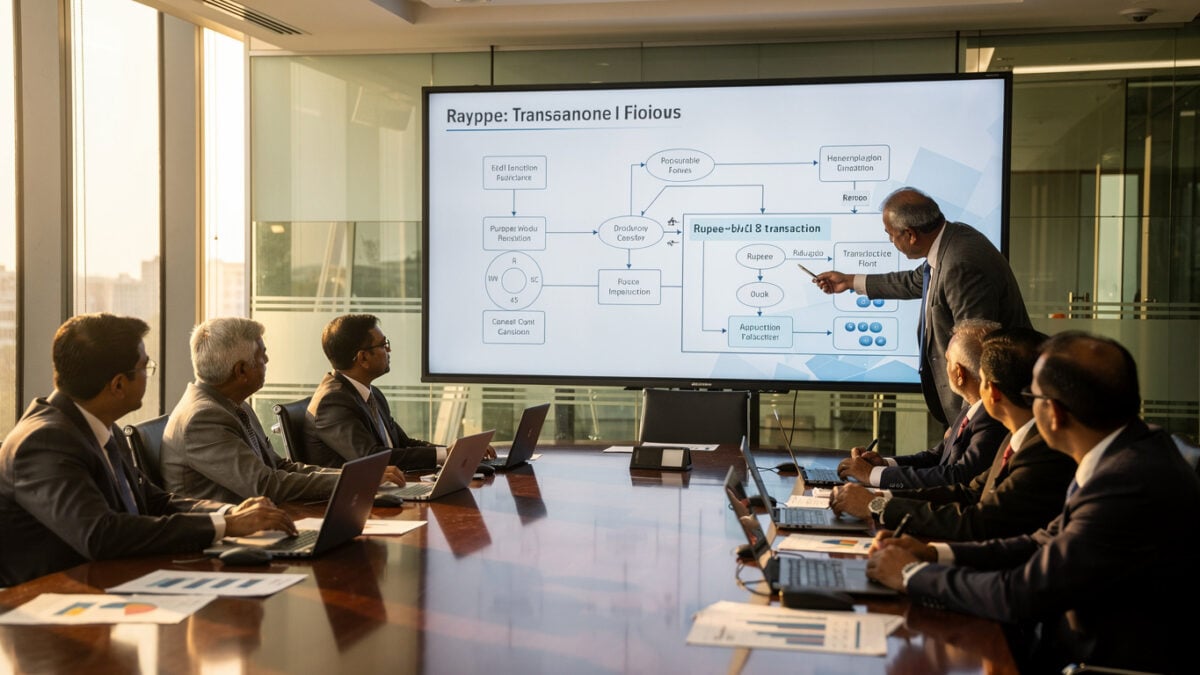
The Reserve Bank of India and the Russian central bank are jointly developing a central bank digital currency mechanism to settle bilateral trade, Sberbank chief executive Herman Gref disclosed in New Delhi on September 10, 2026. The early-stage work aims to ease payment frictions for a trade relationship that reached $59.9 billion in India’s fiscal year 2025–26, with a target of $100 billion by 2030. The disclosure came days before India hosts the annual BRICS summit, where cross-border payment reform is on the agenda.
The trade flow remains heavily tilted toward Russia, with a deficit exceeding $50 billion. The digital-currency channel is one attempt to correct that imbalance without forcing India onto a formally anti-dollar path.
India’s trade deficit with Russia reached $50.489 billion last fiscal year. That single number explains why New Delhi is quietly building a digital-currency settlement channel with Moscow — and why it is simultaneously telling the world it wants no part of an anti-dollar bloc. The bilateral central bank digital currency work, disclosed by Sberbank’s chief executive on September 10, is the first concrete test of that balancing act. India is pushing BRICS partners to link their CBDCs for cross-border payments while explicitly rejecting a unified payment network that could be perceived as challenging the dollar. According to Reuters reporting on BRICS discussions, senior Indian officials outlined that position. It reflects a careful calibration: deepen payment integration to fix a lopsided trade relationship, but never let it look like a geopolitical project. The annual BRICS summit in New Delhi, starting this week, has turned cross-border payment reform into a live policy test. For India, the stakes are measured in barrels of oil and the political cost of being seen as Moscow’s financial ally. The digital-currency channel with Russia is the first piece of that test.
A $50 billion gap and a digital bridge
Herman Gref, chief executive of Russia’s state-controlled Sberbank, disclosed the talks in New Delhi on September 10. “We see huge opportunity for digital currency for all settlements,” he said, describing the work between the Bank of Russia and the Reserve Bank of India as early-stage. No timeline or technical details were announced. Russia launched its digital ruble on September 1 through systemically significant banks, including Sberbank.
India’s Ministry of External Affairs puts bilateral trade at $59.863 billion in the fiscal year ended March 2026. Exports to Russia stood at just $4.88 billion, while imports — overwhelmingly crude oil — reached $55.369 billion. That left a deficit of $50.489 billion, a figure that has become the central problem in the economic relationship.
Crude oil and derivatives from Russia accounted for $47.8 billion of India’s imports, roughly 86 percent of the total. The $100 billion trade target both governments have set for 2030 is, in practice, a bet that oil flows will continue — and that India can find something to sell in return.
Piyush Goyal, India’s Commerce Minister, has urged exporters to sell more to Russia, according to statements made at an industry interaction. According to RDIF statements, modern payment infrastructure is considered a prerequisite for BRICS trade growth.
According to RBI public communications, the digital rupee remains in pilot phase, with cross-border use being explored cautiously and any linkage required to align with domestic stability priorities.
According to Reuters reporting on BRICS discussions, India’s stated policy is to push bilateral CBDC links while rejecting a unified network. Senior officials told Reuters the proposal builds on the Rio declaration and explicitly avoids any anti-dollar framing.
The BRICS Payment Task Force has studied cross-border payment interoperability, promoting local-currency settlements without prescribing a single model.
Western expats in India or Russia could feel the changes first through retail payments and bank relationships. Linking India’s Unified Payments Interface with Russia’s Faster Payments System, and piloting BRICS Pay for traveller transactions, would let foreign residents pay merchants or move funds using local apps, potentially lowering fees compared with card schemes. At the same time, heightened sanctions screening and CBDC experimentation may lead banks to tighten know-your-customer checks on foreigners, altering onboarding standards or cross-border transfer options over the coming year.
Why India is walking a tightrope
After India sharply increased Russian oil purchases in 2022, Russian companies accumulated large rupee balances in vostro accounts that could not easily be converted. The RBI later allowed those rupees to be invested in government securities or used for future purchases. Sberbank’s Gref now says the problem is no longer significant.
But the underlying asymmetry remains. India’s exports to Russia are a fraction of its imports, and the $100 billion target depends on a surge in Indian goods that has not materialized. The digital-currency settlement channel is an attempt to make it easier for Russian buyers to pay Indian exporters without relying on dollar-clearing infrastructure that carries sanctions risk.
According to reports citing people familiar with BRICS discussions, India has rejected the development of a unified BRICS payment network, with officials stressing that any CBDC linkage must be bilateral and voluntary. The stance reflects a calculation that deeper payment integration with Russia is necessary to manage the trade deficit, but that a formal anti-dollar bloc would jeopardize India’s relationships with Western capital and technology partners.
The BRICS summit in New Delhi is the first test. India must decide how far to link the digital rupee without crossing its own red line. The answer will shape emerging-market payment architecture for years.
Beyond the headline
The Bigger Picture
The India–Russia CBDC talks sit atop a wider effort by BRICS economies to insulate trade from external shocks while living with deep structural imbalances. India’s merchandise deficit with BRICS partners and Russia in particular forces it to seek cheaper, more flexible settlement channels without solving the core problem of limited export breadth. The bigger story is how digital payment experiments are being used to buy time while policymakers struggle to rebalance trade in the real economy.
The Power Behind It
Control over payment infrastructure, not just currency choice, is where power lies in this episode. Russia is scrambling to escape Western-sanctioned rails, while India wants to preserve autonomy over UPI, its banking system and any future digital rupee linkages. The technical language of CBDC interoperability masks a political negotiation over who can switch off, monitor or reroute flows — with New Delhi determined that BRICS experiments do not leave that power solely in Moscow or Beijing’s hands.
What Isn’t Being Said
What official communiqués largely omit is the risk that new CBDC or BRICS Pay channels could introduce fresh vulnerabilities: cyber risk, operational dependence on still-unproven technology, and potential fragmentation of compliance standards. Leaders talk about speed and cost reduction but say much less about how disputes over failed transactions, data localisation or sanctions screening will be resolved. Once those frictions surface, they may determine whether these alternative rails stay niche or become genuinely systemic.
Three decisions for Western money in a shifting payment landscape
With the BRICS summit in New Delhi turning cross-border payment reform into a live policy test, Western institutions with exposure to India and Russia face three immediate decisions.
- Western Financial Institution with India/Russia Exposure
Assess how emerging CBDC settlement channels might alter transaction visibility and sanctions compliance. Review the Reserve Bank of India and Indian Ministry of External Affairs briefings on trade and BRICS payment initiatives to gauge the pace of change. Monitor U.S. and EU sanctions updates for any new guidance on digital-currency settlement with Russia.
- Western Commodity Trader with India-Russia Supply Chains
Evaluate if and when digital currency settlement becomes viable for oil and commodity flows. Track the technical specifications and pilot timelines of the digital ruble and India’s CBDC to determine when hedging strategies or operational processes may need adjustment. Check with legal counsel on sanctions exposure before routing payments through experimental channels.
- Western Investor in Indian Financial Technology
Monitor the technical specifications and adoption rates of new payment channels to identify growth opportunities or competitive threats for fintech portfolio companies. Pay attention to UPI–Faster Payments System linkage and BRICS Pay pilots, which could reshape the cross-border payments landscape in India over the next 12–18 months.
- Western Policy Analyst on Sanctions and Financial Diplomacy
Analyze the design and scale of emerging digital payment systems to understand their potential impact on future sanctions regimes and financial intelligence gathering. Track the BRICS Payment Task Force outcomes and any bilateral CBDC agreements to assess whether these rails could reduce the visibility of trade flows currently captured by SWIFT and correspondent banking.
FAQ
Will foreign firms be required to use CBDC-based settlement for India–Russia trade?
No. Early reporting suggests these mechanisms are being explored alongside existing rupee–ruble and conventional bank settlement. Exporters can continue using current rails while monitoring regulatory guidance on CBDC eligibility and documentation. Participation is expected to remain optional in the near term.
How might CBDC or BRICS Pay settlement change bank charges for cross-border trade?
Analysts expect any functional digital-ruble–rupee or UPI–Faster Payments bridge to lower some correspondent banking and FX conversion costs. However, banks may introduce new compliance or technology fees tied to these systems. Traders should check tariff schedules and service descriptions once pilots move into commercial deployment.
Do new BRICS-aligned payment channels alter sanctions exposure for Western participants?
Current Western rules target transactions involving designated Russian entities regardless of payment rail. Companies should treat any CBDC or BRICS Pay route as subject to the same due-diligence and screening obligations as SWIFT-based transfers. Seek legal advice before re-routing payments through experimental systems.
Explainer
- CBDC
- A central bank digital currency is a digital form of a country’s fiat currency, issued and backed by the central bank. Unlike cryptocurrencies, it is a direct liability of the central bank and operates on a regulated ledger. India’s digital rupee pilot began in 2022, while Russia launched its digital ruble in September 2026.
- BRICS
- BRICS is a grouping of major emerging economies originally comprising Brazil, Russia, India, China, and South Africa, expanded in 2024 to include Egypt, Ethiopia, Iran, and the United Arab Emirates. The bloc coordinates on economic and political issues, with annual summits setting priorities. Its New Development Bank funds infrastructure projects in member states.
- Digital ruble
- The digital ruble is Russia’s central bank digital currency, launched on September 1, 2026, through systemically important banks. It is designed to operate alongside cash and non-cash rubles, with the central bank acting as the issuer and operator of the platform. The digital ruble is a key component of Russia’s strategy to build alternative payment rails outside Western systems.
- Unified Payments Interface
- UPI is India’s real-time mobile payment system developed by the National Payments Corporation of India, allowing instant bank-to-bank transfers via a single mobile application. It processes over 10 billion transactions monthly and has become the dominant retail payment rail in India. India is now exploring linking UPI with foreign fast-payment systems, including Russia’s Faster Payments System, to facilitate cross-border transactions.
- Vostro accounts
- A vostro account is a local-currency account held by a domestic bank on behalf of a foreign bank, used to settle trade transactions. After India’s oil imports from Russia surged, Russian banks accumulated large rupee balances in vostro accounts with Indian banks. The Reserve Bank of India later permitted these rupees to be invested in government securities or used for future purchases, easing the trapped-funds problem.
RELATED STORIES