Taiwan’s National Communications Commission will slow mobile data speeds to approximately 1% of normal capacity across 14 cities and counties next month, affecting almost 70% of the population, in the island’s first ever mandatory civilian bandwidth restriction.
The two 30-minute windows, on August 10 and 13, are part of expanded civil-military exercises. Southern Taiwan, home to the stock exchange, has been excluded to prevent disruption of real-time mobile trading.
Taiwan’s defence planners are about to test what a modern society looks like when its most convenient layer of connectivity vanishes. For 30 minutes on two afternoons in August, mobile data across the island’s most populated counties will slow to a trickle—a deliberate stress test for a population that navigates, orders food, and trades stocks on the same 5G stream. But the real story is in what the state chose to protect. The stock market received the first exemption.
The National Communications Commission (NCC) carved out southern Taiwan, where the Taiwan Stock Exchange operates, ostensibly because throttling mobile data during trading hours could disrupt smartphone-based transactions. In doing so, the exercise revealed a deeper vulnerability than the one it was designed to probe: Taiwan’s economy is so threaded through mobile apps that even a simulated half-hour slowdown was deemed too risky for its financial centre. If the drill is a readiness check for a crisis that could sever undersea cables for weeks, the exemption raises an uncomfortable question—how prepared is the rest of the economy, and what else would have to stay online even while the bombs fell?
The market gets a pass, and the lesson is already there
The throttling targets 14 cities and counties spread across two phases. On August 10, from 2:30 to 3:00 p.m., mobile data in central Taiwan—Taichung, Chiayi, Miaoli, Changhua, Nantou, and Yunlin—will drop to about 0.5 to 1 Mbps, roughly 1% of normal capacity. A second window on August 13 hits the northern belt: Taipei, New Taipei, Keelung, Taoyuan, Hsinchu, and Yilan County. Together, an estimated 16 million people will see apps freeze, video calls drop, and cloud syncs stall. Voice calls and SMS will continue normally, as will traffic lights and ATMs, which run on separate fixed-line or dedicated networks.
The NCC’s decision to exclude the south—where urban resilience and air-raid drills are scheduled for the morning—is the most telling detail. Secretary-General Wen Jun-yu confirmed that conducting the throttle while the Taiwan Stock Exchange was open could disrupt real-time smartphone-based trading. The exemption reveals how deeply economic systems depend on mobile connectivity, with market-moving orders now routed through mobile apps as a default interface.
The throttling is embedded in the Urban Resilience exercises, which run alongside the island’s largest annual military drill, Han Kuang 42 (August 5–14). Minister of National Defense Wellington Koo framed the slowdown as a test of “command-and-control backup capabilities under wartime-like conditions,” adding that the results will guide whether to expand the drills to other regions. Presidential spokesperson Karen Kuo noted that similar communication-disruption exercises are conducted in Japan, South Korea, Singapore, and EU states, and that the point is to familiarise the public with switching to fixed-line or Wi‑Fi. Yet the stock-exchange exemption is hard to square with that universal-preparedness logic.
A senior national security official told Reuters: “We hope the current drills will not only involve central government agencies, but also help the public strengthen their own preparations for using different communication methods.” The official cited a spike in Chinese coast guard activities off Taiwan’s Pacific coast as operational context. The statement underscores the genuine threat, but also the tension: preparing civilians for connectivity loss while keeping the financial system’s mobile lifeline intact is a contradiction waiting to be tested.
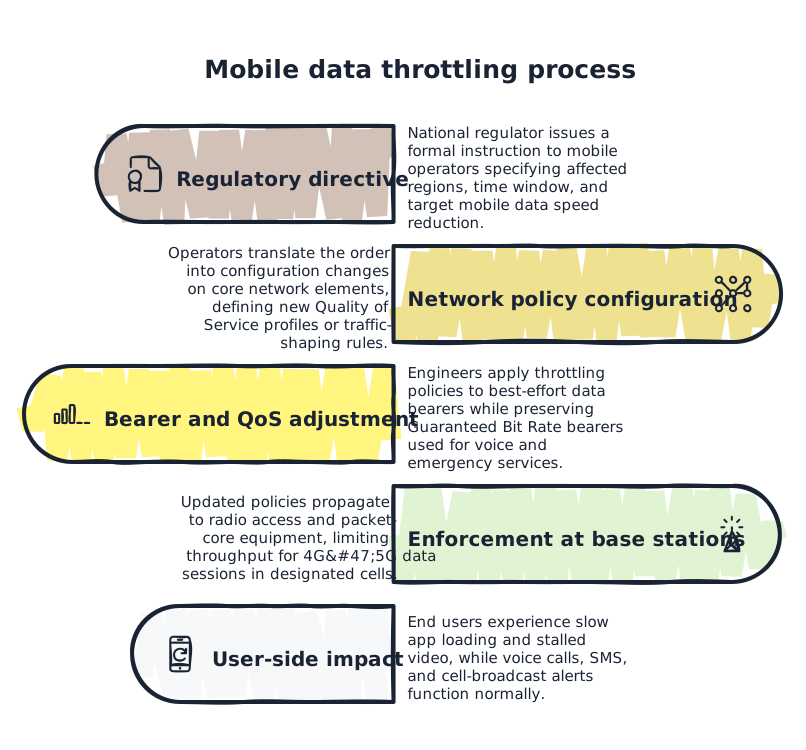
The path from an NCC order to a user’s stalled video feed is a short one, but the steps matter.
| Entity | Current rule | New rule | Effective date |
|---|---|---|---|
| Mobile data users in central/northern Taiwan | Full 4G/5G speeds | Throttled to ~1% of normal throughput (0.5–1 Mbps) | Aug 10 (central), Aug 13 (northern), 2:30–3:00 p.m. |
| Voice calls and SMS | Always highest priority (QCI 1 bearer) | Remain fully functional | N/A (unchanged) |
| Cell Broadcast emergency alerts | Separate signalling channel (BCCH) | Unaffected | N/A (unchanged) |
| Southern Taiwan (incl. Taipei Exchange area) | No throttling planned | Exempted from the drill | N/A (exemption) |
| NCC regulatory authority over telcos | Telecommunications Management Act grants NCC power to direct operators during drills | Invoked for these drills | Aug 2026 |
| Source: National Communications Commission, Taiwan; Ministry of National Defense statements | |||
The architecture of a prepared society gets tested
Taiwan’s bandwidth drill is not an isolated technical exercise. It is the operational debut of President Lai Ching-te‘s Whole-of-Society Defense Resilience Committee, created in April 2026 with five pillars: civil manpower, emergency supplies, energy security, medical capacity, and cyber‑communications redundancy. The mobile‑data slowdown activates the fifth pillar. For years, planners worried about the 15 submarine cables that converge on seven shore stations, an obvious chokepoint that could be severed by sabotage or accident. Since 2023, at least 11 cable incidents have been recorded around Taiwan, including incidents that cut off the Matsu Islands for 50 days.
The legal scaffolding is deliberately flexible. Under the Telecommunications Management Act, the NCC can direct operators to adjust Quality of Service during civil‑defence exercises without declaring a state of emergency. That contrasts with the European Union’s open‑internet rules, where pre-planned, population‑wide throttling is tightly constrained and generally viewed through a human‑rights lens. The U.S. and Australia lean on priority‑access schemes and disaster waivers rather than rehearsed slowdowns. In Taiwan, the government has chosen to test a tool that elsewhere would be classed as a partial internet shutdown. International frameworks on internet shutdowns, including Access Now’s taxonomy, classify throttling as a form of shutdown regardless of duration or stated intent.
The divide is instructive. Regional security analysts, quoted by Reuters and The Straits Times, frame Taiwan’s move as part of a “global trend” in disrupted‑communications simulations, but concede that democratic legitimacy hinges on narrow scope and transparency. Taiwanese commentators have criticised the stock‑market exemption as proof that political and economic sensitivities can override consistency. For Western firms with Taiwan‑based staff, the main exposure during the drill is not data theft but a sudden loss of real‑time connectivity to cloud services, trading platforms, and logistics systems. Pre‑positioning offline documentation and shifting critical workflows to fixed‑line or VPN‑tunnelled Wi‑Fi can turn the window into a rehearsal of its own.
The Ministry of National Defense’s post‑exercise assessment, expected in the months after August, will be the true verdict. If it recommends extending throttling nationwide or adding fixed‑line tests, it signals that authorities see clear value and manageable political cost. If it quietly shelves mobile throttling, sensitivity to economic disruption and civil‑liberties criticism will have won. For now, the drill’s design—a near‑blackout of mobile data with the stock exchange carefully fenced off—has already revealed more about Taiwan’s digital dependency than the exercise itself can measure. The question is whether the next version is honest enough to test the things that really cannot go down, and whether the public is ready to accept the answer.
Beyond the headline
The Bigger Picture
Taiwan is conducting the first real-world stress test of a doctrine that no longer separates the military from the civilian mobile network. For Western militaries, the implication is stark: any adversary with the means to sever undersea cables or degrade 5G will aim at the digital infrastructure of an economy before the first tank moves. Resilience is no longer about protecting grid nodes alone; it is about rehearsing the loss of the apps that coordinate logistics, dispatch emergency crews, and keep a population calm. The drill is a reminder that the next war’s opening salvos will be digital, and that defending a democracy means preparing its citizens for a hyper‑connected silence.
What Isn’t Being Said
Food delivery riders who rely on real‑time location tracking, small e‑commerce sellers processing payments over 4G, and gig workers whose shifts are scheduled by app represent a segment of the workforce for whom even 30 minutes without mobile data could mean lost income and cancelled orders. Unlike equity traders, they have no exemption. The official briefings reviewed do not address compensation or work‑arounds for these groups, raising questions about how resilience planning accounts for the informal economy.
The Reach
When a Taiwanese regulator adjusts QoS profiles on core‑network elements, the effect ripples far beyond the island. Remote monitoring systems that depend on constant cellular connectivity may experience temporary service interruptions. A single half‑hour drill, if it exposes friction points in how systems respond to connectivity loss, can inform broader supply‑chain resilience planning for Western clients with East Asian exposure.
What Taiwan’s data slowdown means for Western firms and governments
As Taiwan’s exercise turns mobile data into a scarce resource for 30 minutes, Western companies and policymakers face immediate planning and policy questions.
- Western multinational firm with Taiwan operations
The NCC’s drill is an immediate trigger to update your Taiwan business‑continuity documentation. Map every workflow that relies on 4G/5G—from field‑sales apps to identity‑verification uploads—and document explicit fallbacks to office broadband, VPN, or voice calls. Pre‑schedule data‑heavy tasks outside the 2:30–3:00 p.m. windows and confirm your local teams can switch to fixed‑line or Wi‑Fi ahead of the exercise.
- Global supply chain manager with East Asian exposure
Identify which nodes in Taiwan and neighbouring hubs depend on mobile data connections for remote monitoring or logistics tracking. Pre‑define a “data‑degraded” operational mode and test it during the drill window, using internal monitoring to see whether temporary connectivity loss triggers false alerts or system errors.
- Western government policy advisor on internet governance
Taiwan’s transparent, pre‑announced, voice‑protected throttling challenges existing human‑rights frameworks that treat any bandwidth restriction as a shutdown. Use this case to inform your country’s position on what constitutes legitimate emergency testing versus rights‑eroding precedent. Compare the NCC’s legal basis—embedded in its Telecommunications Management Act—with the EU’s open‑internet rules and U.S. priority‑access schemes to build a benchmark for acceptable democratic resilience exercises.
- Western investor with APAC emerging market exposure
The stock‑exchange exemption exposes a vulnerability that markets have not yet priced in: in a real crisis, mobile‑dependent trading, payments, and settlement systems could freeze. Scrutinise your portfolio companies’ dependency on cellular infrastructure in Taiwan and ask whether their crisis plans account for extended mobile data loss. The drill’s economic calculus—protecting the equity market while leaving gig workers exposed—also carries a social stability risk that could affect operating conditions in Taiwan over the next year.
FAQ
What practical steps should I take if I am in Taiwan during the drill windows?
Download offline maps in advance and avoid mobile trading or e‑commerce between 2:30 and 3:00 p.m. on the affected days. Agree on voice‑call or SMS contact chains with family or colleagues. If you are a visitor, confirm your hotel’s Wi‑Fi works, save boarding passes locally, and watch for NCC or local government notices on affected counties. Voice calls and SMS remain fully usable, so you can still reach emergency services.
How should companies with staff in the throttling zones prepare?
Map which workflows—trading, large file uploads, identity verification—run over mobile data. Schedule them outside the 30‑minute windows. Instruct remote workers to switch to home or office broadband during the exercise. Customer‑support and incident‑response teams may need temporary staffing adjustments so that key personnel operate from locations with reliable fixed‑line connectivity. Review your SLAs with Taiwanese ISPs to understand how drills are treated contractually.
Will using a VPN or a foreign SIM card bypass the slowdown?
No. Throttling is applied at the radio and core‑network level in the affected Taiwanese cells, so any traffic—including VPN‑tunnelled data—will still be slowed. Roaming visitors on foreign SIMs will experience the same reduced speeds. Fixed‑line broadband and Wi‑Fi remain viable, so you should rely on Wi‑Fi for calls and data during the exercise windows. Enable Wi‑Fi calling on your device if supported.
Explainer
- Han Kuang 42
- Taiwan’s largest annual military exercise, running from August 5 to 14 in 2026. This year it fully integrates civil‑defence components for the first time, including evacuation drills, underground medical operations, and the bandwidth throttle. The exercise simulates a full‑scale attack on the island and is observed by foreign military attachés.
- National Communications Commission (NCC)
- Taiwan’s independent telecom regulator, established in 2006. It oversees spectrum allocation, internet governance, and operator conduct, and can order mobile carriers to adjust Quality of Service during emergencies and civil‑defence exercises under the Telecommunications Management Act.
- Guaranteed Bit Rate bearer
- A dedicated channel in 4G and 5G networks that reserves a fixed amount of capacity for a specific traffic type, such as voice calls. It is assigned the highest QoS class (QCI 1) and remains untouched even when the network is congested or deliberately throttled. This is why phone calls survive the drill.
- Whole-of-Society Defense Resilience Committee
- A cross‑government body created by President Lai Ching‑te in April 2026. It operates on five pillars: civil manpower training, emergency supplies, energy security, medical capacity, and cyber‑communications redundancy. The mobile‑data slowdown is its first public operational test of the communications pillar.
- Cell Broadcast Service
- A mobile technology that sends short emergency messages to all devices in a defined area simultaneously, using a separate signalling channel that does not compete with app traffic. It is the backbone of public warning systems such as the U.S. Wireless Emergency Alerts and Japan’s J‑Alert, and remains functional during the drill.
RELATED STORIES