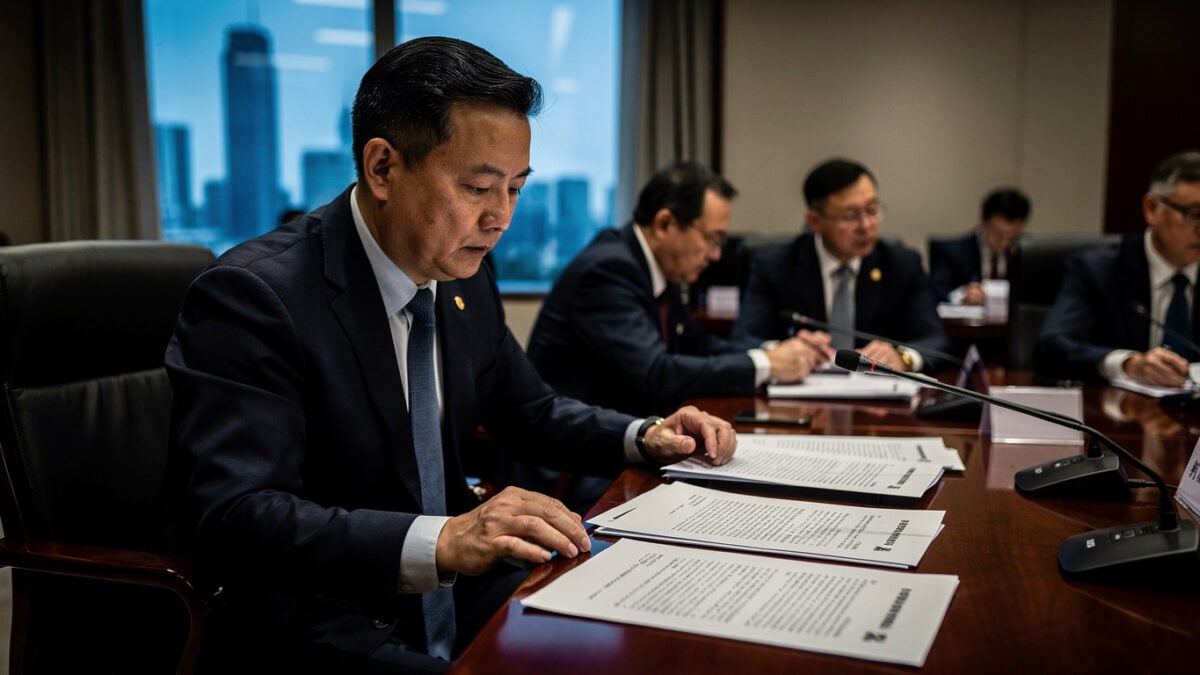
China’s minister of state security has publicly warned that artificial intelligence threatens Communist Party rule and national security, and on the same day the Cyberspace Administration of China released version 3.0 of its AI Safety Governance Framework — a sequence that deepens the governance rift with Washington.
The moves contrast with President Donald Trump’s dismissal of AI guardrails as a hoax, leaving Western technology firms navigating two increasingly incompatible regulatory poles.
The world’s two largest AI powers are now building governance regimes that point in opposite directions. On September 14, China’s minister of state security, Chen Yixin, published an article warning that artificial intelligence threatens Communist Party rule and national security. On the same day, the Cyberspace Administration of China released AI Safety Governance Framework 3.0, embedding risk classification, technical countermeasures, and regulatory sandboxes into a standards-based system. Three days earlier, President Trump had called AI safety concerns a hoax, declaring that “The only control or ‘guardrails’ that AI needs is a STRONG AND SMART (High IQ!) PRESIDENT, and the U.S.A. has that, in spades!”
The two approaches are not merely different; they are structurally incompatible. Beijing is folding AI into its doctrine of comprehensive national security, treating algorithms as strategic assets requiring party oversight. Washington is channeling AI debates into culture-war and economic frames, with no single federal safety statute. For global technology companies, the divergence is no longer a policy abstraction. It is a compliance fork that will force engineering teams, data flows, and market-access strategies to split along geopolitical lines.
A security doctrine, not a technical standard
Chen’s article, carried in the Cyberspace Administration’s flagship journal China Cyberspace Magazine, framed AI as the principal arena of global technology competition and a new front for strategic rivalry. He warned that foreign actors could use AI to detect software vulnerabilities, attack critical infrastructure, steal industrial and state secrets, and spread harmful propaganda. He cited domestic users’ carelessness with foreign AI products as causing large-scale internal data leaks, and pointed to products like OpenClaw as having structural problems including remote control of device management permissions.
The framework released on the same day, drafted under CAC guidance by the National Technical Committee 260 on Cybersecurity with contributions from the China Cyberspace Research Institute, continues the core logic of risk classification, technical responses, and comprehensive governance. It calls for regulatory sandboxes and other risk-controllable mechanisms, and says China will take timely measures against risks that threaten national security or public interests. But it is framed as implementing Xi Jinping’s Global AI Governance Initiative, not as a standalone binding statute.
The structural divergence between the two approaches is easier seen than read.
Chen’s emphasis on independent control of core technologies suggests that Nvidia is unlikely to regain full China sales soon and that AMD‘s prospects for selling many GPUs in China are poor. This assessment points to a market where foreign chipmakers face both export controls and a Beijing determined to achieve technological sovereignty.
Meanwhile, U.S. cybersecurity agencies have flagged a parallel risk. A joint advisory from the NSA, CISA, and FBI warns that China-based AI firms are conducting industrial-scale knowledge distillation campaigns against U.S. frontier models, using API proxies to bypass geographic restrictions. The advisory urges companies to tighten API access controls, monitor abnormal usage patterns, and apply data-minimization when serving China-linked requests. For Western users, the practical implication is clear: inputting sensitive information into AI tools operated under Chinese jurisdiction carries a risk that Chen’s article explicitly names.
| Entity | Current rule | New rule | Effective date |
|---|---|---|---|
| China | AI Safety Governance Framework 2.0 (guidance) | Framework 3.0: risk classification, technical countermeasures, regulatory sandboxes; standards-based, not binding law | September 14, 2026 |
| United States | No comprehensive federal AI safety law; sectoral directives and executive orders | Trump’s National AI Legislative Framework (proposed March 20, 2026) seeks federal pre-emption, focuses on child safety, free speech, innovation; not yet enacted | Pending Congress |
| European Union | EU AI Act adopted; phased implementation | High-risk system obligations from December 2, 2027; transparency rules and AI Office enforcement from August 2, 2026 | Various (2026–2027) |
| Sources: Cyberspace Administration of China; White House fact sheet, March 20, 2026; European Commission | |||
Two visions of what AI is for
China’s Framework 3.0 is not an isolated regulatory update. It is the latest iteration of a state-endorsed standards blueprint aligned with Xi Jinping’s Global AI Governance Initiative, which emphasizes people-centred, risk-aware, secure-controllable development and integrates loss-of-control scenarios and agent-specific rules. By contrast, the United States has no single AI statute. Trump’s national AI legislative framework, proposed in March 2026, seeks a federally pre-emptive law focused on child safety, free speech, and innovation, while sectoral directives govern military and cybersecurity use. U.S. companies navigate a patchwork of general regulators and emerging state rules.
The divergence reflects competing visions of AI’s role in statecraft. Beijing is folding the technology into its doctrine of comprehensive national security; Washington is channeling AI debates into culture-war and economic frames. The EU offers a third model — a structured rights-based regime — but neither superpower fully mirrors it.
Watch the planned mid-September U.S.–China frontier AI safety dialogue, led by Treasury Secretary Scott Bessent. If the talks yield concrete mechanisms on monitoring AI-enabled cyberattacks or lab self-policing, they could signal nascent bilateral guardrails despite the public rhetoric. If they stall, each side will likely double down on unilateral export controls, domestic security rules, and narrative warfare. The next few weeks will show whether the two regimes can find any common ground — or whether the fork becomes permanent.
Beyond the headline
The Power Behind It
Chen’s article, as the Ministry of State Security’s official position, frames AI as a threat to political, institutional and ideological stability. The timing and scope of Framework 3.0’s release on the same day suggests that security concerns are central to China’s regulatory approach. That security lens shapes why foreign AI firms face tightening controls even as Beijing publicly emphasizes the need for balanced governance.
The Bigger Picture
This episode illustrates a deeper divergence in how great powers integrate AI into their political systems. Beijing is folding AI into its doctrine of comprehensive national security, building governance structures that treat algorithms like strategic assets requiring party oversight. Washington, by contrast, is channeling AI debates into culture-war and economic frames, focusing on child safety and infrastructure while its president mocks existential risks. The split is not just regulatory; it reflects competing visions of what AI is for in statecraft.
The Reach
One underappreciated consequence for Western readers lies in corporate compliance architectures. As China hardens AI standards around security and sovereignty, multinational platforms must decide whether to build China-specific safety stacks that satisfy CAC and security-agency expectations, or keep global systems aligned with EU-style rights-based rules and U.S. market priorities. That choice will shape where engineering teams sit, how cross-border data is handled, and which firms can still operate truly global AI services without fragmenting their technology.
The compliance fork in the road
With China hardening AI standards around security and sovereignty, and Washington offering no federal safety framework, Western companies face three immediate decisions.
- Western semiconductor procurement manager for China market
Re-evaluate sales forecasts and supply-chain strategies for the Chinese market. Chen’s technological-sovereignty push, combined with existing export controls, suggests Nvidia and AMD will face a shrinking addressable market. Begin mapping domestic Chinese alternatives and consider shifting inventory to less restricted regions. The CISA advisory on distillation campaigns also flags API-access risks that could affect chip demand from AI labs.
- US-based investor with APAC emerging market exposure in AI/Tech
Assess the long-term viability of AI/tech investments in China. The regulatory divergence introduces operational risks that may not be priced in. Rebalance toward companies with strong domestic Chinese operations that can navigate the new framework, or toward markets less exposed to the U.S.-China governance rift. Track the Bessent-led talks for signals on whether bilateral guardrails emerge.
- Western multinational operating AI-powered services in China
Review AI governance, data handling, and compliance strategies immediately. Framework 3.0’s emphasis on secure controllability and risk classification means localized AI infrastructure and stricter data segregation may become mandatory. Implement the API monitoring and access controls recommended in the U.S. agencies’ joint advisory, and apply geographic restrictions when serving China-linked requests. The EU AI Act’s transparency timeline offers a parallel compliance benchmark that may become the de facto Western standard.
- US AI policy analyst or government advisor
Analyze the implications of the governance divergence for international AI standards, export controls, and future U.S.-China technology dialogues. The Chinese framework’s alignment with the Global AI Governance Initiative signals an intent to export its security-centric model. Prepare policy recommendations that address the gap between the U.S. innovation-first posture and the emerging Chinese and EU regulatory blocs, particularly as the mid-September talks approach.
Explainer
- Cyberspace Administration of China
- The Cyberspace Administration of China (CAC) is the country’s central internet regulator, responsible for content control, data security, and cybersecurity policy. It oversees the implementation of laws like the Cybersecurity Law and the Personal Information Protection Law, and issues binding regulations and standards. The CAC also publishes the flagship journal China Cyberspace Magazine, which carried Chen Yixin’s article.
- AI Safety Governance Framework 3.0
- Version 3.0 of China’s AI Safety Governance Framework, released on September 14, 2026, is a standards-based document that structures AI governance around risk classification, technical countermeasures, and comprehensive governance. It was drafted under CAC guidance by the National Technical Committee 260 on Cybersecurity and is framed as implementing Xi Jinping’s Global AI Governance Initiative. Unlike the EU AI Act, it is not a binding statute but carries significant political weight.
- Knowledge distillation
- Knowledge distillation is a machine-learning technique in which a smaller “student” model is trained to replicate the outputs of a larger “teacher” model. While legitimate in research, U.S. agencies have warned that China-based AI firms are using it at industrial scale to extract proprietary capabilities from U.S. frontier models via API access, often bypassing geographic restrictions. The practice is central to the current U.S.-China AI security tensions.
- Regulatory sandbox
- A regulatory sandbox is a controlled environment where companies can test innovative products under a regulator’s supervision without immediately incurring all normal legal consequences. China’s Framework 3.0 endorses sandboxes for AI, but they operate within a state-directed system where security agencies retain strong oversight. The EU AI Act mandates sandboxes in each member state by August 2, 2026, as part of a rights-based framework.
- National Technical Committee 260 on Cybersecurity
- National Technical Committee 260 on Cybersecurity is China’s primary standards body for cybersecurity, operating under the Standardization Administration of China. It drafts and publishes national standards, including the AI Safety Governance Framework series, often under the guidance of the Cyberspace Administration. Its work shapes the technical baseline for compliance across Chinese industry.
- Global AI Governance Initiative
- Launched by President Xi Jinping in 2023, the Global AI Governance Initiative is China’s framework for international AI cooperation, emphasizing people-centred development, mutual respect, and a balance between innovation and security. It calls for a global governance system that reflects the interests of developing countries. Framework 3.0 is explicitly presented as implementing this initiative.
RELATED STORIES