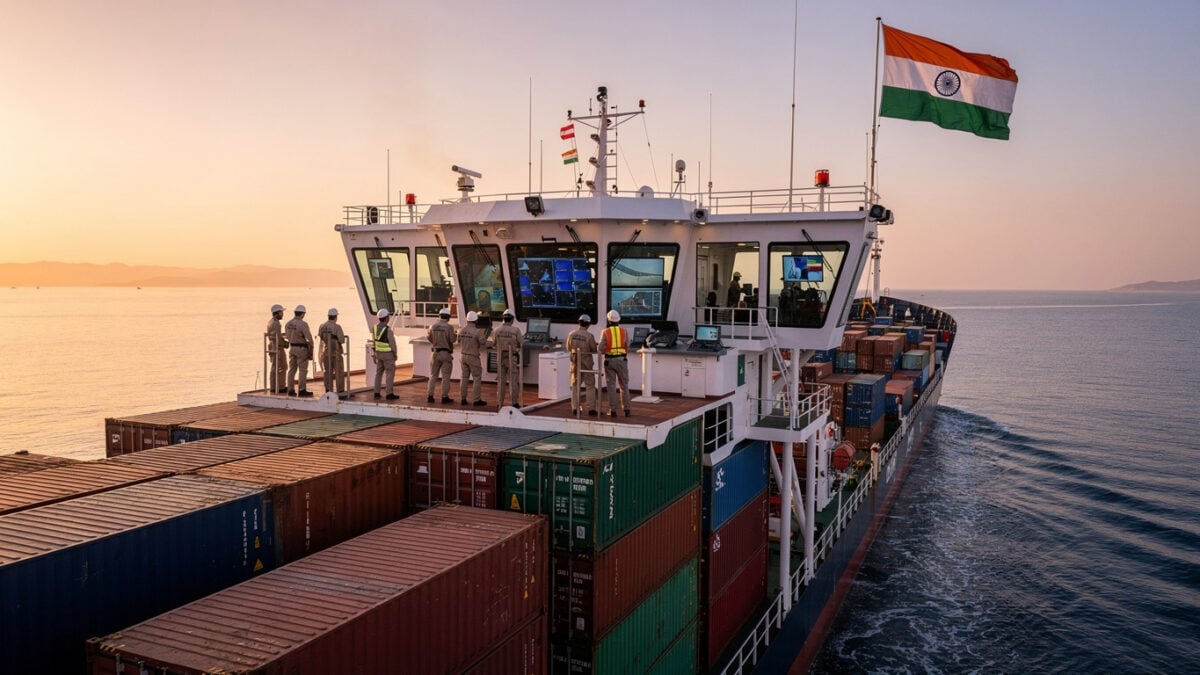
India’s state-backed Bharat Maritime Insurance Pool has written 3,095 policies since its May 2026 launch, cutting war-risk premiums by roughly 35–40% from their West Asia conflict peak. The pool carries USD 1.5 billion in underwriting capacity, backed by a sovereign guarantee of ₹12,980 crore.
The speed of uptake signals demand for a domestic alternative to the London-led P&I system. Whether the pool can build the claims and legal infrastructure to match its early policy volume is the question that will define the next phase.
The number that matters is not the 3,095 policies written by early September. It is the 35–40% drop in war-risk premiums that came with them. India’s Bharat Maritime Insurance Pool has done what foreign insurers could not or would not: price conflict-zone cover at a level Indian shipowners can absorb, and keep it available when sanctions and geopolitical shocks made private-market capacity unreliable.
The pool launched on May 12, 2026 with a sovereign backstop of ₹12,980 crore — roughly USD 1.4 billion — and total underwriting capacity of USD 1.5 billion. Four months later it had issued 3,000 cargo-war policies, 92 hull war-risk policies, and three P&I policies. The numbers are not a pilot. They are a commercial-scale answer to India’s near-total reliance on 13 foreign P&I clubs that insure about 90% of the world’s large ships.
A pool built for the corridors that matter
The pool’s policy count hit 3,095 by September 7, 2026, according to a government backgrounder. Cargo-war policies dominate — 3,000 of them — reflecting the immediate need among Indian importers and exporters to keep goods moving through the Red Sea and near the Strait of Hormuz without absorbing premium spikes that made some voyages uneconomic.
The first P&I policy was handed to Shipping Corporation of India Limited on July 30, 2026, issued by New India Assurance Company Limited. It provides third-party liability cover — crew injury, pollution, wreck removal — with an indemnity limit of up to USD 1.5 billion through the pool’s combined capacity. The first hull-and-machinery war policy had been issued weeks earlier, on May 12, to M/s. Hoger Offshore and Marine Private Limited, covering a vessel transiting high-risk war zones.
Sanjay Mokashi, chief underwriting officer at General Insurance Corporation of India, the pool’s administrator, said removing the need to buy expensive reinsurance for the war-risk portion could reduce premiums by roughly 25%. The actual decline has been sharper — 35–40% below the West Asia conflict peak — because the pool’s sovereign backing eliminates the risk premium that private reinsurers charge for conflict-zone exposure.
The structure is designed to keep the sovereign guarantee at arm’s length. Claims up to USD 100 million are met from the pool’s own reserves and reinsurance recoveries. The guarantee activates only after those resources are exhausted — a contingent backstop, not a first-loss subsidy. A Governing Body oversees operations and any invocation of the sovereign guarantee, while an Underwriting Committee handles technical risk evaluation.
The leverage that shifts when a state underwrites risk
Before BMIP, Indian shipowners relied almost entirely on the International Group of P&I Clubs — 13 mostly Western clubs that insure about 90% of the world’s large ships. When conflicts in the Red Sea and near the Strait of Hormuz disrupted routes, foreign insurers increased premiums or withdrew cover. India, which moves 95% of its trade value by sea, had no domestic fallback.
The pool changes that calculation. Ashish Sheth, chairman and managing director of Sarjak Container Lines, argues that continuity of cover is commercially more important than the headline premium reduction. A domestic fallback is less exposed to sanctions-driven decisions made in London or Oslo. The pool’s eligibility covers Indian-flagged vessels, vessels owned or controlled by Indian entities, and cargo vessels destined for or departing from India — including voyages through volatile corridors.
Ishwar Achanta, a former member of the National Shipping Board, notes that the present arrangement is not yet equivalent to a full international P&I club. Stronger global alignment, legal foundations, and industry participation are still needed. The pool has a 10-year duration, extendable to 15, and its medium-term priorities include building human capital and reinsurance partnerships while keeping reliance on sovereign backing minimal.
Beyond the headline
The bigger picture
BMIP is part of a wider shift in which states treat insurance capacity as strategic infrastructure, not a neutral financial service. When war, sanctions, or politically imposed exclusions can stop a vessel from sailing, the ability to underwrite risk becomes an element of economic sovereignty.
The power behind it
The decisive actor is not the individual insurer issuing a policy but the Indian state, which makes otherwise difficult maritime risks commercially insurable through its balance sheet. That structure gives New Delhi influence over the terms on which trade continues during a geopolitical shock.
The reach
European marine brokers face a new competitive constraint because India can use sovereign backing to keep selected voyages insured when private-market capacity tightens. The implication is narrower margins on India-linked war-risk business, even if Western clubs remain indispensable for global P&I coverage.
What the pool means for money, cargo, and policy
With BMIP operating at commercial scale and the next policy renewal cycle approaching, four groups face decisions that did not exist six months ago.
- Western maritime insurer or P&I club executive
You need to assess the impact of BMIP on your India-related business strategy and pricing models. The pool has already written 3,095 policies in four months — volume that would otherwise have flowed through London or Oslo. Monitor GIC Re and New India Assurance disclosures for underwriting and claims data, and evaluate whether collaboration or competition is the more viable path in the Indian Ocean region.
- Western supply chain manager with Indian maritime exposure
You should evaluate BMIP’s coverage, eligibility, and premium structure through your Indian partners or freight forwarders before your next policy renewal. The 35–40% war-risk premium reduction is a tangible cost saving for cargo moving through the Red Sea or Strait of Hormuz. Confirm whether your vessels and cargo interests meet the pool’s underwriting rules — Indian-flagged, Indian-controlled, or destined for or departing from India.
- Western investor in global shipping or insurance sectors
You should monitor the financial performance and market share reports of major Western P&I clubs and Indian insurance and shipping entities. GIC Re, New India Assurance, and listed Indian shipping operators are the most direct public-market names to track. The near-term risk is that claims experience or weak reinsurance limits the pool’s credibility; the opportunity is lower volatility for Indian-controlled cargo operations.
- Western government policy advisor on Indo-Pacific trade or security
You need to analyze how BMIP’s growth impacts India’s strategic autonomy in maritime trade and its implications for international cooperation on shipping security and sanctions enforcement. A domestic fallback reduces the leverage that Western governments have over shipping continuity during a crisis. The pool’s expansion also signals that Sri Lanka, Bangladesh, and the UAE may pursue feasibility studies for their own war-risk or P&I backstops.
FAQ
Who can qualify for BMIP cover?
BMIP eligibility covers Indian-flagged vessels, vessels owned, managed or controlled by Indian entities, and cargo vessels travelling to or from India. The official framework also contemplates voyages through high-risk corridors. Businesses should confirm whether the vessel, cargo interest and voyage satisfy the pool’s underwriting rules before relying on the cover.
What does the cover include?
The pool’s stated product range includes hull and machinery, cargo, P&I and war-risk protection. P&I liabilities identified by the government include crew and cargo liabilities, pollution, wreck removal, collision and related third-party exposures. Applicants should distinguish war-peril protection from ordinary marine cover because each responds to different insured events and limits.
How are large claims supported?
The operating structure uses pool reserves and reinsurance before drawing on the sovereign guarantee. Government material identifies USD 100 million as the threshold associated with the pool’s own resources, while the guarantee is a contingent support mechanism rather than automatic first-loss insurance. Policyholders should obtain the precise claims sequence and exclusions from the issuing insurer.
Explainer
- P&I club
- A Protection and Indemnity club is a mutual insurance association that covers third-party liabilities for shipowners — pollution, crew injury, cargo damage, and wreck removal. The International Group of P&I Clubs comprises 13 mostly Western clubs that insure about 90% of the world’s large ships. Before BMIP, Indian shipowners relied almost entirely on these clubs, leaving them exposed to premium spikes and cover withdrawal during geopolitical shocks.
- GIC Re
- General Insurance Corporation of India is the state-owned national reinsurer and the designated administrator of the Bharat Maritime Insurance Pool. It manages daily operations, submits performance reports, and handles reinsurance arrangements for the pool. GIC Re’s role as pool administrator places it at the centre of India’s effort to build domestic maritime underwriting and claims expertise.
- Sovereign guarantee
- A sovereign guarantee is a government commitment to cover financial obligations if a designated entity cannot meet them from its own resources. For BMIP, the Indian government has provided a guarantee of ₹12,980 crore — roughly USD 1.4 billion — that activates only after the pool’s own reserves and reinsurance recoveries are exhausted. It is a contingent backstop, not a first-loss subsidy.
RELATED STORIES