
Southeast Asia’s insurance markets face structural upheaval as AI-driven individual pricing erodes the centuries‑old risk‑pooling foundation. Indonesia, Malaysia and the Philippines each count their credentialed actuaries in the low thousands, while the EU has classified AI underwriting as high‑risk—yet ASEAN has no comparable safeguards, and the region’s super‑apps are already feeding behavioural data into pricing models.
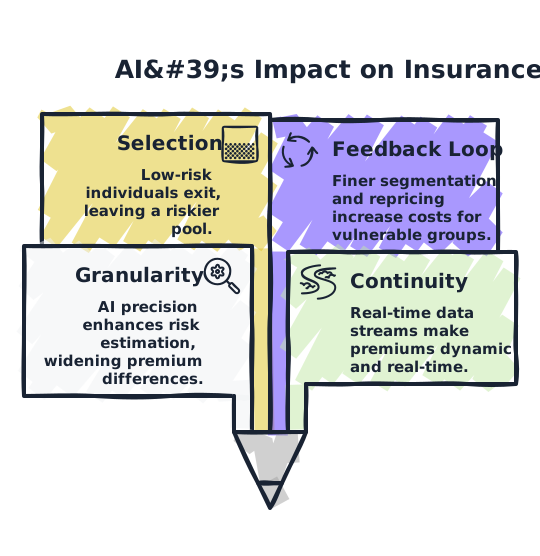
The mechanisms—granularity, continuity and selection—split lower‑risk customers into cheap individual products, leaving behind a riskier pool and threatening an adverse‑selection spiral. With a data‑rich, lightly regulated environment, ASEAN’s markets risk becoming an uncontrolled testbed whose failures could ripple through global reinsurance.
Across Southeast Asia, the actuarial profession faces a structural squeeze. Indonesia, Malaysia and the Philippines reportedly maintain credentialed actuary counts in the low thousands each—a fraction of the professional depth in Europe or North America. At the same time, AI‑driven underwriting tools, fed by transaction records from super‑apps and ride‑hailing platforms, are moving from pilots into production across the region. The gap between the two is widening, and no national insurance supervisor in Southeast Asia has adopted an AI‑specific regulatory framework.
The EU’s AI Act, in force since August 2024, already classifies many insurance pricing systems as high‑risk, demanding risk assessments and human oversight. That same requirement does not exist in Jakarta, Kuala Lumpur or Manila. The math of risk pooling—unchanged for three centuries—is being rewritten by code. The algorithms are racing ahead of the lawyers and the mathematicians, and the region’s safety nets are not nearly as sophisticated as the data streams the models are consuming.
Regulatory gaps and data abundance create asymmetric risk
The mismatch between ASEAN’s regulatory frameworks and the sophistication of AI pricing tools entering the market is the core vulnerability. As Thomas Holmes, Chief Actuarial Officer at Akur8, puts it: “A statistically flawless model can still fail in practice, producing unstable rate relativities.” His warning hits at the core of what is unfolding in Southeast Asia, where the data needed to build those models is abundant but the actuarial workforce to govern them is not.
A 2022 Akur8 survey found that 88% of pricing professionals expected the convergence of actuarial science and data science to add value. By 2026, machine‑learning capabilities are no longer an experiment; they are an assumed part of pricing teams. That confidence rests on a foundation that ASEAN markets lack. McKinsey has documented AI deployments already cutting customer onboarding costs by 20–40% and boosting agent productivity by 10–20%—signs that the tools are moving from pilots into production globally.
The sequence below traces how these three levers feed into a self‑reinforcing loop.
| Entity | Current rule | Key AI‑specific requirement | Effective date |
|---|---|---|---|
| EU | AI Act (Regulation (EU) 2024/1689) | Many underwriting and pricing tools classified as high‑risk; risk management, human oversight and transparency obligations mandatory | Phased application from 2025–2026 |
| United States | No federal statute; state‑level rules emerging | Colorado AI insurance regulation and NAIC model bulletins require life and health insurers to monitor for unfair discrimination from external data and complex models | Colorado rules effective from 2025‑2026; NAIC guidance evolving |
| Indonesia | General data protection and insurance supervision laws | No AI‑specific insurance underwriting requirements publicly disclosed; model explainability and fairness audits not mandated | Not applicable |
| Malaysia | General data protection and insurance supervision laws | No AI‑specific insurance underwriting requirements publicly disclosed | Not applicable |
| Philippines | General data protection and insurance supervision laws | No AI‑specific insurance underwriting requirements publicly disclosed | Not applicable |
| Sources: EU AI Act; NAIC, Colorado Division of Insurance; national personal data protection and insurance laws of Indonesia, Malaysia, Philippines. Table reflects publicly available regulatory guidance as of 2026. | |||
No ASEAN regulator has yet publicly identified an AI‑driven adverse‑selection spiral in a major insurance line. The region’s short history of digital health and motor telematics means that the worst‑case dynamics remain modelled rather than observed. But the regulatory vacuum is real, and consultancies like Bain have warned that structural issues such as low penetration and limited returns from technology investments remain unresolved even as AI adoption accelerates.
Data abundance and regulatory gaps converge in ASEAN
Globally, AI‑insurance tooling is led by specialist vendors like Akur8 and Shift Technology, plus cloud platforms from AWS and Microsoft. These systems are deployed mainly in motor and health lines, usually under tight data‑protection and anti‑discrimination rules. In ASEAN, the distinct advantage lies with super‑apps and digital banks that own rich behavioural data and can embed micro‑policies at checkout or ride‑booking screens—an environment where the same guardrails are largely absent.
In the EU, the AI Act forces insurers to build formal risk‑management systems, document training data and keep humans meaningfully in the loop. The US patchwork is moving toward algorithmic fairness rules. By contrast, Indonesia, Malaysia and the Philippines rely on general data‑protection and consumer‑protection laws. Gaps remain everywhere: model explainability, fairness audits, cross‑platform data sharing. According to cyber risk intelligence provider KYND, insurers are already accumulating hidden AI‑related exposures because clients adopt AI tools without always disclosing them—a phenomenon the industry has begun to call “silent AI,” analogous to earlier silent-cyber risks.
The mismatch is dangerous because the data feeding ASEAN’s pricing engines is richer and less regulated than in the West. As Thomas Holmes of Akur8 puts it, a model can be statistically perfect and still fail in practice. When that failure cascades, the first to notice may be a reinsurer in London or Zurich, not a local supervisor. By then, the damage to the pool will have already been done.
Beyond the headline
The bigger picture
What is unfolding in ASEAN insurance is not just an underwriting tweak but a stress test of how far societies are willing to let price discrimination run when algorithms make it technically easy. As AI tools slice risk into ever finer segments, countries that treat insurance primarily as a commercial product will drift toward exclusion, while those that see it as part of the social safety net will be forced into some combination of subsidies, coverage mandates or bans on extreme segmentation. The region’s decisions will reveal which conception of insurance ultimately prevails in data‑saturated economies.
The response gap
Regulators in Europe and some US states are already building AI‑specific guardrails for insurance, yet their Southeast Asian counterparts are still focused on basic solvency and consumer‑protection issues like mis‑selling. That leaves a mismatch between the sophistication of tools entering ASEAN markets and the capabilities of agencies tasked with policing them, especially where actuarial departments are small and algorithm audits compete with more immediate priorities such as capital adequacy. Until supervisory teams gain the expertise and legal hooks to interrogate models directly, reinsurers and multinational parents will shoulder much of the responsibility for containing emerging pricing pathologies.
What isn’t being said
Most public debate about AI in insurance centres on consumer privacy and headline‑grabbing cases of algorithmic bias, but far less attention is paid to the capital‑market plumbing that depends on stable risk pools. If AI‑driven segmentation in ASEAN quietly destabilises motor or health portfolios, the immediate losers are high‑risk households, yet the secondary effects fall on reinsurers, bondholders and even bank lenders exposed to local carriers. That possibility rarely appears in policy consultations, largely because the data needed to model it sits inside proprietary pricing engines and reinsurance contracts rather than public datasets.
What a broken cross‑subsidy costs you
As AI‑driven segmentation fractures insurance pools across Southeast Asia, the implications reach well beyond the region’s borders. Four groups have decisions to make.
- Western insurer with ASEAN operations
Review how your local subsidiaries are using telematics, wellness data, or platform partnerships. If they are building proprietary AI pricing models, map your reinsurance treaties and capital buffers against the risk of sudden adverse selection in motor or health books. Check annual reports for mentions of AI in underwriting, then compare with NAIC or EIOPA emerging guidance to assess whether your models could trigger regulatory scrutiny back home.
- Global reinsurance underwriter
Stress‑test your ASEAN motor and health treaties for a scenario where lower‑risk policyholders migrate to individually priced micro‑products over 18 months, leaving pools riskier. Ask cedants to provide documentation on their AI model governance, including fairness audits and adverse‑selection monitoring. The data is scarce, but a lack of independent validation is itself a signal.
- Fintech investor with APAC exposure
When an ASEAN insurtech promises to underwrite policies using behavioural scores, reinsurers and industry observers recommend digging into its data‑sourcing disclosures, the actuarial oversight of its models, and any reinsurer’s willingness to back the portfolio. A heavy dependence on super‑app data with no independent model validation is a red flag. The returns could be high, but the regulatory and pool‑stability risks are still unquantified.
- Western insurance regulator or policy professional
Monitor regulatory consultations from Otoritas Jasa Keuangan (OJK) in Indonesia and Bank Negara Malaysia for any mention of AI in insurance. ASEAN’s experience with ungoverned AI pricing—especially any adverse‑selection episodes in high‑volume lines—could become a cautionary case study for the EU’s AI Act and state‑level US rules. Early engagement with ASEAN counterparts may help shape guardrails before spillovers arrive.
FAQ
What rights do Western consumers have when an insurer uses AI to set premiums?
Under the EU’s GDPR Article 22, individuals have the right not to be subject to a decision based solely on automated processing, including profiling, that has legal or similarly significant effects—such as major premium changes. Insurers must provide meaningful information about the logic involved and allow customers to request human intervention or contest a decision. European data‑protection authorities have indicated that opaque, fully automated risk scoring for mass‑market products raises concerns under these obligations, though specific guidance on insurance applications continues to develop.
How are global reinsurers responding to AI‑driven underwriting changes?
Reinsurers such as Swiss Re and Munich Re are publishing thematic reports on AI and digital‑risk accumulation, tightening wording around cyber and technology exclusions. They are increasingly asking cedant insurers to document how AI tools are used in underwriting and claims, including governance structures and stress tests for adverse selection. This scrutiny can raise capital charges or reinsurance costs for primary carriers in emerging markets that push AI‑enabled pricing too far without adequate controls.
What should small businesses know about AI‑based insurance pricing?
Small businesses purchasing commercial property, liability or cyber cover may encounter AI‑driven questionnaires and external‑data checks that feed straight into pricing models, particularly in the US and parts of Europe. Brokers report that inconsistent data across public records, credit files and online footprints can trigger unexpected premium jumps or coverage restrictions. Advisers recommend monitoring your digital presence, correcting inaccuracies in business registries, and proactively explaining risk‑management measures to underwriters so that early AI models do not misclassify you as higher‑risk than you are.
Explainer
- Adverse selection
- A situation in insurance where higher‑risk individuals are more likely to buy or keep coverage, while lower‑risk individuals exit, leaving a riskier pool. AI‑driven pricing can accelerate this by giving healthy or low‑risk customers cheap individual products, while sicker or higher‑risk ones face surging premiums or exclusion. The resulting spiral pushes the average cost of the pool ever higher, threatening the stability of entire insurance lines.
- Risk pooling
- The foundational insurance principle that groups large numbers of similar exposures and charges a premium based on the group’s expected loss, so that the many low‑risk members cross‑subsidise the few who incur claims. This model has underpinned affordable insurance for centuries. AI’s ability to price each life individually threatens to fracture that pool, making coverage unaffordable for those who need it most.
- Super‑app
- A mobile application that bundles multiple services—messaging, payments, ride‑hailing, food delivery, financial products—into a single platform, common in Southeast Asia (Grab, Gojek, Shopee). These apps collect vast streams of behavioural and transaction data that can feed AI‑based insurance pricing models, often with fewer regulatory restrictions than in Western markets.
- EU AI Act
- Regulation (EU) 2024/1689, in force since August 2024, which classifies AI systems by risk and imposes strict obligations on high‑risk applications. Insurance underwriting and pricing tools that materially affect access to essential services are treated as high‑risk, requiring risk management, human oversight and transparency. The Act’s phased application began in 2025 and contrasts sharply with the absence of similar rules in ASEAN.
- Actuarial
- The professional discipline that applies mathematical and statistical methods to assess risk in insurance and finance. Actuaries design pricing models, calculate reserves and ensure solvency. In Southeast Asia, the credentialed actuarial workforce is measured in low thousands per country, a structural weakness when complex AI pricing algorithms require deep oversight and validation.
RELATED STORIES


