Philippine prosecutors filed three counts of grave threats against Vice President Sara Duterte-Carpio on 11 August 2026 in a Quezon City court. The charges, brought under Article 282 of the Revised Penal Code, stem from a 2024 briefing where she claimed to have hired an assassin to kill President Ferdinand Marcos Jr., his wife, and a cousin if she were killed first. Bail was set at P120,000 (US$2,100).
The filing opens a second legal front for Duterte-Carpio, who is already facing an impeachment trial in the Senate over confidential funds. Her defence team argues that a sitting impeachable officer cannot be prosecuted for conduct also covered by the impeachment case — a claim the Department of Justice contests.
The legal architecture for removing a Philippine vice president has two distinct wings: an impeachment court in the Senate and a criminal trial in the regular judiciary. It was never designed to run both at once, and no court has ever been asked to decide whether it can. On 11 August 2026, the Department of Justice forced the question, filing three counts of grave threats against Sara Duterte-Carpio over a 2024 late‑night press briefing in which she said she had arranged for an assassin to kill Marcos, his wife, and a cousin if she were killed first.
Her defence lawyer, Paul Lawrence Lim, immediately signalled a jurisdictional fight. “As a sitting impeachable officer, the Vice-President may not be prosecuted for an alleged offence that is also the subject of an impeachment case,” he said in a statement. The DOJ takes the opposite view: the criminal case can run in parallel, subject only to ordinary court standards. The result is a stress test for institutions that were built to process ordinary political conflict, not a dynastic feud played out in parallel courts.
Two institutions, one calendar, no precedent
DOJ spokesperson Polo Martinez said prosecutors had found prima facie evidence with “reasonable certainty of conviction” before moving. The filing landed at the Office of the Clerk of Court of the Quezon City Regional Trial Court at 1:30 pm local time. It was built on a National Bureau of Investigation criminal complaint submitted in February 2025 — the same referral that spawned a now‑dismissed sedition count, according to the vice president’s camp.
The vice president’s defence rests on a single claim: an impeachable officer cannot face criminal prosecution for acts that also form the basis of an impeachment case. University of the Philippines law professor Dante Gatmaytan flatly disagrees. “Nothing will stop the DOJ from proceeding,” he told reporters. The two proceedings, he said, can move independently.
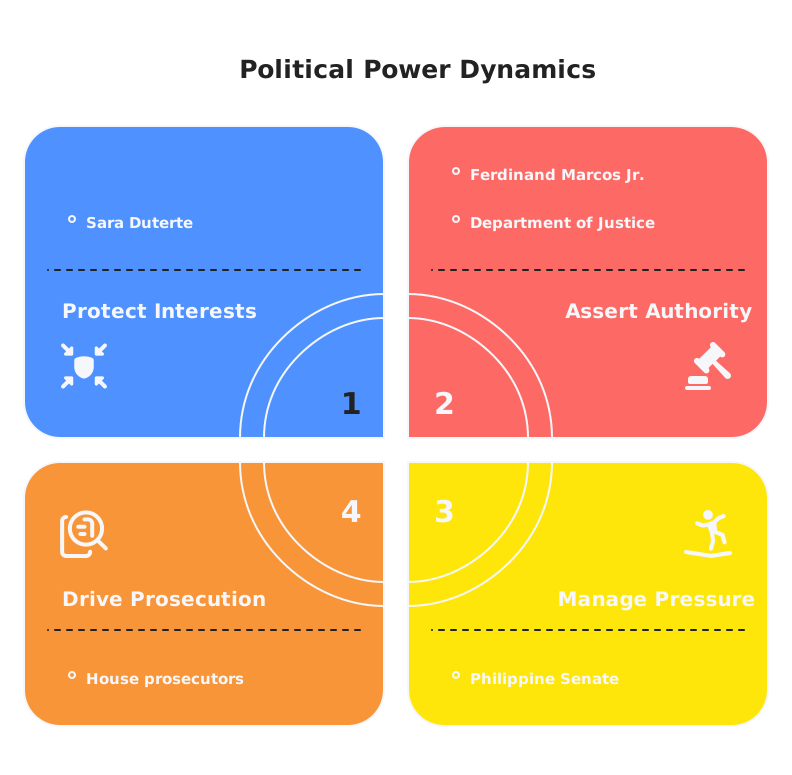
The network of interests below shows that what looks like a legal case is just as much a struggle for institutional control.
| Entity | Current rule | New rule | Effective date |
|---|---|---|---|
| Department of Justice | Criminal prosecution can run concurrently with impeachment; prima facie evidence standard. | No change | 11 August 2026 (filing) |
| Senate (Impeachment Court) | Sixteen of twenty‑four votes needed to convict and remove from office. | No change | Ongoing |
| Quezon City Regional Trial Court | Hears criminal complaints under the Revised Penal Code; bail for grave threats set at P120,000. | No change | Upon filing |
| Source: Philippine Department of Justice; Revised Penal Code; Senate rules | |||
The Senate impeachment trial’s next procedural move on the grave‑threats article will signal whether lawmakers intend to let the criminal case run in parallel. If they do, the pressure shifts to the court; if they object, the defence gets a sequencing argument that could delay everything.
The fight is over the calendar, not the crime
The mechanism behind the deadlock is structural, not personal. Philippine practice separates impeachment and ordinary criminal enforcement into distinct channels. The Senate can remove an official from office but cannot convict on criminal liability; that is left to the DOJ and the courts. Because no law explicitly bars simultaneous proceedings, both sides are now in a scrum over which institution moves first — and whose clock matters more.
The country’s neighbours are reading the crisis as a signal about Manila’s domestic bandwidth rather than a foreign‑policy shift. Malaysia, Vietnam, and Indonesia are likely to keep public language restrained while watching whether the government’s attention drifts from maritime coordination, ASEAN messaging, and election‑season diplomacy.
A second near‑term marker is whether the DOJ or court clarifies the exact charge count and jurisdictional path in the coming hearing cycle. A standard criminal treatment broadens the legal calendar; a successful procedural objection would turn the dispute into one about admissibility and sequencing — which is precisely where the defence wants it.
The last time a Philippine vice president faced removal was in 2001, when Joseph Estrada’s impeachment trial collapsed into street protests. Duterte‑Carpio’s case may not follow that script, but it is testing the same question: whether the country’s institutions can absorb a political crisis without breaking.
Beyond the headline
The Power Behind It
The real contest is not just over one legal filing, but over which institution gets to define the political timetable. By moving in parallel, the DOJ, the Senate, and the defence are all trying to control whether this becomes a criminal case that can outlive impeachment, or an impeachment fight that frames the criminal case as political retaliation.
The Bigger Picture
This is a test of whether Philippine dynastic conflict can be processed through institutions without either camp losing legitimacy in the process. The deeper story is that legal proceedings are now functioning as the main arena for elite competition, which means procedural victories may matter as much as final judgments.
The Timing
The timing is sharpened by the overlap between a fresh criminal filing and an active impeachment calendar. That convergence raises the stakes because each new hearing can alter the public narrative before the next one begins, making delay, sequencing, and courtroom posture politically valuable in their own right.
The next 90 days will frame the 2028 race
With the dual proceedings now active, the calendar will determine whether the legal track becomes a permanent feature of the election cycle.
- US State Department official monitoring Indo‑Pacific stability
Assess how prolonged political distraction affects military basing agreements, joint exercises, and regional cooperation. The U.S. Embassy Manila website and the State Department’s Philippines travel advisory page should be checked this week for any security or political‑disruption guidance.
- Western business operator with Philippine market exposure
Evaluate current investment plans and operational timelines for potential delays or increased regulatory uncertainty. Any slowdown in permitting or procurement could hit sectors dependent on government approvals, so monitor the Philippine Department of Justice and Senate impeachment updates for hearing schedules within 48 hours.
- International human rights advocate focused on Southeast Asia
Monitor the fairness and transparency of both proceedings, paying close attention to whether the dual‑track approach respects due‑process guarantees. Watch for any signals from the UN or regional bodies about adherence to international legal standards in politically charged cases.
- Academic researcher specializing in Philippine political dynamics
Analyse how the parallel legal and impeachment tracks reshape elite power struggles. The case offers a live test of institutional resilience and could redefine the interplay between law and patronage politics ahead of 2028.
FAQ
What punishment could the grave‑threats charge bring?
The charge was filed under Article 282 of the Revised Penal Code and tied to the Cybercrime Prevention Act. If convicted, Duterte‑Carpio faces ordinary criminal penalties including imprisonment, not only political fallout. The reported bail of P120,000 indicates the court is treating it as a bailable offence at this stage.
Why does the impeachment vote threshold matter?
A Senate conviction requires at least 16 of 24 senators. That number determines whether Duterte‑Carpio is merely sanctioned or removed from office and barred from elective politics. Because the chamber holds the power to end her vice presidency, the count remains the decisive political question.
Can the criminal case run while the impeachment trial continues?
UP law professor Dante Gatmaytan says yes — nothing in Philippine law requires impeachment to finish first. That makes the question one of timing and forum, not a settled constitutional bar. The defence’s objections are therefore likely to focus on sequencing and jurisdiction, not the underlying facts.
Explainer
- Article 282
- A provision of the Philippine Revised Penal Code that defines and penalises “grave threats.” It covers threats to commit a crime amounting to a felony, and in this case carries a reported bail of P120,000. The law has been used before in politically charged complaints, making it a familiar yet contested tool in elite legal battles.
- Senate impeachment court
- The Philippine Senate, when sitting as an impeachment tribunal, has the sole power to try and decide all cases of impeachment against the president, vice president, and other high officials. A conviction requires a two-thirds vote — 16 of 24 senators — and results in removal from office and disqualification from holding any public office. The chamber’s dual role as a legislative body and a court makes its procedural choices intensely political.
- Prima facie evidence
- A legal standard meaning that, at first look, enough evidence exists to support a charge unless rebutted. In Philippine criminal procedure, a prosecutor must find prima facie evidence to file a case in court. The DOJ’s claim of having reached this threshold is the official justification for moving ahead against the vice president.
- Cybercrime Prevention Act
- Republic Act 10175, enacted in 2012, criminalises offences committed through information and communications technology. Reports indicate the DOJ tied the grave‑threats filing to this law, which could elevate the penalties if the threatening remarks were made online or through digital platforms. The act has often been invoked alongside traditional penal code charges in politically sensitive cases.
RELATED STORIES