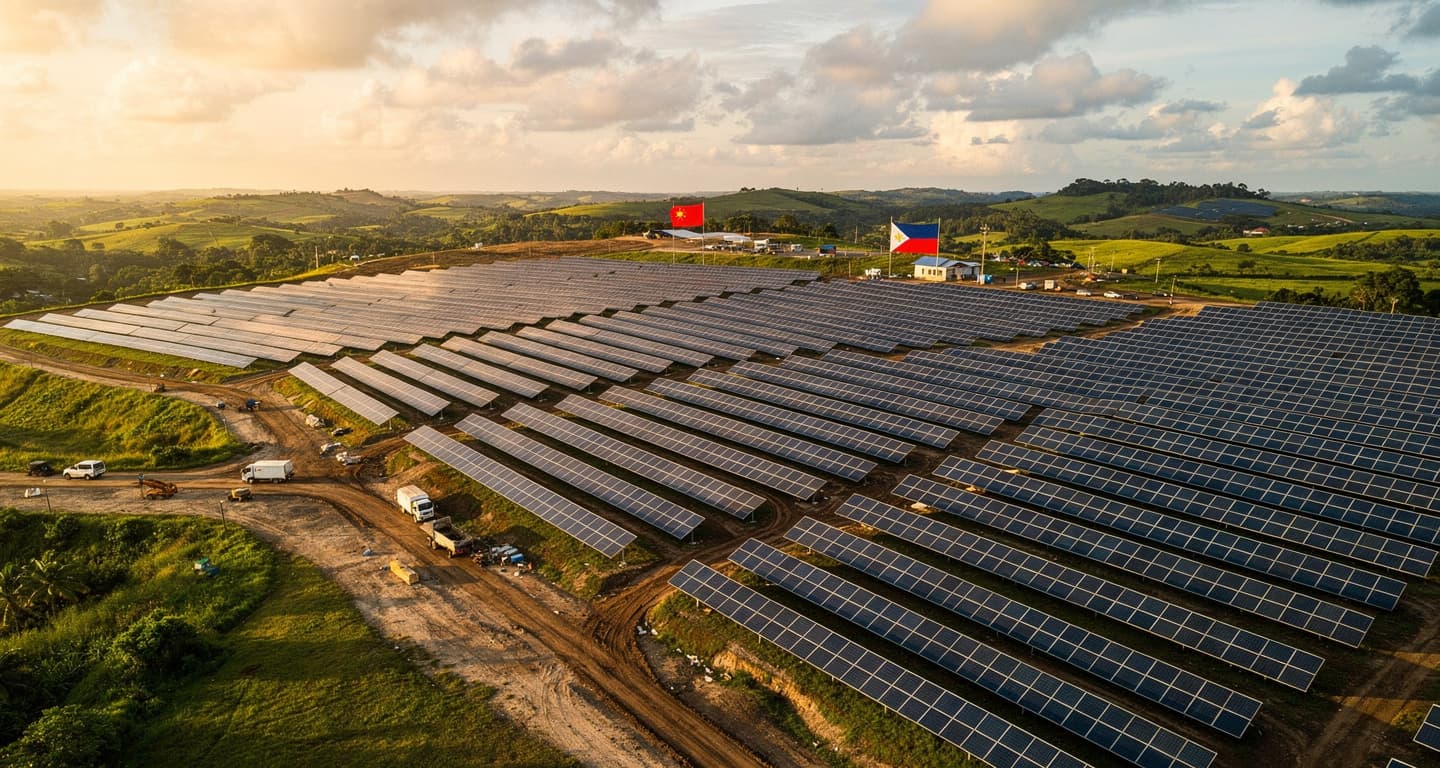
President Ferdinand Marcos Jnr has assembled a $170 billion infrastructure program to lure manufacturers fleeing China. The incentives include tax breaks of up to 40 years. And in the first half of 2026, the Philippine Economic Zone Authority approved PHP 140 billion in investments — the most in a decade.
Verisk Maplecroft named the Philippines a supply chain “rising star” but flagged persistent governance and infrastructure gaps. Whether those gaps close faster than Vietnam and Malaysia are winning factories will decide if the legislative blitz turns into plant openings.
The Philippines has passed the laws. Now it has to build the ports, railways, and power plants — and do it faster than Vietnam and Malaysia, which captured earlier waves of the supply chain shift, are consolidating their manufacturing ecosystems.
With more than 200 infrastructure projects underway, Manila is betting $170 billion that it can outpace its neighbors. But the same analysis that calls the Philippines a supply chain “rising star” warns that governance gaps and lagging infrastructure could still keep factories from landing. The window will not stay open long.
Laws cannot pour concrete
The PEZA approved PHP 140 billion in the first half of 2026. Its full-year target is PHP 300 billion — the strongest performance in more than a decade. Tereso O. Panga, PEZA’s director general, says the 52‑million‑strong workforce and English proficiency are the raw draw. “If we’re unable to provide them areas, just like that, we lose out,” Panga said.
The centerpiece is Build Better More — more than 200 projects worth $170 billion, from railways linking Clark to Manila to a new international airport. Qualified investors can lock in tax breaks stretching up to 40 years. Foreign ownership limits in renewable energy have been scrapped entirely. Land leases now stretch to 99 years. For Western expats running businesses, these terms make holdings more bankable — but only if they keep corporate ownership rules and PEZA permits in order and watch for amendments to the PEZA law that could shift approval pathways.
Economist Ronilo Balbieran of the University of Asia and the Pacific warns that logistics bottlenecks and paper‑based processes still inflate costs. The digital push is slow. Cristina A. Roque, the trade secretary, says the government is hunting investors who will build industries and upgrade infrastructure, not just park capital.
The incentives are generous. The question is whether power grids and customs systems can be upgraded before boardrooms commit to Hanoi or Kuala Lumpur instead.
Ports, power, and the clock
If PEZA hits its PHP 300‑billion target by early 2027, the reforms will have proof. If it misses, questions over zone readiness and competitiveness will sharpen. Marcos’ Singapore trip in 2026 drew representatives from 14 firms spanning logistics, private equity, and digital technology. Interest is high — but confirmed investments are still thin.
Philippine policy now outpaces many peers in openness. The country allows 100 percent foreign ownership in renewables, 99‑year leases, and enjoys trade agreements with Japan and South Korea. Yet grid reliability and bureaucratic delays remain the unglamorous risks that investors must price into any deal. The competition is already playing out in electric vehicles, where both Thailand and the Philippines saw a surge of Chinese EV imports in 2025‑2026.
The legislative reforms have drawn the map. The next 18 months will show whether the Philippines can build roads fast enough to keep the factories coming. For now, it is the candidate with the most to prove, not the one with the factory.
Beyond the headline
The Bigger Picture
The contest is no longer about who offers the lowest taxes or cheapest labor. It is about which state can rapidly convert legislative reform into functioning industrial corridors, reliable power, and digital infrastructure. The Philippines’ push shows how Southeast Asian governments are racing to become nodes in a distributed “China Plus One” production map — where execution speed and institutional capacity beat headline incentives.
The Timing
The Philippines’ window is defined by the investment committee cycles of multinationals rewriting supply chains. If infrastructure delivery lags over the next two years, boardrooms will lock in long‑term capacity in Vietnam and Malaysia, leaving Manila a latecomer to this wave.
The Reach
The mechanism is the Luzon Economic Corridor and its network of economic zones linking ports, airports, and data centers. If this spine functions, it could add a scalable, English‑speaking base to global supply chains alongside Vietnam and Malaysia. If grid and permit delays persist, Western capital will treat the Philippines as a niche hub, not a core production center.
Four decisions for different money
With the Philippines racing to convert laws into infrastructure, each type of investor faces a distinct calculus.
- Western manufacturer considering Southeast Asia relocation
You need to weigh new incentives against the reality of logistics and power. PEZA’s own director general warns that failing to provide industrial land will lose deals. Before committing, check the list of PEZA zones that align with your sector, track upcoming amendments to the PEZA law via the Philippine legislation portal, and model the cost of backup power generation.
- US‑based investor with APAC emerging market exposure
The PHP 300‑billion PEZA target matters. If hit, it validates that reforms are translating into projects. Focus on the Luzon Economic Corridor and New Clark City, where infrastructure spending is concentrated. Cross‑check official communications from the Department of Trade and Industry and Presidential Communications Office with your own country‑risk assessments before committing to manufacturing or data‑center plays.
- Western expat business owner in the Philippines
The 99‑year land lease and full foreign ownership in renewables reshape your operational stability. Confirm your corporate structure complies with ownership rules, secure long‑term lease contracts registered with land authorities, and monitor PEZA law amendments that could alter approval processes. The payoff is more bankable holdings — the risk is getting caught in a governance gap.
- Supply chain manager for a multinational corporation
Conduct due diligence on the actual state of Philippine infrastructure. Logistics bottlenecks and paper‑based processes persist, warns economist Ronilo Balbieran. If your China Plus One strategy depends on speed, model lead times from port to factory floor and check whether grid capacity can absorb your load. The laws have changed; the roads and power lines have not — yet.
FAQ
What steps must investors take to use the new 99‑year land leases?
Foreign investors must structure holdings through compliant Philippine entities, secure long‑term lease contracts registered with appropriate land authorities, and align with PEZA or local zoning rules where industrial parks are involved. Contracts should include termination, step‑in, and renewal clauses to guard against political or regulatory changes over multi‑decade horizons.
How do tax incentives interact with sector eligibility?
The revised incentive system offers up to 40 years of combined tax and non‑tax benefits primarily for priority sectors — advanced manufacturing, renewable energy, digital infrastructure — located in economic zones or strategic corridors. Investors should confirm eligibility criteria with PEZA or the Board of Investments, as benefits vary by sector, project size, export orientation, and compliance with performance milestones.
What does 100% foreign ownership in renewables mean for industrial power sourcing?
Western manufacturers can co‑develop or contract directly with renewable power producers, improving long‑term price visibility and sustainability credentials. However, they must still navigate grid connection constraints, transmission backlogs, and Energy Regulatory Commission approvals. Power‑purchase agreements should factor construction timelines and potential delays in integrating new capacity into the main grid.
Explainer
- PEZA
- The Philippine Economic Zone Authority grants incentives to firms locating in designated zones. It approved PHP 140 billion in investments in the first half of 2026, aiming for PHP 300 billion for the year. That would be the strongest annual figure in more than a decade, signalling momentum behind the government’s reform push.
- Build Better More
- The Marcos administration’s flagship infrastructure program, with over 200 projects valued at an estimated $170 billion. It includes railways, seaports, airports, and power generation to support industrial growth and connectivity. The program is central to Manila’s pitch that the Philippines can physically absorb a wave of new manufacturing investment.
- Luzon Economic Corridor
- A planned logistics spine linking Subic Bay, Clark, Manila, and Batangas. It aims to integrate ports, airports, and data centers into a single network to attract export‑oriented manufacturing and technology hubs. If built on schedule, it could reshape the Philippines’ position in regional supply chains; delays would keep investment concentrated in traditional clusters like Vietnam and Malaysia.
- China Plus One
- A corporate strategy of diversifying production bases beyond China to mitigate supply‑chain risk. Southeast Asian nations are competing to capture this shift, with Vietnam and Malaysia securing earlier waves. The phrase frames the Philippines’ current bid: it is vying to become the “one” for manufacturers seeking a large, English‑speaking alternative.
RELATED STORIES