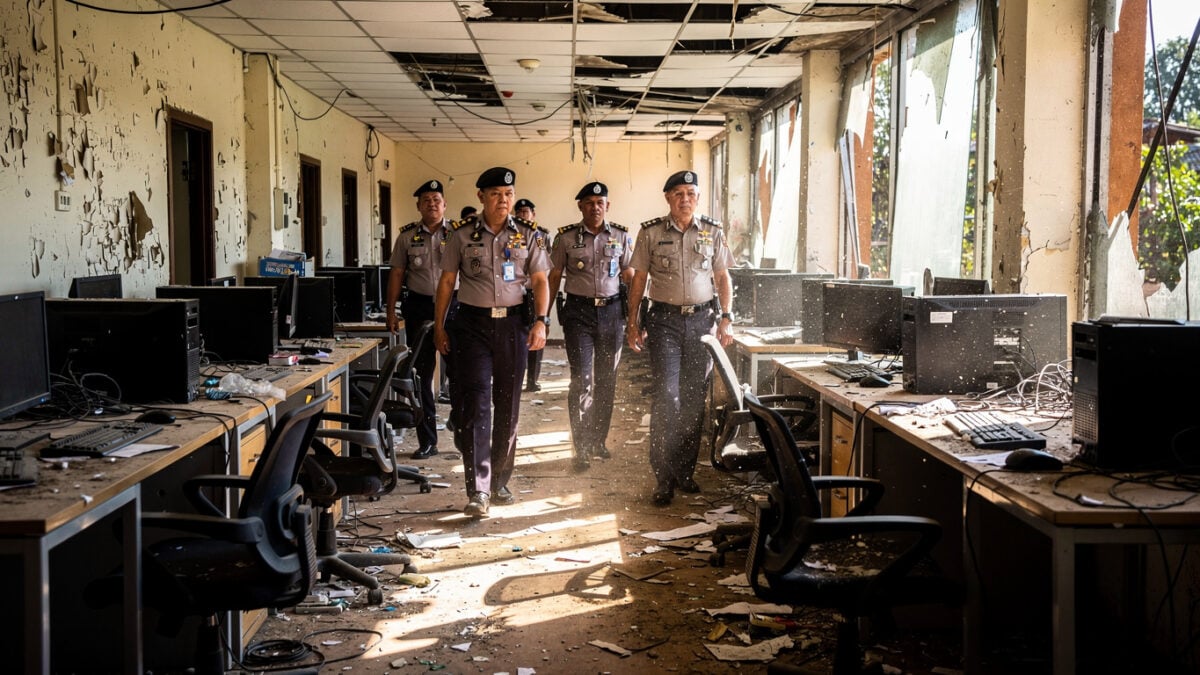
Cambodia opens its first International Conference on Combating Online Scams in Phnom Penh on September 23, 2026, claiming the dismantling of large-scale compounds and the freezing of over US$300 million in assets. The government presents the two-day summit, backed by UNODC and Interpol, as proof of a successful house-cleaning.
The conference arrives under a shadow. US lawmakers estimate scam profits reached 60 percent of Cambodia’s formal GDP, and critics argue the crackdown has left the political and financial networks that enabled the industry largely untouched.
The numbers Cambodia will present this week are designed to close a chapter. Large-scale scam compounds have been dismantled. More than US$300 million frozen. Tens of thousands of foreign nationals deported. Prime Minister Hun Manet, opening the country’s first international conference on online scams on September 23, will call it cleaning the country’s own house.
The house, however, still has its wiring. The same week, a letter from US lawmakers landed in Washington, estimating that the profits from those compounds had reached as much as 60 percent of Cambodia’s formal GDP — a figure that makes the frozen assets look less like a victory and more like a rounding error. The question hanging over the Phnom Penh conference is not whether Cambodia can clear a site. It is whether it can, or will, touch the people who collected the rent.
The sanctions that named the system
The most precise map of who benefited from Cambodia’s scam economy was not drawn by Phnom Penh. It came from the US Treasury, which on April 23 sanctioned Kok An, a Cambodian senator and tycoon, along with 28 people and entities in his network. The designation, under Executive Order 13694, blocks any property they hold in the United States and bars US persons from dealing with them. Thailand had already issued an arrest warrant for Kok An, who is known to be close to former prime minister Hun Sen.
The US Treasury designated Kok An for allegedly controlling scam compounds. The sanctions were a signal, but they also exposed a structure. The Treasury’s action did not target a rogue operator at the edge of the economy. It named a senator with deep political ties, and the network around him. Last week, US lawmakers widened the aperture, writing to Treasury Secretary Scott Bessent and Secretary of State Marco Rubio to examine several other Cambodian tycoons, provincial officials, and government figures for sanctions eligibility. House Foreign Affairs Committee Chairman Brian Mast put the profit estimate in that letter: up to 60 percent of GDP.
The UK is moving on a parallel track. On the sidelines of the conference, it will sign a memorandum of understanding with Cambodia on intelligence sharing, financial and digital investigations, and victim protection. UK Minister of State David Hanson described the agreement as a practical mechanism for “sharing intelligence, tracing dirty money, and above all protecting the people.” According to the UK Home Office, the UK froze more than £125 million in assets linked to the Prince Group network in October 2025, including a £12 million north London mansion and a £100 million City of London office building.
The gap between these external actions and Cambodia’s own accountability measures is what critics are watching. Jacob Sims, a visiting fellow at Harvard University’s Asia Centre, argues the conference risks functioning as international validation for a claimed victory before the financial beneficiaries and political enablers of the scam economy have been fully pursued. “The elite now seem willing to cut losses after reputational harm,” he said, but warned the centres would reopen without accountability over missing money and unrelenting outside monitoring.
| Entity | Current rule | New rule | Effective date |
|---|---|---|---|
| US Treasury | No sanctions on Kok An network | Sanctions on Kok An and 28 entities under EO 13694 | April 23, 2026 |
| UK Home Office | Ad-hoc cooperation with Cambodia | MoU on intelligence sharing, financial investigations, and victim protection | September 2026 |
| US Congress | No formal scrutiny of additional Cambodian elites | Letter requesting sanctions eligibility review for multiple tycoons and officials | September 2026 |
| UK Treasury | No asset freezes on Prince Group | £125 million in assets frozen, including London properties | October 14, 2025 |
| Source: US Department of the Treasury, UK Home Office | |||
A crackdown that stops at the ledger
The official results are not invented. Cambodia’s anti-scam commission has sent 446 cases involving 3,927 suspects to court, and four cases involving 15 officials are under investigation for alleged involvement in scam activity. Hay Makara, a member of that commission, said authorities dismantled every large-scale compound they identified. But he also noted that networks are moving into smaller, more dispersed settings — rental homes, hotels, vehicles. The visible target is gone. The activity is not.
What the campaign has not produced is a transparent accounting of where the billions went. The US$300 million in frozen assets is a figure. The 60-percent-of-GDP estimate from Congress is another. Between them sits a question no conference agenda can answer: whether the frozen funds represent the proceeds of the wider networks, or only the portion authorities could identify domestically. Western sanctions have already shown that Cambodian-linked wealth sits in overseas property and corporate structures. Tracing it requires ownership transparency and cooperation that extends well beyond Phnom Penh.
Mu Sochua, president of the Khmer Movement for Democracy and a former opposition lawmaker, calls the conference political theatre while the system protecting scam compounds remains intact. She argues the raids target only the lowest tier — victims forced into cyber-slavery and low-level operators — while high-level bosses, politically connected tycoons, and complicit officials who leased land, granted security, and collected proceeds remain untouchable. The evidence that would refute her claim — prosecutions of those enablers, court records showing asset recovery from elites — has not yet appeared.
Beyond the headline
The power behind it
The decisive power is not in the conference hall. It sits in the institutions that control land, licensing, policing, and financial access. A crackdown can remove visible compounds while leaving those underlying permissions intact. The credibility test is whether enforcement reaches the system that made industrial-scale fraud possible.
What isn’t being said
The official success narrative counts sites, arrests, and frozen accounts more easily than it measures prosecutions of people who enabled operations or money returned to victims. Physical closure can be reversed. Transparent ownership records, court outcomes, and recovery figures would show whether the campaign has changed incentives. Those numbers are not on the agenda.
The money trail
The central financial question is whether frozen assets represent the proceeds of the wider networks or only the portion authorities can identify domestically. Western sanctions have already shown that Cambodian-linked wealth can sit in overseas property and corporate structures. Asset recovery depends on ownership transparency and cooperation beyond Phnom Penh — neither of which the conference is mandated to deliver.
The conference outcome that matters
With the summit’s outcome document expected on September 24, and sanctions pressure from Washington and London intensifying, four groups face distinct decisions.
- US-based investor with APAC emerging market exposure
The alleged scale of scam proceeds — potentially 60 percent of Cambodia’s GDP — and their laundering through Cambodian banks raises questions about the stability of the country’s financial institutions. You should reassess risk exposure to Cambodian financial assets and entities, particularly those with opaque ownership structures. Review the US Treasury’s OFAC sanctions notice on Kok An and its linked entities before conducting any transaction involving Cambodian counterparties, payment firms, or property structures connected to the designated network.
- Western financial crime compliance officer
US and UK sanctions against Cambodian entities, coupled with the new UK-Cambodia MoU on intelligence sharing, directly impact your transaction-screening obligations. Update your compliance protocols to reflect the new sanctions lists and enhanced due diligence requirements for Cambodian counterparties, especially those with complex ownership structures or ties to politically exposed persons. Check the UK Home Office and UK Sanctions List for updates to the Cambodia memorandum and Prince Group-related designations before making cross-border payments.
- European tour operator with Southeast Asia packages
The ongoing issue of online scam operations and human trafficking, even if decentralised, can affect Cambodia’s reputation as a safe destination. Monitor the effectiveness of the anti-scam efforts and consider how to address potential customer concerns about safety and ethical tourism in your marketing and operational planning. The conference’s victim-protection language may offer material for responsible-tourism messaging if it translates into verifiable action.
- NGO worker focused on human trafficking in Southeast Asia
The crackdown has led to the deportation of tens of thousands of foreign nationals, many of whom were trafficking victims. The conference’s focus on victim protection may or may not translate into effective support. Assess the adequacy of reintegration programs in Cambodia and neighbouring countries, and advocate for independent monitoring of trafficking survivors. The UK-Cambodia MoU’s victim-protection provisions are a starting point, but their implementation will require sustained outside scrutiny.
Explainer
- Kok An
- A Cambodian senator and tycoon sanctioned by the US Treasury in April 2026 for allegedly controlling scam compounds. His network of 28 people and entities was designated under Executive Order 13694, blocking their US-based property and transactions. He is known to be close to former prime minister Hun Sen, and Thailand had already issued an arrest warrant for him before the US action.
- UNODC
- The United Nations Office on Drugs and Crime, a global body that supports member states in combating illicit drugs, organised crime, and terrorism. Its July 2026 report estimated scam losses in East Asia, Southeast Asia, Australia, and New Zealand at US$88.3 billion to US$114.1 billion for 2025 alone. The agency is co-sponsoring the Phnom Penh conference alongside Interpol.
- Executive Order 13694
- A US presidential order authorising sanctions against individuals and entities engaged in significant malicious cyber-enabled activities. Amended over time, it allows the Treasury to block property and interests in property of designated persons within US jurisdiction. The April 2026 designation of Kok An and his network was made under this authority.
- Prince Group
- A Cambodian conglomerate sanctioned by the UK and US in October 2025 for its role in operating scam centres across Southeast Asia. The sanctions froze UK-based assets worth more than £125 million, including a £12 million mansion in North London and a £100 million office building in the City of London. Its chairman, Chen Zhi, was also designated.
RELATED STORIES


