More than 1,446 people are confirmed dead and 6,669 missing after a 26 August glacier collapse sent a catastrophic flood through the Nepal–Tibet border region. Nepal is seeking US$20 million from the UN’s loss-and-damage fund, framing the disaster not as a natural tragedy but as a climate justice debt.
The physical toll is only part of the picture. For young Nepalis, the flood has triggered a psychological crisis that is only beginning to be measured — and for which support is almost entirely absent.
Alina B.K. could not focus on her university exams. The 21-year-old forestry student and coordinator of the Pokhara network of Nepalese Youth for Climate Action watched the death toll rise after the 26 August glacier collapse, and the numbers — more than 1,446 dead, 6,669 missing — made her course material feel remote. The disaster was not abstract; it had swallowed roads, schools, and whole transit towns along the Nepal–Tibet border. Her anxiety was not about a future climate. It was about the one she was living in.
The flood that tore through the Lhende, Bhote Koshi, and Trishuli river systems was the deadliest Himalayan slope failure in memory. For young people in Nepal, it collapsed the barrier between distant climate projections and immediate fear. “With the floods and deaths happening around us, it is really hard not to feel anxious and emotionally overwhelmed,” B.K. said. She coordinates the Pokhara network of Nepalese Youth for Climate Action. Her testimony, gathered in the disaster’s aftermath, opens a window onto a less visible consequence: a generation learning that the ground beneath them can give way, and that the global systems meant to protect them will not arrive in time.
A future crushed by ice and water
The 26 August event was not a simple flood. A rapid scientific assessment by the World Weather Attribution network describes a multi-stage rock–ice avalanche that began around 5,200 metres on Langtang Lirung. Decades of glacier thinning — about 0.5 metres per year — and more than 300 metres of glacial retreat since 2010 primed the slope. When it failed, the cascade of rock, ice, and water travelled through three river systems with force that erased villages. “There is no doubt that climate change is one of the factors that drove the disaster,” said Friederike Otto, climate scientist at Imperial College London and co-founder of WWA.
Downstream, the numbers are only now settling into something like a final count. Nepal’s disaster authority reports 1,403 bodies recovered on its side of the border and 6,150 people still listed as missing across affected districts, according to regional reporting. Combined with Chinese figures, the confirmed death toll stands at about 1,446, with at least 6,669 missing. A joint government assessment estimates nearly 33,000 people displaced from more than 8,300 families across five districts. Around 4,000 have relocated to Kathmandu.
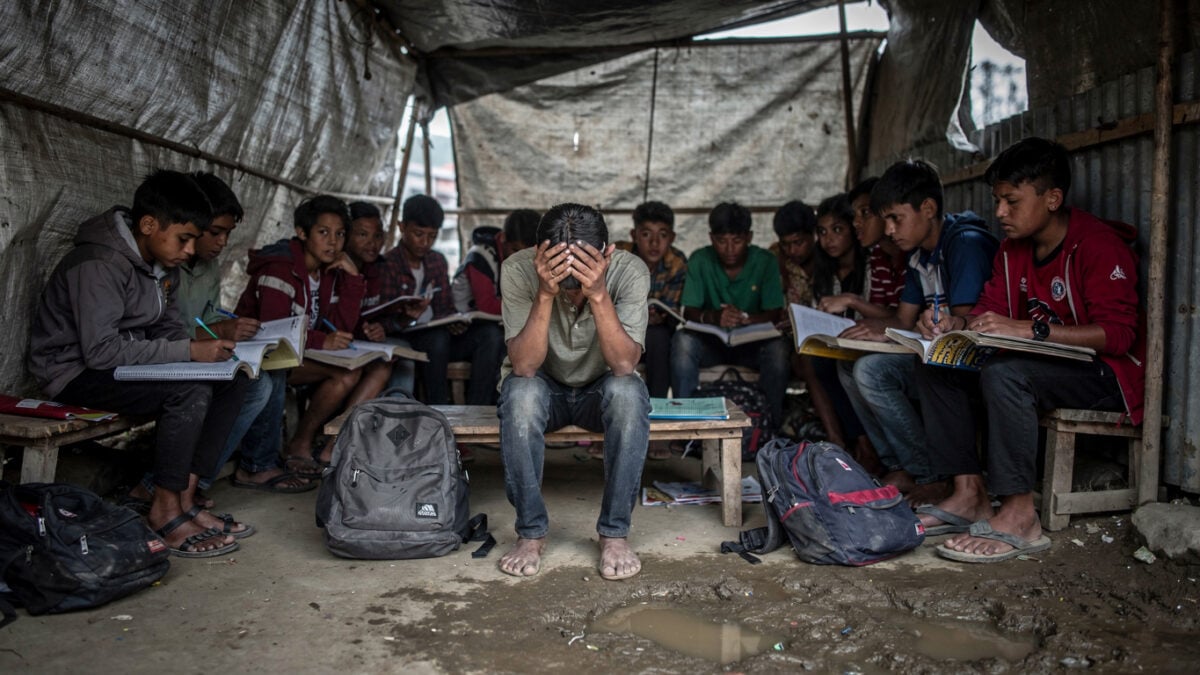
For children who witnessed the wall of water, the psychological cost is mounting. Save the Children staff in Rasuwa and Nuwakot districts report nightmares, fear of returning to school, and persistent anxiety about another flood. Children in temporary shelters told aid workers they were scared of future floods and anxious about returning to school. The organisation is running child-friendly spaces with psychosocial counsellors, but its teams describe a need that far outstrips what a few short-term projects can provide.
What makes the psychological burden so acute is the gap between Nepal’s contribution to the problem and its exposure to the consequences. The country produces roughly 0.1% of global greenhouse-gas emissions. China, by comparison, accounts for roughly 25.9%; the United States 11.1%; India 7.8%. The ice that collapsed had been thinning for decades. The carbon that thinned it came from elsewhere.
An unbearable gap
The flood did more than destroy infrastructure. It shattered a particular kind of faith — the belief, held by many young, educated Nepalis, that their future was something separate from the country’s geography. Madhukar Upadhya, a watershed management expert in Nepal, has argued that changing climate combined with low human development is making life in rural mountain communities extremely difficult. According to his assessments, displaced families from the August floods face long-term livelihood and psychological challenges, not just short-term displacement.
That view is now reaching international climate diplomacy. Nepal is seeking about US$20 million from the UN-backed Fund for Responding to Loss and Damage, framing the catastrophe through the loss-and-damage agenda rather than traditional humanitarian aid. The request explicitly links the disaster to climate justice arguments about low-emitting, highly exposed countries. It is a claim not only for money but for recognition that the psychological cost — the anxiety, the lost concentration, the future that feels stolen — is a compensable harm.
Manjeet Dhakal, a Nepali climate activist, contends that the scale of the August disaster is testing Nepal’s response capacities and shows the country is reaching the limits of adaptation. For a 21-year-old like Alina B.K., that conclusion is not a policy insight. It is the reason her exam notes blurred. The glacier collapse was made inevitable by rising heat — and the heat was made elsewhere. The gap between those two facts is where the dread lives.
Beyond the headline
The human cost
The catastrophe on the Nepal–Tibet border has turned everyday routines into sources of dread for young people who survived or watched the disaster unfold from afar. For displaced students now attending new schools in Kathmandu, lessons take place in temporary structures while classmates and teachers remain missing. Youth activists such as forestry students and local organisers are grappling with the sense that exam schedules, career plans and community ties can be erased overnight by hazards they did not create.
The bigger picture
The flood and its psychological aftermath reveal how Himalayan climate risks are now cascading through educational and social systems as much as physical landscapes. Glacier retreat and permafrost thaw are destabilising mountains at the same time that Nepal’s development model concentrates roads, hydropower and border trade in narrow valleys. When that infrastructure fails, whole networks of schools, labour migration and cross-border commerce unravel, leaving young people facing both immediate trauma and a structurally uncertain future.
What isn’t being said
Most coverage focuses on casualty counts and dramatic images of destroyed towns, but far less attention goes to the thin mental-health safety net available to young Nepalis in disaster-affected areas. Counselling and psychosocial services are often provided by a handful of NGOs under short-term projects, while public universities and rural schools lack systematic support for trauma or climate anxiety. Including this gap in the narrative changes the story from one of individual resilience to one of institutional responsibility and investment needs.
The burden moves from the mountain to the mind
With recovery operations ongoing and Nepal’s loss-and-damage request under review, the psychological dimension of the disaster is only beginning to surface. These points matter now.
-
Western NGO worker in South Asia
Review current programme portfolios in Nepal for integration of mental health and psychosocial support into disaster recovery. ReliefWeb’s Nepal flood pages provide updated situational reports and appeal documents that can guide funding requests. The IFRC’s Nepal country page offers information on operations that explicitly include psychosocial components for youth — support for these programmes can help close the gap between short-term counselling and sustained care.
-
Western parent of a university student in Nepal
Investigate what mental health support is available at your child’s institution and in their local community. Universities in Kathmandu have absorbed displaced students, but counselling services remain thin. Discuss with your child what they are experiencing — not only immediate safety concerns but the slower erosion of focus and hope that comes with climate dread. The conversation itself is a form of support that formal systems are not yet providing.
-
ESG investor with South Asia exposure
Evaluate portfolios for exposure to companies or infrastructure projects in Nepal and the wider Himalayan region. The social risk is no longer only physical — the mental health burden on young, educated populations represents a human capital risk that affects long-term economic stability. Corporate social responsibility initiatives should be assessed for whether they include psychosocial support in disaster-affected areas, not only infrastructure rebuilding.
-
Western climate policy professional focused on loss and damage
Use the Nepal case to strengthen arguments that non-economic loss and damage — specifically the psychological toll on vulnerable populations — requires dedicated funding within the UN Loss and Damage Fund. The US$20 million request is a test case for whether the fund will recognise mental health as a compensable climate harm. The Save the Children reporting from Rasuwa and Nuwakot provides concrete, ground-level evidence of what that harm looks like in children.
Explainer
- World Weather Attribution
- A global network of scientists that conducts rapid studies to determine whether and how much climate change influenced specific extreme weather events. Its methods use peer-reviewed models and observational data to calculate the change in probability or intensity of an event in today’s warmer world. The network’s assessment of the Langtang Lirung collapse is the first to explicitly link a Himalayan glacier failure to long-term warming trends in the published record.
- Fund for Responding to Loss and Damage
- A financial mechanism established under the UN climate regime to provide support to vulnerable countries facing impacts that cannot be avoided through adaptation. It addresses both economic losses and non-economic losses, which can include cultural heritage, biodiversity, and mental health. Nepal’s US$20 million request after the August flood is an early test of whether the fund will compensate psychological harm alongside destroyed infrastructure.
- Nepal’s National Disaster Risk Reduction and Management Authority, the government body with formal responsibility for tracking casualties, coordinating rescue and relief, and implementing national disaster risk reduction plans. After the 26 August flood, its early data releases set official baselines for confirmed deaths, missing persons, and displacement. Those figures now shape international appeals and domestic recovery planning.
- Cascading hazards
- A sequence of natural events where one hazard triggers another, multiplying the damage — for example, a glacier collapse that sets off a flood that washes away roads, cutting off access for rescue teams. In the Langtang Lirung case, decades of glacier retreat, permafrost thaw, and prior seismic damage combined to produce a multi-stage rock–ice avalanche. Mountain hydrologist Walter Immerzeel warns that such events signal fundamental shifts in High Mountain Asia’s stability.
- Climate anxiety
- A term describing persistent distress, fear, or dread about the impacts of climate change on one’s life and future. It is increasingly documented among young people worldwide, with a 2021 Lancet survey finding that 59% of respondents aged 16–25 were very or extremely worried. For young Nepalis like Alina B.K., the anxiety is not anticipatory — it is a direct response to having watched a climate-linked disaster kill thousands in their own country.
RELATED STORIES