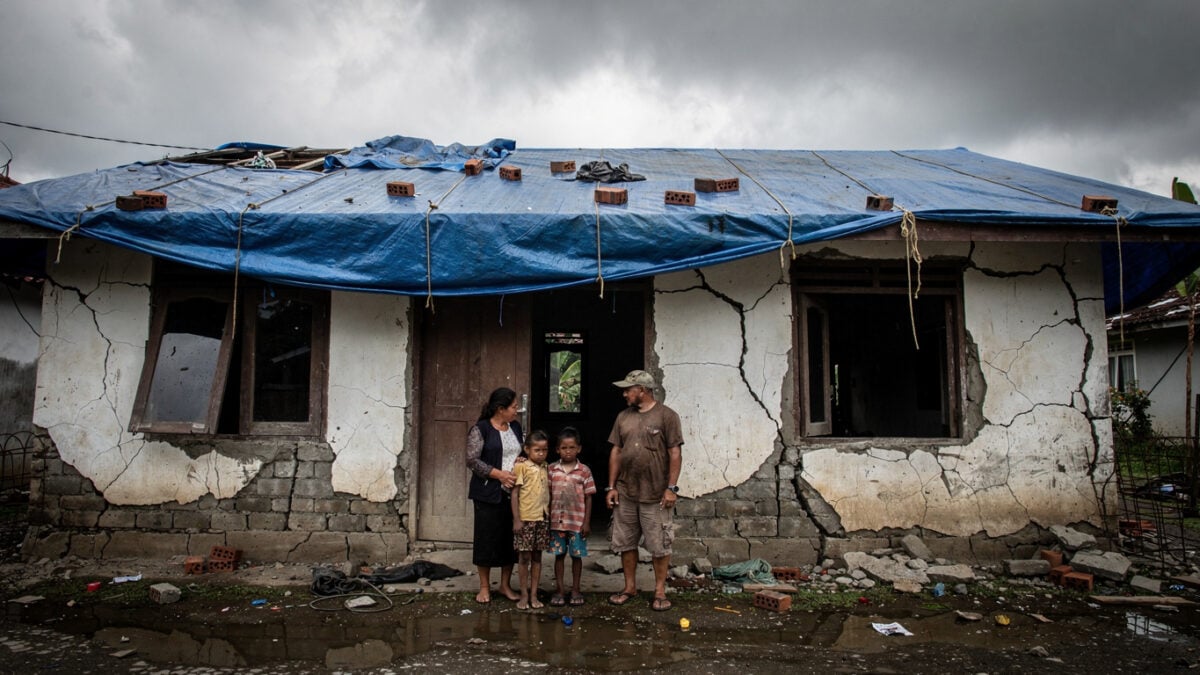
On August 31, a magnitude-5.5 aftershock struck the Flores Sea, 16 days after a magnitude-7.7 earthquake killed 111 people and damaged more than 95,000 homes in Indonesia’s East Nusa Tenggara. As of August 30, 27,414 homes were severely damaged and 188,161 people remained in shelters, with seismic models pointing to elevated shaking into mid-September.
The aftershock caused no reported casualties. The danger lies in the thousands of weakened structures still standing. The sequence has produced over 10,000 aftershocks, and officials warn the risk will persist for at least another two weeks.
Sixteen days after the mainshock, 27,414 homes in Flores are still standing — but only just. The walls that held on August 15 are now cracked and weakened, and every new tremor tests them again. More than 188,000 people are sleeping in shelters, not because the ground is still shaking violently, but because the homes they left might not survive the next moderate jolt.
The magnitude-5.5 aftershock that arrived on August 31 did not add to the death toll. It did not need to. The danger was already built into the structures it shook. Indonesia’s meteorology agency, BMKG, expects significant aftershocks to continue until at least mid-September, keeping the risk live.
The danger is already in the walls
BNPB, the national disaster agency, counted 95,567 damaged homes across seven regencies by August 30. Of those, 27,414 are severely damaged — families who need urgent temporary housing or relocation. Another 21,992 homes have moderate damage, and 46,161 are lightly damaged. The numbers have barely moved in days, because aftershocks keep inspectors from reaching every structure.
The mainshock on August 15 triggered a tsunami with a wave height of 1.61 metres at Reok. The current sequence has now produced over 10,000 aftershocks, 35 of them above magnitude 5 and 157 felt by residents. The daily count has not fallen smoothly: day six rebounded to 802 events, a pattern the ETAS (Epidemic-Type Aftershock Sequence) model attributes to a secondary sequence triggered by an earlier large aftershock.
The sequence below shows how the ground has not yet quieted.
According to a 2024 Earthquake Spectra study by Anne Hulsey and colleagues on reinforced concrete frames, a building that experienced a 4 percent story drift during a mainshock can lose up to 46 percent of its collapse capacity — though how this translates to the mixed masonry and timber construction common in Flores remains less certain. That means a moderate aftershock can finish what the mainshock started.
BMKG and BNPB both advise against re-entering cracked structures until an engineer clears them. Berton SP Panjaitan, BNPB’s acting communications head, said on August 30 that aftershocks had begun to decline but that shocks should still be expected for about three to four weeks after the mainshock. President Prabowo Subianto led a coordination meeting in Nagekeo on August 26, according to the cabinet secretariat, where officials briefed him on the damage and displacement.
| Entity | Current rule | New rule | Effective date |
|---|---|---|---|
| Housing assistance (lightly damaged) | None | Rp15 million (about $817) per home | Announced August 2026 |
| Housing assistance (moderately damaged) | None | Rp30 million (about $1,634) per home | Announced August 2026 |
| Presidential assistance allocation | Regional contingency budgets | Rp200 billion added to NTT and eight districts | August 2026 |
| Post-Disaster Rehabilitation and Reconstruction Plan (R3P) | Ad hoc recovery | Coordinated plan for rebuilding homes, bridges, schools, health facilities | In preparation |
| Source: BNPB, Indonesian Cabinet Secretariat | |||
A slow decay, not a sudden stop
Aftershocks from large shallow earthquakes do not fade quickly. They follow a power law, not an exponential curve. The modified Omori-Utsu law describes a decay where the rate drops sharply at first, then flattens. For a magnitude-7.7 event, the productivity term is large, so activity stays elevated for weeks to months. Bath’s law suggests the largest aftershock could be about one magnitude unit below the mainshock — meaning a magnitude-6.7 or larger event cannot be ruled out.
The Flores Back-Arc Thrust is an active seismic source that has produced large earthquakes before. New national hazard maps for 2025 show high design demands across eastern Indonesia. Regional vulnerability studies for coastal communities in NTT find that at peak ground accelerations around 0.6 g, the probability of slight and moderate building damage approaches 100 percent, with extensive damage reaching roughly three-quarters of the building stock.
Western involvement in the recovery is largely indirect, flowing through international NGOs and multilateral institutions. These channels will shape how quickly and how resiliently Flores rebuilds. The key date band to watch is early to mid-September. BMKG’s geophysics deputy, Nelly Florida Riama, forecast on August 19 that high aftershock activity should decline significantly within 21 to 30 days. If the sequence decays as expected, authorities can begin systematic engineering inspections and accelerated re-entry or demolition. If sizeable shocks continue, temporary shelter demand and logistical risk will persist.
The next BMKG update, expected around mid-September, will tell whether the ground has quieted enough for engineers to begin the real work: deciding which of those 27,414 homes can be saved, and which must come down before the next shake does it for them.
Beyond the headline
The Human Cost
Behind the aggregate figures are families who have now spent more than two weeks sleeping in crowded tents or makeshift shelters, often with limited water and disrupted schooling. In Manggarai and Nagekeo, entire neighbourhoods must weigh whether to keep children near visibly cracked homes or remain in camps as aftershocks persist, stretching social networks and informal care systems that were never designed for months-long displacement.
The Science Gap
Technical models of aftershock decay and structural fragility are sophisticated, but they rarely translate into clear thresholds that rural households can act on. Residents hear that risk will decline within three or four weeks without knowing whether a specific M5 or M6 shock remains plausible or what level of crack or tilt makes a house unsafe. That ambiguity exposes a gap between probabilistic science and the binary decisions communities must make about staying or leaving.
The Response Gap
Indonesia has mobilised thousands of personnel and tons of aid, yet reconstruction planning still lags the pace of seismic activity. Verification of tens of thousands of damaged homes and deployment of earmarked housing funds must compete with continuing aftershocks, limited engineering capacity, and difficult terrain. Until those bottlenecks are resolved, the state’s ability to convert emergency spending into safer, permanent housing will remain constrained.
What the coming weeks demand
With aftershocks expected to continue into mid-September and thousands of damaged homes still standing, different groups face distinct decisions.
- NGO worker operating in East Nusa Tenggara
Reassess field safety protocols against BMKG’s daily aftershock reports at bmkg.go.id. Adjust aid delivery for sustained displacement: shelter materials and water systems will be needed for weeks, not days. Advocate for long-term housing solutions that incorporate seismic resilience, using BNPB’s reconstruction plan as a coordination framework.
- Western investor with Indonesian infrastructure exposure
Evaluate project timelines in Flores and nearby islands for potential delays from road damage and ongoing seismic risk. Factor in higher costs for resilient construction and monitor BNPB’s housing verification process, which will signal when rebuilding contracts are likely to be tendered. The Rp30 million per moderately damaged home sets a baseline for reconstruction spending.
- European tour operator with Southeast Asia packages
Monitor travel advisories from your foreign ministry and check local conditions in Labuan Bajo and Ruteng. The aftershock sequence may disrupt overland routes and create client concerns about regional stability. Adjust marketing to emphasise alternative Indonesian destinations if Flores bookings weaken, and prepare flexible rebooking policies for September.
- Structural engineer specializing in seismic resilience
Analyse damage reports from BNPB and any field reconnaissance from GEER or EERI teams to understand how mixed masonry and timber buildings performed under repeated shaking. The Hulsey et al. fragility curves offer a starting point, but local calibration is needed. Use the Flores sequence to refine post-earthquake re-entry protocols and contribute to Indonesia’s building code updates for aftershock-prone regions.
Explainer
- BMKG
- Indonesia’s Meteorology, Climatology, and Geophysical Agency. It monitors earthquakes, issues tsunami warnings, and provides official seismic forecasts. The agency operates a network of over 400 seismographs across the archipelago.
- BNPB
- Indonesia’s National Disaster Management Agency. It coordinates emergency response, damage assessments, and long-term rehabilitation after disasters. BNPB was established in 2008 following the 2004 Indian Ocean tsunami.
- Flores Back-Arc Thrust
- A tectonic fault zone north of Flores Island where the Australian Plate collides with the Banda Arc. It produced the magnitude-7.7 earthquake on August 15, 2026. The fault has generated several large earthquakes in the past century, including a magnitude-7.8 event in 1992.
- Omori-Utsu law
- A power-law model describing how aftershock frequency decays over time after a mainshock. The modified version includes an exponent p, typically between 0.8 and 1.2, that controls the decay rate. It was first observed after the 1891 Nobi earthquake in Japan.
- Bath’s law
- An empirical observation that the largest aftershock is typically about 1.2 magnitude units smaller than the mainshock. It holds statistically across many sequences but individual events can vary. For a magnitude-7.7 mainshock, a magnitude-6.5 or larger aftershock remains possible.
RELATED STORIES


