Firmus Technologies secured $2 billion in fresh equity at a post-money valuation above $10.5 billion, the Australian AI infrastructure company announced on August 7, 2026. The round nearly doubles its $5.5 billion valuation from April 2026, with follow-on commitments from Nvidia and Coatue Management alongside new backing from Blackstone and Jane Street.
The raise pushes total new equity over the past twelve months past $3 billion. The capital will fund the next phase of Project Southgate, its Australian AI infrastructure buildout, and early work on a newly disclosed campus in Indonesia.
In April 2026, Firmus Technologies was worth $5.5 billion. By August 7, that number had nearly doubled. The re-rating did not come from a new product or a breakthrough model. It came from a widening recognition that the real bottleneck in artificial intelligence is not algorithms. It is the physical layer—power, cooling, land, and the hardware to fill them. Firmus Technologies sits squarely on that bottleneck. The equity round it announced is the largest signal yet that private capital has reached the same conclusion. Nvidia, Coatue, Blackstone, and Jane Street are not betting on a startup. They are buying into a position in the infrastructure layer that most of the AI industry has not yet secured. The deal raises questions about what regional control of compute capacity outside North America could mean for the Asia-Pacific and the broader distribution of AI infrastructure globally.
The re-rating that took four months
The $2 billion commitment pushed Firmus’s total new equity over the past twelve months past $3 billion, according to the company’s August 7 announcement. Nvidia and Coatue, both existing investors, added follow-on capital. Blackstone and Jane Street entered as new backers—Blackstone having already led a $10 billion debt package for Firmus in February 2026.
That is a lot of money for a company most people have never heard of.
Emanuel Ajay Datt, managing director of Datt Group, offered the explanation that private capital has seized on. “The pace at which Firmus has re-rated demonstrates how private capital views AI infrastructure as one of the few capital-scarce opportunities in global markets right now,” he said, as reported by Reuters.
The scarcity is physical.
Firmus is building what it calls AI factories—purpose-built facilities for training and inference, designed around Nvidia’s DSX AI Factory Reference Architecture. The two companies formalised their partnership in late June 2026 through an agreement covering hardware procurement and Nvidia-powered cloud services. The arrangement gives Firmus privileged access to the GPU supply chain at a moment when chip availability determines who can build and who cannot.
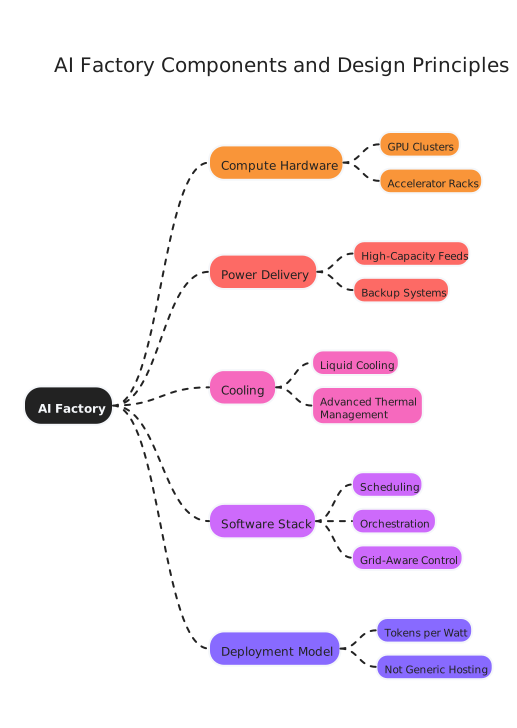
The components that separate an AI factory from a conventional data centre are shown below.
The buildout is not staying in Australia. Firmus disclosed it is preparing a 360MW AI factory campus in Batam, Indonesia, in partnership with Nvidia and DayOne, a data-centre operator. Batam sits 26 kilometres from Singapore—close enough to serve the city-state’s concentrated AI demand without competing for its scarce land and power. The company framed the Indonesia project as early-stage. The location and the partners suggest the strategy is already specific.
The race is now for electricity, not algorithms
The capital flowing into Firmus is part of a larger reordering. AI investment is moving from general-purpose cloud toward infrastructure built specifically for training and inference workloads. The bottleneck is no longer model architecture. It is electricity, cooling, and the land to put them on.
In Asia-Pacific, Singapore remains the demand centre, but its land and power constraints are forcing buildout into neighbouring markets. Australia offers space and renewable energy. Indonesia—particularly Batam—offers proximity without the same physical limits. The competitive advantage goes to operators that can secure electricity, land, and long-term anchor customers first.
Asian institutional investors have been quietly repositioning toward the same conclusion, shifting exposure toward the physical layer of the AI buildout. Western neocloud operators and hyperscaler-adjacent capacity providers face a similar calculus. But APAC winners will be those that solve power and permitting faster than rivals.
Firmus’s model ties it closely to Nvidia’s ecosystem. That is a strength in the near term—privileged access to GPUs is a competitive moat. Over a longer horizon, it means more compute capacity outside the United States can still deepen dependence on one Western chip supplier. The same capital that funds regional independence also reinforces the supply-chain lock-in.
The valuation re-rating was fast. What happens next depends on whether Firmus can convert funding into operating capacity—and whether the customers arrive to fill it. The next twelve to eighteen months will answer both questions. The capital is already committed. The demand is not yet proven.
Beyond the headline
The Money Trail
The deeper story is not just a financing round but the way AI infrastructure is becoming a balance-sheet game. Large private capital groups are stepping in where the bottlenecks are physical: power, land, hardware access, and long deployment cycles. That shifts value away from software margins and toward whoever can finance and operate the capacity.
The Bigger Picture
This deal reflects a broader move from centralized AI computing toward distributed regional buildouts. As model demand grows, countries and companies are trying to avoid complete dependence on US-based compute, which makes local infrastructure a strategic asset rather than a commodity. Australia and nearby APAC markets are now part of that reordering.
The Reach
Nvidia is the actor with the most direct leverage here, because Firmus’s build model depends on its hardware ecosystem and reference architecture. The mechanism is supply-chain lock-in around GPUs and AI-factory design. The non-obvious implication is that more compute capacity outside the US can still deepen dependence on one Western chip supplier.
Four decisions the capital flow forces now
With $2 billion in fresh equity reshaping the APAC AI infrastructure landscape, four groups face choices they did not have to make four months ago.
- US-based investor with APAC emerging market exposure
Reassess whether your portfolio captures the infrastructure layer of AI, not just the application layer. Firmus’s re-rating may lift comparable data-centre and energy-adjacent plays across Australia and Indonesia. Track Blackstone’s infrastructure communications for new APAC compute commitments over the next quarter.
- Western semiconductor procurement manager
The expansion of Nvidia-dependent AI factories in APAC signals growing regional demand for advanced components outside traditional Western hubs. Review your sourcing maps for GPU-class hardware and cooling systems. Lead times may shift as Australian and Indonesian deployments compete for the same supply that feeds North American and European data centres.
- European tour operator with Southeast Asia packages
A 360MW AI factory campus in Batam will draw on local power, water, and construction labour. Monitor project disclosures for environmental impact assessments and infrastructure strain. Changes to the island’s resource profile could affect the appeal of nearby destinations over the next two to three years.
- Western enterprise AI services buyer
Independent APAC compute capacity offers new options for data residency and latency reduction in the region. Investigate whether Firmus’s Nvidia-powered cloud services could diversify your provider mix for APAC operations. The infrastructure is not yet operational, but the contracts that will fill it are being negotiated now.
Explainer
- Firmus Technologies
- Australian AI infrastructure company founded to build and operate large-scale AI factories across the Asia-Pacific region. It partners with Nvidia on hardware and cloud services, and has raised over $3 billion in equity over twelve months as of August 2026. Unlike most AI startups, it does not develop models or applications—it provides the physical compute layer that others run on.
- Project Southgate
- Firmus Technologies’ initiative to develop a network of AI training and inference facilities across Australia. The project targets power-dense campus-style deployments rather than retrofitted data centres. Its rollout timeline and specific site selections have not been publicly detailed beyond the company’s August 2026 funding announcement.
- DSX AI Factory Reference Architecture
- Nvidia’s blueprint for building purpose-built AI computing facilities, covering GPU clusters, networking, cooling, and software orchestration. It standardises the hardware and operational stack so that partners like Firmus can deploy compatible capacity quickly. The architecture locks partners into Nvidia’s ecosystem while giving them a faster path to operating at scale.
- Batam
- An Indonesian island located approximately 26 kilometres south of Singapore, increasingly used as a site for data-centre and industrial development. Its proximity to Singapore makes it attractive for serving the city-state’s AI demand without competing for its constrained land and power. Firmus’s planned 360MW AI factory campus there, in partnership with Nvidia and DayOne, would be among the largest such facilities in Southeast Asia.
- Neocloud
- A category of cloud providers that specialise in renting GPU-accelerated compute for AI workloads rather than general-purpose cloud services. CoreWeave is the most prominent Western example; in APAC, operators like Firmus are adapting the model to regional power, land, and regulatory conditions. The neocloud model competes directly with hyperscalers but typically offers more specialised hardware configurations and pricing.
RELATED STORIES