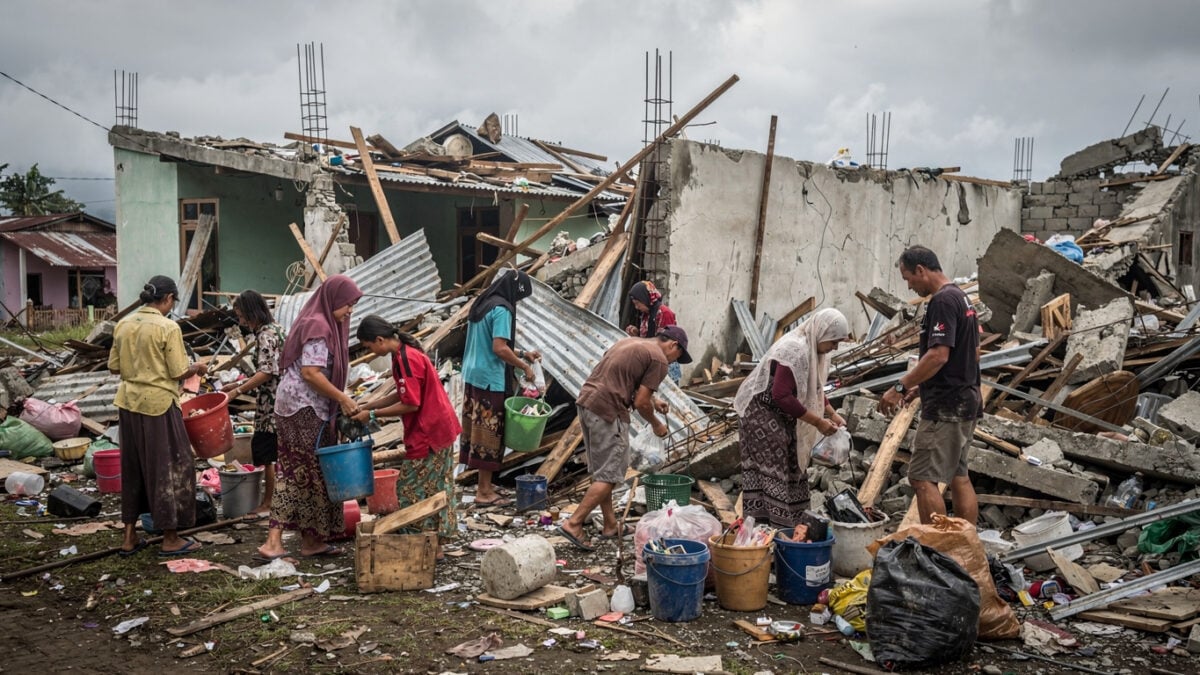
A magnitude-7.7 earthquake struck East Nusa Tenggara on August 15, 2026, killing 111 people. Before the fault moved, Indonesia had already cut the core budget of its National Disaster Mitigation Agency for 2026.
By August 30, 188,161 people were still displaced across seven regencies. The funding baseline, not the president’s visit, is now the central test.
By August 30, BMKG had recorded 9,765 aftershocks in East Nusa Tenggara, with more expected for at least another three weeks. That is the operational reality the BNPB was staffed and funded to manage before the fault moved. That activity is not new for Indonesia, and neither is the risk.
Indonesia sits on the Pacific Ring of Fire, and its state budget had created reserve funds and a dedicated disaster agency. But the 2026 allocation lowered the agency’s core budget before the earthquake hit. The question is not whether the president reached Nagekeo quickly. It is whether the institutions charged with the response could work at the scale the shaking demanded.
The government moved money after the shaking stopped. The platform meant to fix the fiscal response was launched after the damage was counted. What had not been done before August 15 was to fund the agency at the level the hazard data already implied.
The risk had already been measured.
The budget was set first
The 2026 state budget cut BNPB’s core allocation to about Rp491 billion, roughly a quarter of the previous year’s allocation.
The separate national disaster reserve had already been drawn down before the quake. Of the Rp5 trillion allocated for 2025, about Rp2.97 trillion remained at year-end.
After the earthquake, the Ministry of Home Affairs moved an additional Rp200 billion in presidential aid to East Nusa Tenggara. The transfer came through the ministry’s existing regional finance channels.
That lifted total regional contingency funds for the province and eight affected districts above Rp299 billion, from less than a third of the sum before the disaster. The rise sat inside a system that had already been cut.
No ministry has yet published a timeline linking the 2026 core allocation to specific delays in Nagekeo. The causal step remains argued, not documented.
BNPB had counted 95,567 damaged houses by August 30, including 27,414 severely damaged homes. The agency is preparing a reconstruction plan for the families left without them.
Social Affairs Minister Saifullah Yusuf said about Rp14 billion had been allocated for food packages, rice, and cash compensation. Seven communal kitchens were set up across the affected regencies.
Home Affairs Minister Muhammad Tito Karnavian has told regional heads to spend the extra contingency funds quickly, especially in remote villages. The ministry’s acting inspector general, Bachril Bakri, put the instruction plainly: “Uang tambahan BTT harus cepat dipakai untuk masyarakat, terutama di pelosok-pelosok desa.” Translated, the money should be spent quickly for communities, especially in remote villages. Both statements point to the same operational problem.
President Prabowo Subianto reached Nagekeo on August 26, eleven days after the quake, and called the delay deliberate. He said high-profile visits can distract front-line agencies.
The money moved after the fact.
The fiscal fix came late
On August 31, the government launched the ARISE platform under the Ministry of Finance. It combines regional fiscal data, disaster risk information, and early-warning indicators to show how shocks like earthquakes could strain local budgets.
The platform is intended to guide central-government transfers and contingent financing, and it is being piloted in disaster-prone provinces including East Nusa Tenggara. Whether it changes actual disbursement depends on whether its risk scores are linked to budget circulars.
Behind the headline transfers, the costs are spread unevenly. The national disaster reserve funds part of the emergency logistics. Local governments divert their own budgets. Residents absorb income losses and rebuilding costs that formal compensation often does not reach.
BNPB’s Berton S.P. Panjaitan said the agency is preparing a Post-Disaster Rehabilitation and Reconstruction Plan for more than 27,000 families whose homes were severely damaged. The planning does not by itself put a roof over those families.
BMKG Deputy for Geophysics Nelly Florida Riama said the aftershock sequence is declining but will continue for 21 to 30 days. Residents should remain cautious around damaged buildings and landslide-prone slopes.
A dashboard does not shelter anyone.
The aftershocks will taper. The budget lines will not change on their own. The system meant to fix the fiscal response arrived after the shaking exposed the gap, and whether it closes that gap depends on the next budget cycle, not the next aftershock.
Beyond the headline
The bigger picture
Indonesia’s response to the East Nusa Tenggara earthquake sits at the intersection of rising hazard exposure and shrinking core budgets for mitigation. A country logging more than 43,000 quakes a year is simultaneously tightening funds for its main disaster agency while leaning on reserves and ad hoc presidential aid. The deeper question is whether prevention and preparedness can become non-negotiable budget lines rather than residual items cut when other priorities crowd in.
The response gap
On paper, Indonesia can mobilize money from national reserves and emergency transfers; on the ground, displaced families in remote Flores districts still wait for permanent shelter and functioning schools. The gap is less about the absence of tools than about slow execution: complex budget revisions, fragmented damage data, and logistical constraints in mountainous islands delay when aid stops being announced and starts rebuilding lives.
The money trail
The funding chain behind the response runs from national reserves and presidential aid down to village-level spending, but each step carries its own incentives. Central ministries are rewarded for keeping deficit figures lean, regional leaders for showing rapid disbursement, and contractors for securing reconstruction work. Communities often shoulder hidden costs—borrowing to repair homes before subsidies arrive or accepting cheaper materials—because the actors controlling the money are judged more on absorption rates than on long-term resilience.
Four groups now carry the next decision
With aftershocks expected into mid-September and the next budget cycle approaching, four groups with exposure to East Nusa Tenggara face distinct choices.
- Western NGO operating in East Nusa Tenggara
You should monitor BNPB’s emergency dashboard and BMKG open data for real-time displacement and seismic updates. Treat the new ARISE platform as the entry point for aligning longer-term recovery work with government funding, and read the Ministry of Finance documentation before committing. In remote regencies, build buffer time into logistics because official aid is reaching villages at different speeds.
- Western investor with Indonesian infrastructure exposure
You need to re-evaluate seismic risk on any asset in or near East Nusa Tenggara, especially roads, health facilities, and schools. Watch whether ARISE risk scores become tied to central transfers, because that will signal how quickly reconstruction funding reaches regional budgets. If the reduced core agency budget persists, expect residual risk to stay with asset owners and insurers.
- European tour operator with Indonesian packages
You should update client risk assessments for Flores and surrounding islands, where aftershocks are expected into mid-September and damaged roads remain a practical constraint. Communicate any itinerary changes before departure, and hold alternative Indonesian destinations ready for the remainder of the season. Check BMKG notices for the latest seismic advisories.
- Policy analyst tracking disaster finance in Southeast Asia
You should track whether Indonesia codifies ARISE risk scores in budget circulars during the next cycle, since that is the test of whether fiscal planning shifts from reactive transfers to risk-based allocation. Compare the reduced core budget with the previous year’s figure and with disaster spending in other Pacific Ring of Fire countries. The outcome will tell you whether Indonesia is a model or a warning.
Explainer
- BNPB
- Indonesia’s National Disaster Mitigation Agency, the government body that coordinates emergency response and damage assessment. It was established in 2008 to manage disasters under a single command. Its 2026 core budget is roughly a quarter of the previous year’s allocation, a fact at the centre of the current response debate.
- BMKG
- Indonesia’s Meteorology, Climatology and Geophysics Agency. It operates seismic monitoring and issues tsunami warnings across the archipelago. Its aftershock office recorded more than 9,700 events after the August 15 quake, a count that is not final.
- ARISE
- The Adaptive Regional Integrated System for Fiscal Resilience, an Indonesian government platform led by the Ministry of Finance. It combines regional fiscal data, disaster risk information, and early-warning indicators. The system is being piloted nationally, with specific pilots in disaster-prone provinces including East Nusa Tenggara.
- BTT
- Belanja Tidak Terduga, Indonesian for unplanned or contingency budget. Regional governments keep BTT for emergency spending when disasters hit. After the East Nusa Tenggara quake, presidential aid raised total BTT across the province and eight affected districts above Rp299 billion.
RELATED STORIES