Malaysia’s economy expanded 5.8% in the second quarter of 2026, outpacing forecasts, as data centre investments reached a global high of 18% of GDP and semiconductor exports surged. The country now ranks among the world’s four largest net exporters of AI-related hardware, alongside South Korea, Taiwan, and Thailand, according to IMF data.
The growth, however, rests on a political foundation showing cracks. Prime Minister Anwar Ibrahim’s coalition lost seats in an August 2 state election, and fuel subsidy costs could double to RM40 billion this year, threatening the fiscal stability that underpins investor confidence.
Malaysia’s data centre investments now equal a share of GDP that HSBC analysts call a global high. Semiconductor exports are on track to break records. In the first quarter of 2026 alone, the country approved RM92.8 billion in investments across 1,249 projects, expected to create over 50,000 jobs, according to the Malaysian Investment Development Authority (MIDA). Japan emerged as the largest foreign investor with RM21.5 billion, a sharp increase from RM1.6 billion a year earlier.
Yet fuel subsidy costs are on course to double this year, diverting resources from the long-term investments the government has promised. And on August 2, Anwar Ibrahim’s Pakatan Harapan coalition won only 11 of 36 seats in Negeri Sembilan, down from 17 previously, including the defeat of the transport minister. It was the third state-level defeat in a year, landing just as Malaysia’s AI-fuelled economy was delivering its strongest growth in decades. The question the numbers do not answer is whether the political architecture that attracted those investments can hold.
For now, the money keeps arriving. Global tech giants are expanding their footprints. The country’s perceived neutrality has made it a haven for supply-chain relocations. That perception, however, depends on political stability that is no longer a given. The next two years will determine whether the current surge becomes a durable upgrade or a peak that fades when the global AI cycle matures.
The growth is real. The political ground is shifting.
In the first quarter of 2026, Malaysia approved RM92.8 billion in investments across 1,249 projects, according to the Malaysian Investment Development Authority (MIDA). Those projects are expected to create over 50,000 jobs. Data centres and cloud computing accounted for RM34.6 billion of that total, nearly 89% of the information and communications subsector’s approvals.
Japan emerged as the largest foreign investor with RM21.5 billion, a sharp increase from RM1.6 billion a year earlier, reflecting deepening ties under the Malaysia–Japan Comprehensive Strategic Partnership. The United States and China each committed roughly RM10.1 billion.
The same week MIDA released those figures, Anwar’s coalition was losing ground in Negeri Sembilan. Official results showed the Pakatan Harapan coalition secured 11 of 36 seats, down from 17, including the defeat of the transport minister. Earlier losses in Johor and Sabah have compounded uncertainty ahead of the 2028 general election.
According to Lee Heng Guie, executive director of the Socio-Economic Research Center, fuel subsidy outlays could reach RM40 billion in 2026, more than double the budgeted RM15 billion. That would crowd out infrastructure spending precisely when the government is trying to move up the semiconductor value chain.
Malaysia’s National Semiconductor Strategy (NSS), announced in May 2024, aims to capture 7% of worldwide advanced packaging shipments by 2035. The strategy leans on a new Malaysia Advanced Packaging Consortium (MAPC) of five local firms, from chip designers to equipment makers. But moving up the value chain also pulls Malaysia deeper into US-led export-control regimes, notes Amalina Anuar, a fellow at the ISEAS–Yusof Ishak Institute. The US–Malaysia Agreement on Reciprocal Trade (ART) commits Kuala Lumpur to mirror US restrictions on AI-related chips, making it harder to appear neutral to Beijing.
“Demand continues to outpace supply, reinforcing our view that capacity remains the key gating factor,” Apex Research wrote in a recent note, pointing to book-to-bill ratios around 1.5 for firms like ViTrox. Hong Leong Investment Bank Research sees the AI and data centre capex cycle staying intact through the second half of 2026.
The scale of the transformation is easier to see than to describe.
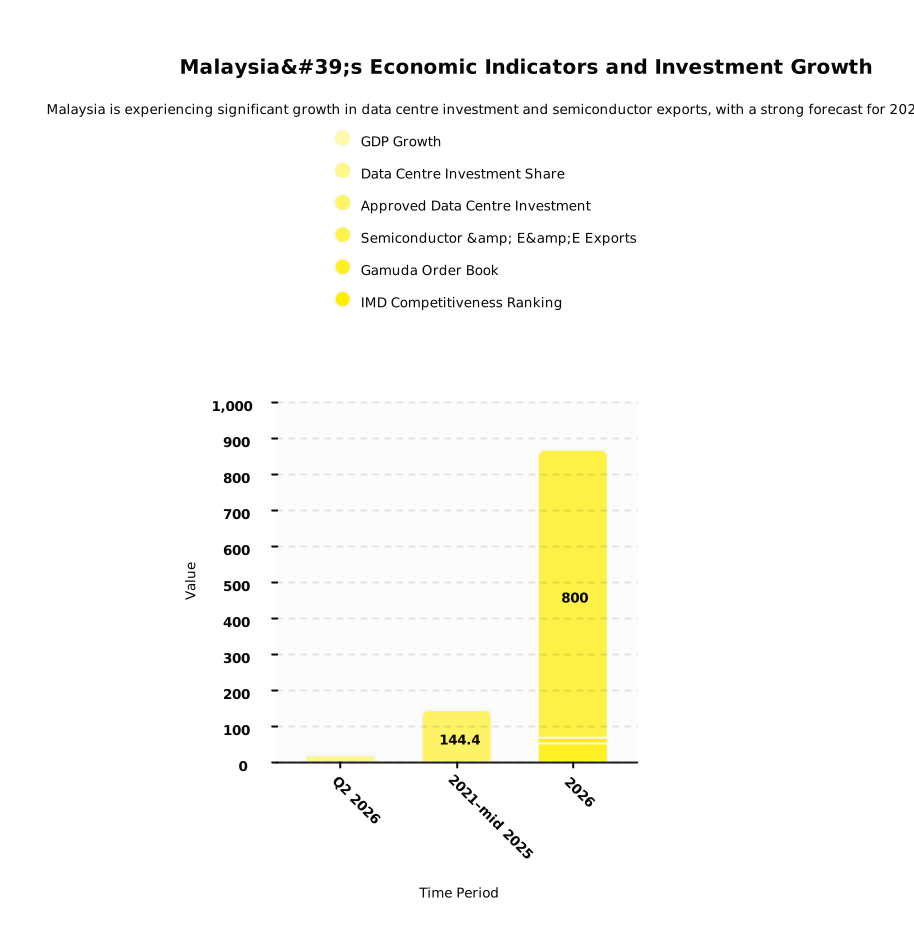
| Metric | Figure | Source | Date |
|---|---|---|---|
| Q2 2026 GDP growth | 5.8% | Department of Statistics Malaysia | Q2 2026 |
| Data centre investment share of GDP | 18% | HSBC | 2026 |
| Approved data centre investment (2021–mid 2025) | RM144.4 billion | MIDA | 2021–2025 |
| Forecast 2026 semiconductor and E&E exports | RM800 billion | Regional business reporting | 2026 |
| Gamuda order book (June 2026) | RM52 billion | Gamuda | June 2026 |
| IMD World Competitiveness Ranking 2026 | 15th of 70 | IMD | 2026 |
| Sources: Department of Statistics Malaysia, HSBC, MIDA, regional business reporting, Gamuda, IMD | |||
The architecture beneath the boom
Malaysia’s AI hardware surge is not a standalone story. It is a node in a US-led technology stack that spans design tools, fabrication equipment, and export controls. The country holds roughly 13% of the global outsourced semiconductor assembly and test (OSAT) market, and its electrical and electronics exports to the United States surged 54.8% year-on-year in the first half of 2026 to RM173.37 billion, according to trade data.
That integration brings growth but also dependency. The ART agreement, signed in 2025, commits Malaysia to mirror US export restrictions on AI chips. As Amalina Anuar, a fellow at the ISEAS–Yusof Ishak Institute, argues in a recent analysis, the technical stack underpinning Malaysia’s role is heavily aligned to US-origin regimes, complicating efforts to appear neutral while deepening AI-related capabilities. Malaysia’s perceived neutrality has been a key draw for supply-chain relocations, but that perception is now under strain from both geopolitical alignment and domestic political uncertainty.
The fiscal picture adds another layer. Malaysia’s total trade reached RM1.796 trillion in the first half of 2026, with a trade surplus of RM147.15 billion. But the subsidy bill threatens to absorb a growing share of the budget. According to Lee Heng Guie, executive director of the Socio-Economic Research Center, targeted fuel subsidies divert resources from long-term growth, and tech-driven expansion risks being uneven, concentrated in states like Penang, Johor, and Sarawak.
Malaysia’s expansion is already reshaping the calculations of its neighbours. Indonesia, watching data-centre investments tilt north, is accelerating efforts to upgrade power grids and adjust regulations. Thailand, a major electronics producer, is defending its position through incentives for advanced packaging. Both may seek deeper participation in Malaysia-centred supply chains to avoid being relegated to lower-value roles.
The mismatch between investment momentum and structural reform is where future instability is most likely to emerge. As Asia’s AI factory boom rests on a single demand cycle, Malaysia’s political calendar adds a local risk layer. The next budget revision, expected in the fourth quarter of 2026, is the first moment the pattern could break. Or confirm itself for another cycle.
Beyond the headline
The Bigger Picture
Malaysia’s shift from low-margin packaging to advanced AI manufacturing reflects a wider fragmentation of semiconductor value chains. Smaller economies are plugging into US-led technology stacks while courting Chinese capital. In this landscape, control over export controls and regulatory levers matters as much as physical fabs or labour costs in determining who captures value.
The Response Gap
Investment agencies and firms are scaling projects rapidly. The political system is moving more slowly on the distributional and fiscal strains created by concentrated AI growth. Labour shortages in higher-skill roles, regional imbalances between states like Sarawak and the rest of the country, and rising subsidy bills are all documented. No national plan yet matches the speed of capital inflows, and that gap is where future instability is most likely to surface.
The Timing
Three clocks are ticking: an AI supercycle driving immediate demand, a semiconductor strategy targeting 2035, and an electoral calendar culminating around 2028. Decisions on export-control alignment, subsidy reform, and workforce development over the next two to three years will determine whether the current surge becomes a durable economic upgrade or a peak that fades once the global AI cycle matures.
The decisions that will define the next two years
With Malaysia’s AI boom entering a politically sensitive phase, four groups of Western stakeholders face distinct choices.
- Western semiconductor procurement manager
Malaysia’s advanced packaging capacity and OSAT share make it a critical node in your supply chain. Political instability could delay projects or shift regulatory conditions. Monitor the Q4 2026 budget revision for subsidy reform signals, and track state by-elections through 2027. Diversify sourcing to include other ASEAN sites while Malaysia’s policy environment remains fluid.
- US-based investor with APAC emerging market exposure
Malaysia’s A-rated sovereign status and 5.8% GDP growth offer compelling returns, but fiscal risks are rising. Watch for Moody’s updates on fiscal consolidation and any slippage in subsidy reform. Construction and tech manufacturing equities linked to data centres may outperform, while consumer and banking stocks face headwinds if subsidies are cut. Review MIDA’s incentive guidelines before committing capital.
- Western tech company executive considering APAC expansion
Malaysia’s skilled English-speaking workforce and lower costs remain attractive, but the ART agreement ties your operations to US export controls. Before expanding, assess how potential political shifts could affect licensing and compliance. Engage with MIDA and MITI on pioneer status and tax relief timelines, and factor in labour market tightness for high-skill roles.
- European tour operator with Southeast Asia packages
Record visitor arrivals and investment-driven business travel are expanding tourism demand, especially in Johor and Penang. Political instability could disrupt travel patterns, but for now the trend is upward. Consider adding packages that combine tech hub visits with leisure destinations, and monitor official travel advisories for any shifts in safety or visa policies.
FAQ
What visa options exist for tech workers moving to Malaysia?
Malaysia’s Digital Nomad Pass (DE Rantau) and tech-focused employment visas allow foreign IT and semiconductor professionals to reside and work in designated hubs, typically for 12 months with renewal options. Requirements differ for remote workers versus in-country employees. Verify current criteria on the MDEC portal, as rules can change quickly.
Are there restrictions on foreign ownership in AI-related sectors?
Foreign investors in manufacturing, including electronics and data centres, can generally hold 100% equity. However, sectors like telecommunications and energy may face caps or licensing conditions. The National Semiconductor Strategy encourages foreign participation while promoting local supply-chain integration. Consult MITI and MIDA for the latest guidelines.
What tax incentives apply to AI infrastructure investments?
Companies investing in AI infrastructure, semiconductors, or advanced packaging can access pioneer status, investment tax allowances, and customised grants. These incentives often run for fixed periods, such as through 2030, after which standard corporate tax rates apply. MIDA’s incentive guidelines outline eligibility, application processes, and compliance requirements.
Explainer
- OSAT
- Outsourced Semiconductor Assembly and Test. The industry segment that packages and tests chips designed and fabricated by other companies. Malaysia holds roughly 13% of the global OSAT market, making it a critical back-end node in AI chip supply chains.
- National Semiconductor Strategy
- Malaysia’s plan, announced in May 2024, to move from low-margin packaging into advanced packaging and integrated circuit design. It targets capturing 7% of worldwide advanced packaging shipments by 2035. The strategy is built around a consortium of local firms and government support.
- Malaysia Advanced Packaging Consortium
- A group of five Malaysian companies—SkyeChip, Inari Amertron, Pentamaster, NSW Automation, and FusionAP—formed to build a home-grown advanced packaging ecosystem. It aims to shift the country from executing foreign designs to co-developing packaging roadmaps.
- Agreement on Reciprocal Trade
- A 2025 US–Malaysia trade pact that, among other provisions, commits Malaysia to mirror US export controls on semiconductors, including AI-related chips. It deepens Malaysia’s integration into US-led technology regulatory architectures while complicating its neutrality messaging.
- Silicon Island
- A land reclamation project off Penang led by Gamuda, designed to expand the state’s semiconductor and tech manufacturing footprint. It is a flagship development supporting Malaysia’s push into higher-value AI hardware and advanced packaging.
RELATED STORIES