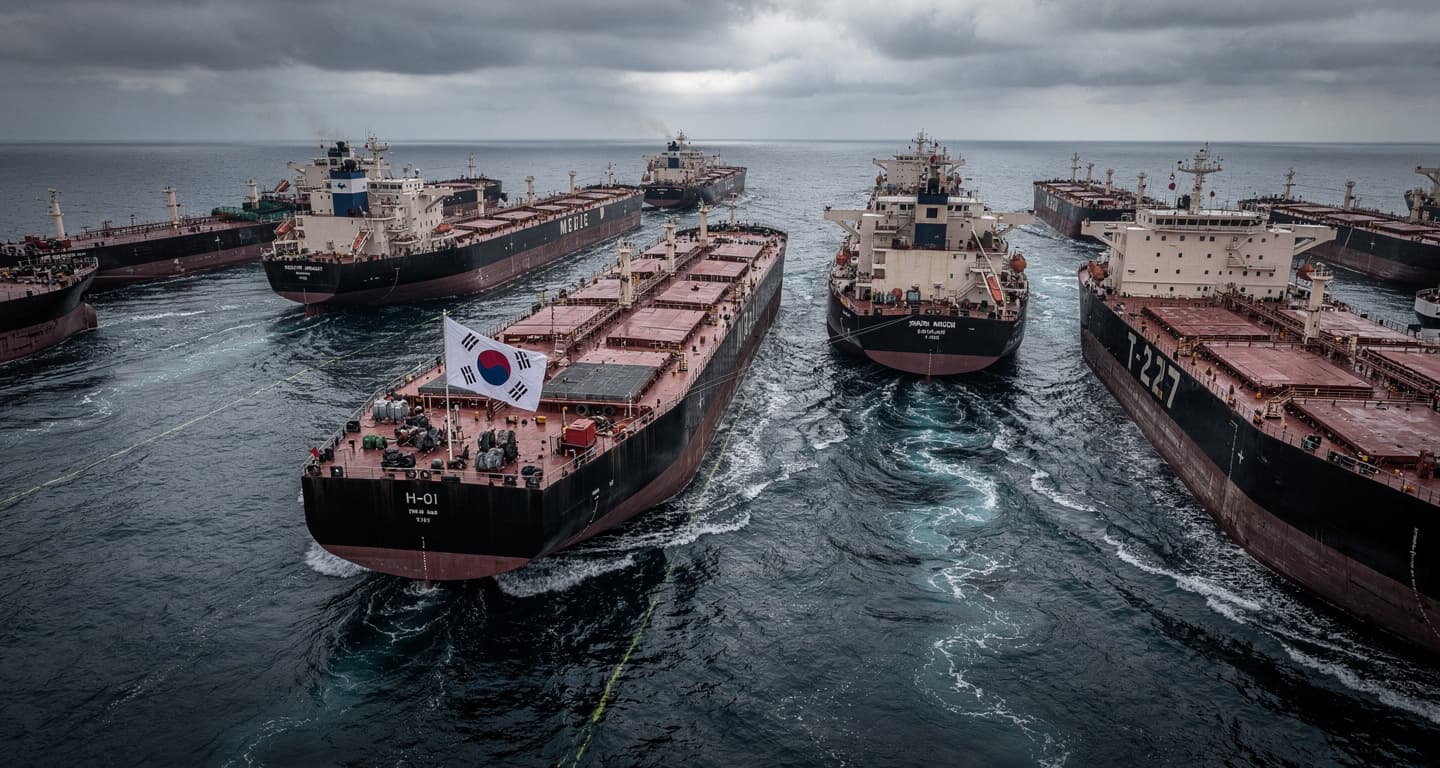
Malaysia’s MYR 2.5 billion (USD 530 million) Maharani Energy Gateway, a 3,487-acre freeport project in Muar, Johor, awarded to KAJ Development Sdn Bhd under a concession signed on March 23, 2023, is emerging as a credible candidate for a new regional energy logistics hub as chronic insecurity in the Strait of Hormuz and the Red Sea forces Asian and Middle Eastern crude and LNG flows to reroute through the Malacca–Singapore corridor. The Strait of Malacca already carries an estimated 16 million barrels per day of crude oil and petroleum products — roughly one quarter of global seaborne oil trade — according to the U.S. Energy Information Administration’s April 2024 chokepoints assessment.
The project’s commercial case rests on structural rerouting, not temporary crisis. The critical test comes when Kuala Lumpur either gazetted the Maharani Free Commercial Zone under the Free Zones Act 1990 or does not — a decision expected by late 2026.
The Strait of Hormuz has not closed. It does not need to. Since the onset of the Iran War, repeated military escalations — tanker seizures, drone strikes, naval confrontations — have been enough to send war-risk insurance premiums soaring, reroute cargoes around the Cape of Good Hope, and strip effective tanker and LNG capacity from global markets. The consequence, now visible in freight pricing and cargo flows, is that Asia’s energy import architecture is being redesigned in real time.
The rerouting pressure is concentrating on the Malacca–Singapore corridor, and Malaysia sits directly on that artery. The Maharani Energy Gateway, a USD 530 million offshore storage and ship-to-ship transfer project on Malaysia’s southwest Johor coast, was approved in 2023 and is now drawing attention from energy traders and analysts as a potential swing hub for crude, petroleum products, and LNG at precisely the moment the market needs new logistical anchors.
The buried story here is not a new terminal. It is the possibility that Malaysia could use this moment to redesign regional energy logistics rather than simply host another storage facility — converting geography into systemic influence as the global energy map shifts away from Middle Eastern chokepoints toward distributed, resilience-focused infrastructure.
Whether Kuala Lumpur has the governance discipline to seize that window is a separate, and far less certain, question.
The details
The Maharani Energy Gateway covers 3,487 acres in Muar, Johor, awarded to KAJ Development Sdn Bhd under a concession agreement signed on March 23, 2023. The Malaysian Investment Development Authority’s project approval confirms the site is designed for offshore storage, ship-to-ship transfer, blending, and bunkering — the specific capabilities that energy traders now prioritise when traditional load ports are militarised.
Hiroshi Hashimoto, Senior Analyst at the Institute of Energy Economics, Japan (IEEJ), said in February 2026 that sustained insecurity around the Strait of Hormuz and the Red Sea is accelerating Asian utilities’ pivot toward LNG contracts tied to more flexible Atlantic and Pacific routes, and increasing interest in storage and trading hubs in Southeast Asia. James Brown, Head of Asia-Pacific Commodities Research at ING, told analysts in March 2026 that Southeast Asian ports positioned on the Malacca Strait could become “critical swing hubs” for crude and products if Middle East export routes remain militarised — but warned that investors will demand strong governance and clear free-zone rules before committing large capital.
That governance framework already exists in outline. Malaysia’s Free Zones Act 1990 (Act 438) empowers the Minister of Finance to declare and regulate free commercial zones, providing customs, tax, and administrative incentives. The Petroleum Development Act 1974 vests ownership and exclusive rights over Malaysian petroleum resources in Petroliam Nasional Berhad (PETRONAS), giving the national oil company a central coordinating role in any strategic storage or LNG facility decision. The question is whether those statutory tools will be deployed with the speed and credibility the market is now demanding.
Global seaborne LNG trade reached approximately 54 million tonnes in January 2026, up from around 50 million tonnes in January 2025, driven by higher imports in Europe and Asia, according to the International Energy Agency’s Gas Market Report Q1 2026. That growth is occurring precisely as the routes carrying those cargoes become more expensive and unpredictable — a dynamic that structurally rewards new storage and transfer nodes positioned outside the conflict zones. The same disruptions that are threatening to cut Europe-Asia flight capacity by 30–50% by June due to jet fuel shortages are reshaping how energy traders think about supply chain resilience across every fuel type.
How Malaysia’s energy hub would actually get built
Development of a Maharani-type energy hub rests on three distinct approval pillars, none of which is automatic. The federal Ministry of Finance must formally gazette the site as a free commercial zone under the Free Zones Act 1990. Johor state authorities must clear land use and planning permissions. Project-level licences from the Marine Department Malaysia and the Department of Environment must follow. PETRONAS’s alignment on any LNG-related infrastructure adds a fourth layer of coordination. Foreign investors would typically enter through long-term terminal use agreements governed by Malaysian ports and contract law — a structure familiar to Gulf and Northeast Asian capital, but one that requires legal certainty before commitments are made.
The relevant comparison is not Singapore. It is Fujairah. The UAE’s east-coast port was once a secondary logistics location outside Hormuz; geopolitical instability elevated it into one of the world’s most strategically important bunkering and storage hubs. That transformation took years and required consistent regulatory commitment — not just geography. Malaysia already has a proven precedent in its own backyard: the Pengerang Integrated Petroleum Complex (PIPC) in Johor, designed for up to 5 million barrels of crude and petroleum storage and 10.5 million tonnes per year of LNG regasification, shows that Johor can anchor serious energy infrastructure when the institutional will is present.
Watch for the formal gazettement of the Maharani Free Commercial Zone — expected by late 2026. If it happens, Kuala Lumpur is committing to full-scale port, storage, and customs infrastructure. If it does not, investors will continue favouring established hubs. The next IEA Oil Market Report in mid-2026 is the second signal: a marked, sustained rise in Malacca-route tonnage relative to Hormuz would confirm structural diversion rather than temporary war-related rerouting.
Beyond the headline
The bigger picture
This story is ultimately about how conflict, rerouting economics, and the slow fracture of Middle Eastern chokepoint reliability are forcing a redrawing of the global energy map toward a more distributed, logistics-heavy system. Malaysia’s potential role shows how mid-sized states positioned along alternative corridors can convert geography into systemic influence — but only if they move quickly and credibly enough to capture momentum before competing hubs absorb it.
The reach
A Malaysian energy hub on the Malacca Strait would subtly shift price formation and risk management for the crude and LNG benchmarks that underpin fuel and power costs in Europe and North America. It also offers Western energy firms and traders a hedge against Gulf-centric exposure, creating new opportunities in storage, blending, and derivatives linked to Southeast Asian delivery points — reducing the current overdependence on Middle Eastern load ports whose reliability is now structurally compromised.
Our take
Malaysia has a rare window, but geography alone has never built a hub — governance has. If Kuala Lumpur treats Maharani as another politically connected mega-project, capital and cargo will continue flowing to Singapore and Pengerang, where the rules are known and enforced. If it uses this moment to professionalise its energy logistics framework — transparent free-zone rules, credible environmental safeguards, PETRONAS alignment — the balance of power in Asian oil and gas trade will shift accordingly. The gazettement decision expected in late 2026 will be the first real signal of which Malaysia shows up.
What Western energy investors and traders should watch in Malaysia
With the Maharani Free Commercial Zone gazettement decision expected by late 2026 and structural rerouting away from Hormuz already visible in freight data, Western companies with Asian energy exposure face a narrow window to assess and position ahead of the market.
- Track the gazettement decision: The formal declaration of Maharani as a free commercial zone under Malaysia’s Free Zones Act 1990 is the single most important signal. Monitor announcements from Malaysia’s Ministry of Finance and the Malaysian Investment Development Authority at mida.gov.my for regulatory updates through the second half of 2026.
- Monitor Malacca Strait throughput data: The U.S. Energy Information Administration’s World Oil Transit Chokepoints tracker and the IEA’s quarterly Gas Market Reports are the cleanest public signals for whether rerouting is structural or temporary. A sustained rise in Malacca-route tonnage relative to Hormuz confirms the investment thesis.
- Assess PETRONAS alignment: Under the Petroleum Development Act 1974, any LNG-related infrastructure in Malaysia requires PETRONAS coordination. Western firms considering terminal use agreements should map PETRONAS’s position early — without it, midstream and LNG-related investments face significant regulatory friction.
- Price in the governance risk: James Brown at ING has been explicit: investors will demand strong governance and clear free-zone rules before committing large capital. Due diligence on Maharani should include a specific assessment of whether KAJ Development Sdn Bhd’s concession terms are transparent and whether Johor state land approvals are progressing on a credible timeline.
- Compare against Pengerang: Malaysia’s existing Pengerang Integrated Petroleum Complex in Johor already offers proven storage and LNG regasification capacity. Western firms weighing Malaysian exposure should assess whether Maharani offers genuinely complementary capabilities or whether Pengerang already serves the same strategic function with lower execution risk.
RELATED STORIES