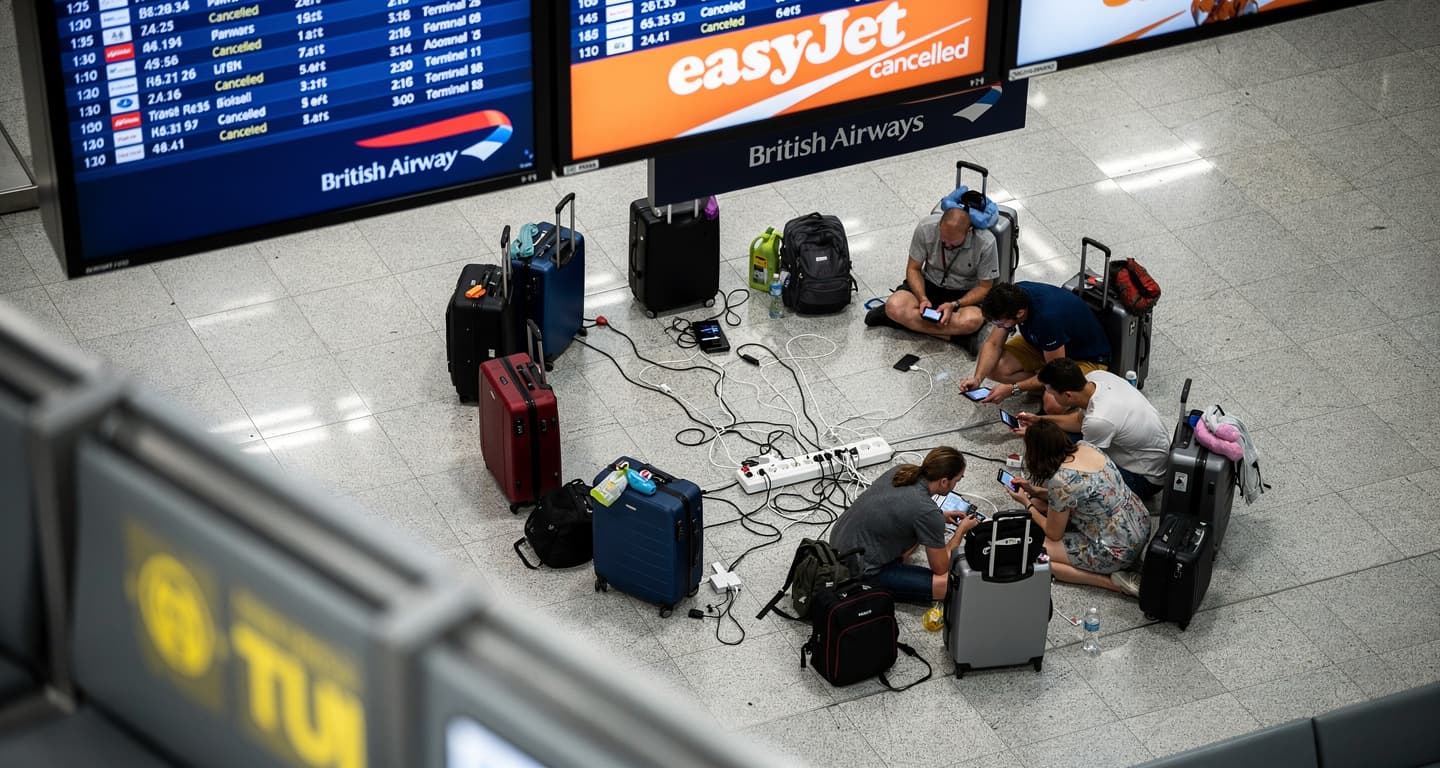
South Korean airlines are facing a margin crisis, not merely a cost pass-through. As of May 2026, domestic fuel surcharges on Korean Air and Jeju Air have more than doubled on several routes compared with late 2025 — rising from KRW 3,300–9,900 to KRW 15,400–23,100 per segment on Korean Air’s domestic network — driven by a 20% rise in Singapore jet fuel prices since late February 2026 and a 5–6% depreciation of the won against the dollar. Aviation analyst Lee Chang-min at Hana Securities warns that current fuel and currency conditions leave carriers with “little buffer” for further shocks.
Further fare hikes or government intervention now look likely, not optional. South Korea’s Ministry of Land, Infrastructure and Transport is due to publish its Q3 2026 fuel-surcharge reference table in late July — a release that will set the pricing environment for the rest of the year.
The real pressure on South Korean aviation is not what passengers are paying today — it is what airlines stand to lose if they stop raising prices. Lee Chang-min, aviation analyst at Hana Securities, calculated in a May 2026 client note that every 10% rise in jet fuel compresses Korean full-service carriers’ operating margins by roughly 1 percentage point unless fares or surcharges keep pace. Since late February 2026, Singapore jet fuel prices have climbed from approximately USD 95 to around USD 115 per barrel — a move that, combined with a won that has shed 5–6% against the dollar since November 2025, is pushing carriers toward a structural squeeze rather than a cyclical blip.
Jeju Air, South Korea’s largest low-cost carrier, began accepting applications for voluntary unpaid leave in June 2026, following T’way Air, which announced the same measure the previous month. Other carriers are weighing flight reductions and temporary leave programmes. Meanwhile, Incheon International Airport Corporation data show international passenger traffic at Incheon reached 15.9 million in Q1 2026, up 18% from 13.5 million in Q1 2025 — but growth slowed sharply in April as higher surcharges took hold, signalling that demand resilience has limits.
The won’s depreciation compounds every dollar-denominated fuel bill. What looks like a Middle East energy story is, for Seoul’s aviation sector, also a currency story — and the two are moving in the same direction at the same time.
Surcharges, unpaid leave, and a KRW 3 billion lifeline for Jeju
The surcharge numbers are stark. Korean Air’s domestic fuel surcharge now runs KRW 15,400–23,100 per segment, against KRW 3,300–9,900 on most bands in mid-2025 — more than doubling on popular routes such as Gimpo–Jeju. Jeju Air’s equivalent table shows KRW 14,300–22,000 per one-way ticket in May 2026, up from KRW 4,400–8,800 on comparable distance bands in October 2025, a roughly 2–3x increase year-on-year. Full surcharge details are published on Korean Air’s fuel surcharge page.
The pricing mechanism is not discretionary. Under Ministry of Land, Infrastructure and Transport Notice No. 2024-734, domestic and international fuel surcharges are adjusted monthly using a banded formula tied to the average Singapore jet fuel price and the KRW/USD rate. When both inputs move adversely — as they have since February 2026 — carriers have limited room to absorb rather than pass on costs.
Kim Bum-soo, research fellow at the Korea Transport Institute (KOTI), argued in an April 2026 briefing that sustained high oil prices could push low-cost carriers on domestic routes — particularly to Jeju — into route consolidation or temporary suspensions without targeted subsidies or airport fee reductions. Jeju Island’s government has responded with an emergency tourism promotion package of approximately KRW 3 billion (around USD 2 million), including discounts and local vouchers for visitors staying two nights or longer, authorised under the Tourism Promotion Act (Act No. 19208, amended 2024). A travel industry official, speaking without attribution, described the more worrying trend as not a decline in traveller numbers but a growing tendency to delay bookings and adopt a wait-and-see posture — a demand signal that is harder to reverse than an outright price shock.
| Carrier | Oct 2025 range | May 2026 range | Change |
|---|---|---|---|
| Korean Air | KRW 3,300–9,900 | KRW 15,400–23,100 | ~2–3x increase |
| Jeju Air | KRW 4,400–8,800 | KRW 14,300–22,000 | ~2–3x increase |
Why the margin math is getting harder to ignore
Singapore jet fuel prices — the benchmark that feeds directly into South Korea’s monthly surcharge formula — rose from approximately USD 95 per barrel in late February 2026 to around USD 115 per barrel by mid-May 2026, a 20% increase in under three months. At the same time, Bank of Korea daily closing data show the won weakening from around KRW 1,310 per USD in late November 2025 to approximately KRW 1,380–1,390 by mid-May 2026. Fuel is priced in dollars; revenues on domestic routes are collected in won. The arithmetic is punishing.
Experts warn the timeline for relief is uncertain. Even if the Strait of Hormuz fully reopens, analysts say it may take several months for global oil supplies to stabilise — a horizon that tests the financial resilience of low-cost carriers whose balance sheets were already thinner than those of full-service operators after the pandemic. This is a pattern with precedent: during the 2008 oil spike, several smaller South Korean carriers exited domestic routes before prices corrected, and the consolidation that followed reshaped the competitive landscape for years. The parallel is not exact, but Kim Bum-soo’s warning about route suspensions without government support is not theoretical.
The July publication of the Ministry’s Q3 2026 surcharge reference table is the next concrete decision point. If jet fuel and the won remain at current levels when that table is set, another quarter of elevated fares is locked in — and with it, another quarter of suppressed demand on routes like Jeju that have no realistic alternative to air travel. This dynamic is also playing out elsewhere in the region: as explored in our coverage of how Singapore Airlines and Scoot are calibrating fare increases to stop short of full cost recovery, the tension between protecting load factors and recovering fuel costs is a regional airline problem, not a Korean one.
Beyond the headline
The bigger picture
South Korea’s airline and tourism squeeze is a textbook case of how geopolitical energy shocks cascade through service economies built on cheap, frequent domestic flights. It demonstrates that even a country with strong carriers, high passenger volumes, and a popular domestic tourism destination can find its post-pandemic recovery tempered by fuel and currency vulnerabilities it does not control. The structural exposure is not new — it was simply masked by the low-oil, stable-won environment of 2023 and 2024.
The reach
For North American and European travellers, South Korea is becoming a more expensive flight but remains a relatively affordable destination once on the ground — Jeju City mid-range hotels in June 2026 run KRW 90,000–140,000 per night, a fraction of comparable London or New York rates. For investors, Korean airlines now function as leveraged instruments on energy and currency markets: the fuel cost structure means a sustained oil price above USD 110 per barrel makes profitability at low-cost carriers structurally difficult, not cyclically inconvenient.
Our take
Seoul’s policy response — emergency vouchers for Jeju, voluntary unpaid leave at carriers — is demand management dressed up as crisis response. It addresses the symptom without touching the exposure. A country whose aviation sector runs a monthly surcharge formula mechanically tied to Singapore jet fuel and the KRW/USD rate has, in effect, outsourced its domestic fare policy to Middle East geopolitics. Until Korean carriers improve fuel hedging practices and regulators develop more flexible support mechanisms for strategically important routes, the next oil shock will produce exactly the same crisis — just faster.
What this means for travellers, investors, and corporates
With South Korean fuel surcharges already at two-to-three times their late-2025 levels and the Ministry’s Q3 2026 pricing table due in late July, the window for locking in lower fares before another potential adjustment is narrowing.
- Book domestic South Korean flights before late July: The Ministry of Land, Infrastructure and Transport’s Q3 2026 surcharge reference table — published under MOLIT Notice No. 2024-734 — will set fare floors for July through September. If jet fuel remains near USD 115 per barrel when the table is calculated, surcharges will not fall. Booking before the table drops reduces exposure to a further reset.
- Track the KRW/USD rate via Bank of Korea ECOS data: The won’s trajectory directly affects both surcharge calculations and the real cost of South Korea trips for dollar- and euro-based travellers. Bank of Korea ECOS daily exchange rate data is publicly accessible and updated each business day. A move back toward KRW 1,310 would meaningfully reduce surcharge pressure.
- Monitor low-cost carrier capacity announcements: If Jeju Air or T’way Air announce route suspensions or frequency reductions on Gimpo–Jeju or Gimhae–Jeju services, it signals the margin crisis has moved from cost management to network restructuring — a more serious and slower-to-reverse development.
- For investors in Korean consumer and travel names: The underperformance of airline stocks relative to the KOSPI since March 2026 may not be fully priced into hotel, duty-free, and travel-adjacent names if inbound and domestic demand softens through Q3. The iShares MSCI South Korea ETF (EWY) provides indirect exposure; sector-specific Korean Exchange-listed names carry more concentrated risk.
- Corporate travel managers should reprice South Korea routing assumptions: The fuel surcharge increases on Korean Air and Jeju Air apply to domestic segments within itineraries — meaning connecting routes through Seoul to secondary Korean cities are also affected. Business travel budgets built on 2025 benchmarks will be materially understated for Q3 2026.
FAQ
How are South Korean domestic fuel surcharges calculated, and who controls them?
Under Ministry of Land, Infrastructure and Transport Notice No. 2024-734, domestic fuel surcharges are adjusted monthly using a banded formula tied to the average Singapore jet fuel price and the KRW/USD exchange rate. Airlines do not set them freely — the Ministry publishes a reference table each quarter, and carriers apply the resulting bands. When both fuel prices and the dollar rise simultaneously, as in early 2026, the formula automatically produces higher surcharges with limited discretion for airlines to absorb the increase.
Could the South Korean government intervene to cap airline fuel surcharges or support low-cost carriers?
The Korea Transport Institute’s Kim Bum-soo argued in April 2026 that sustained high oil prices could push low-cost carriers into route suspensions unless the government provides targeted subsidies or airport fee reductions. The Tourism Promotion Act (Act No. 19208, amended 2024) already authorises emergency tourism support, as demonstrated by Jeju Island’s KRW 3 billion package. Broader aviation support — including direct carrier subsidies or fee waivers — would require separate ministerial action and has not been announced as of May 2026.
Are Western tourists visiting South Korea affected differently from domestic travellers?
Yes. International visitors pay fuel surcharges on inbound and outbound flights priced in hard currencies, where global airfare inflation and fuel cost recovery have both been significant. Once in South Korea, however, the weaker won means ground costs — hotels, food, transport — are cheaper in dollar or euro terms than a year ago. The net effect for most Western visitors is a higher cost to reach South Korea but a relatively affordable experience on the ground, particularly outside Seoul.
What is the significance of the Strait of Hormuz to South Korean aviation costs?
South Korea imports the majority of its crude oil from Middle Eastern producers, and Singapore jet fuel — the benchmark in its surcharge formula — is itself sensitive to Persian Gulf supply flows. Analysts note that even if the Strait of Hormuz fully reopens, it may take several months for global oil supplies to stabilise and prices to fall. This lag means South Korean carriers face elevated surcharge calculations through at least one further quarterly pricing cycle after any resolution, with no immediate relief for either airlines or passengers.
RELATED STORIES