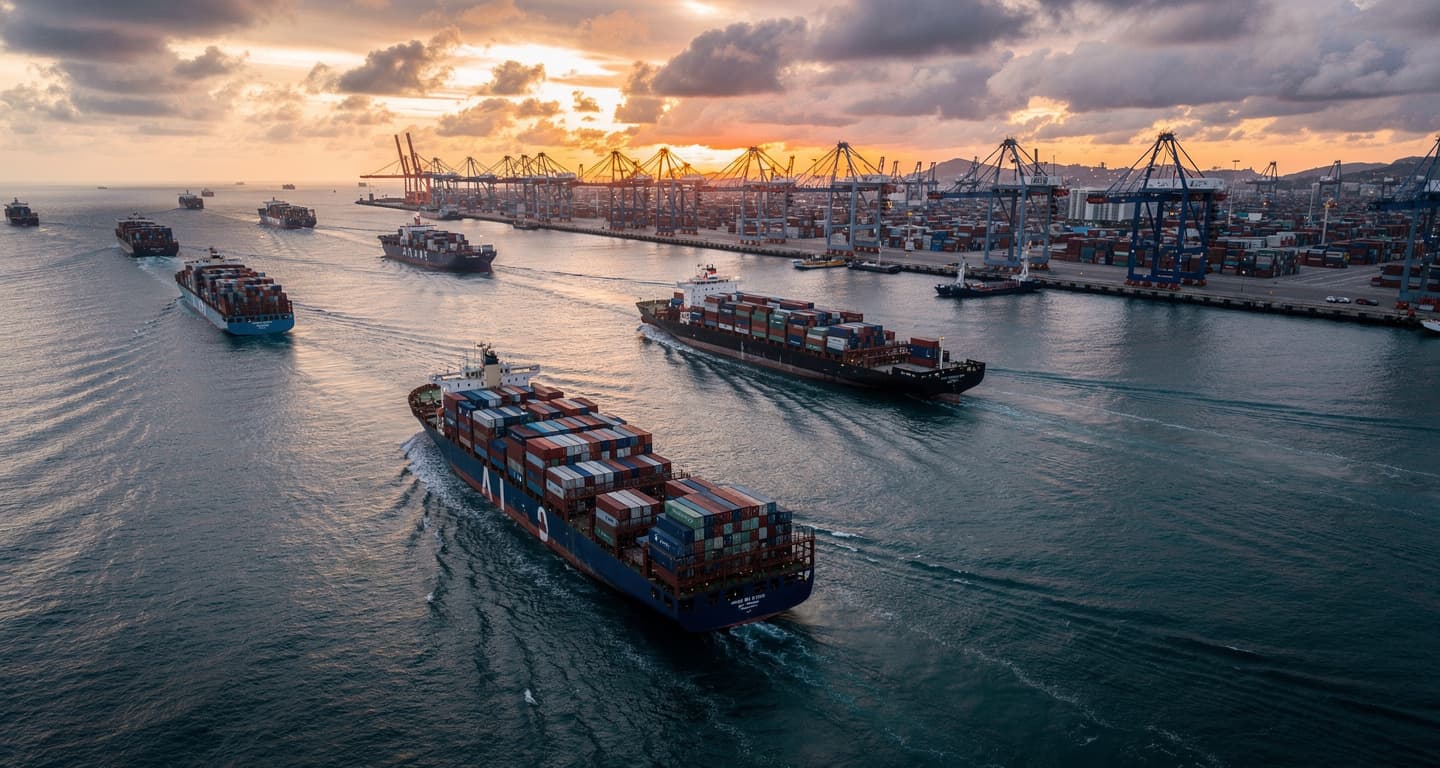
Asian factories expanded for a seventh straight month in June 2026, with the RatingDog General Manufacturing PMI at 51.7 and a high-tech sub-index at 53.5. The growth is almost entirely driven by global demand for AI hardware — chips, servers, and data-center gear — even as the Iran war lifts energy costs and stretches shipping lead times across China, Japan, Taiwan, Vietnam, Malaysia, and the Philippines.
The strength masks a single-point failure. Nearly all of that momentum rests on one demand cycle, governed by two competing rulebooks in Washington and Beijing.
The factory data looks like resilience. It is closer to concentration risk wearing a good disguise.
Asian manufacturing grew again in June 2026, and the reason is narrow: the world cannot get enough AI hardware. Semiconductors, networking gear, and server components are carrying whole national manufacturing sectors on their backs. Japan’s manufacturing PMI reached 54.8, its sixth month of growth, with new orders rising at their fastest pace in more than two years.
Strip out the AI build-out and the picture thins fast. The same survey compilers flagged rising prices, supply shortages, and longer shipping times tied to the Middle East conflict. Factories are absorbing those costs because AI orders let them.
That is the setup worth watching. A regional economy this dependent on one product cycle is only as stable as that cycle — and this one runs through export controls in Washington and a dense regulatory spine in Beijing. The question is not whether the factories are humming now. It is what happens when either the demand or the rules shift.
One demand cycle is carrying six economies
The high-tech PMI tells the real story. At 53.5, AI-linked production is growing faster than the broader manufacturing economy — a gap that shows how much of the expansion is one specific bet. China’s export machine runs at roughly $500 million per hour, and AI-related goods now make up a meaningful slice of it.
Below China, the numbers are thinner. Malaysia crossed back into expansion at 50.7 from 49.9. The Philippines barely moved, edging to 50.9. Taiwan and Vietnam reported growth without dramatic figures. These are not economies booming on their own strength. They are riding the same wave.
Here is the twelve-to-eighteen-month problem. US export controls do not just restrict what China can buy — they are reshaping what it builds. The Bureau of Industry and Security tightened rules in October 2023 and October 2024, tying licenses to performance thresholds like computational density and interconnect speed. The result is that Chinese chip development is bending away from off-the-shelf GPUs toward custom silicon.
Enforcement is now the live variable, not the rule itself. Customs teams have started intercepting suspicious shipments, including a $13 million AI chip seizure in Malaysia bound for re-export. That is the choke point where factory orders become legally undeliverable overnight.
Two rulebooks, one production line
The buffer against war-driven costs is real. What it hides is a structural bind. Asian factories are now producing under two competing regulatory systems at once — and neither is theirs.
Washington controls the top of the hardware pipeline through export rules. Beijing controls deployment through a layered regime built on the Cyberspace Administration of China‘s measures on recommendation algorithms, deep synthesis, and generative AI. A draft comprehensive AI law, reportedly released in December 2025, would add graded risk rules and extraterritorial reach — if it advances from consultation to adoption, which is not yet certain.
Japan and Taiwan sit in a useful spot. As compliant nodes inside US-aligned supply chains, they stand to attract sensitive AI manufacturing that relocates out of mainland China. That shift, not the current PMI, is where the next decade of factory orders gets decided.
So the humming factories are not the story. The story is that their stability now depends on decisions made by regulators on two continents, over hardware most buyers never see.
Beyond the headline
The bigger picture
The AI hardware surge is not just a cyclical upswing. It binds Asian manufacturing into a geopolitical contest over who controls the infrastructure of computation. Factories are effectively producing under two competing rulebooks, and the apparent resilience masks how dependent regional growth has become on one technology stack and its contested governance.
The money trail
Regulatory choke points now decide which orders can legally ship. An export license denial or a customs seizure can strip millions in booked revenue from a supplier in days. Western cloud and platform firms increasingly reroute spending toward jurisdictions seen as lower-risk, meaning a licensing decision moves more money than a price change ever could.
The timing
This upswing arrives as Beijing’s draft AI law and content-labelling rules tighten, and as US controls shift from design to enforcement. That convergence suggests the current quarter’s PMI strength could prove a high point rather than a floor — an interpretation, not a forecast. The Iran war’s energy shock is colliding with a regulatory inflection point, making the next rule change as consequential as the conflict.
What the boom asks of you now
With AI demand carrying the region and enforcement ramping up, exposure to this supply chain now depends on decisions made by regulators, not just markets.
- Investors in AI hardware suppliers
Review the US BIS advanced computing and semiconductor rules on the Department of Commerce site to see how licensing thresholds and restricted destinations affect suppliers with China exposure. A single enforcement advisory can reprice a fab’s order book. Watch Federal Register notices for the next threshold change.
- Enterprise cloud and IT buyers
Map which cloud platforms, AI services, and data-center partners your organisation uses that may rely on Chinese infrastructure. Then check your obligations under China’s CSL, DSL, and PIPL before expanding AI workloads into Asia-based facilities. Diversifying providers now is cheaper than untangling a compliance problem later.
- Supply chain and procurement teams
Assume a Chinese chipmaker you have never mapped is already inside your components. Trace AI-linked parts to origin, and build a fallback route through Japanese or Taiwanese suppliers before shipping lead times and energy costs force the decision for you.
Explainer
- PMI
- The Purchasing Managers’ Index is a monthly diffusion index built from surveys of purchasing managers on output, orders, employment, and prices. A reading above 50 signals expansion; below 50 signals contraction. The June 2026 high-tech sub-index of 53.5, well above the headline 51.7, is what reveals AI’s outsized role in the growth.
- Bureau of Industry and Security
- The BIS is the US Department of Commerce agency that controls exports of dual-use items, including advanced semiconductors. Its October 2023 and 2024 rules tie chip export licenses to performance thresholds aimed at limiting China’s AI and supercomputing capability. Its narrowly tailored commercial exceptions are why some trade continues under license rather than stopping outright.
- Cyberspace Administration of China
- The CAC is China’s lead regulator for internet and AI services. It governs AI through layered measures on recommendation algorithms, deep synthesis, and generative AI, requiring algorithm filings and security assessments before large-scale deployment. Its content-labelling focus, rather than the EU’s product-risk model, shapes how AI built on Asian hardware behaves once deployed.
- CSL, DSL and PIPL
- These are China’s Cybersecurity Law, Data Security Law, and Personal Information Protection Law, in force between 2017 and 2021. Together they form the baseline for data security and cross-border transfer rules underpinning AI governance. They operate even without a single omnibus AI statute, which is why China’s regime is dense but fragmented rather than unified.
RELATED STORIES