Maersk will impose a two-tier Emergency Contingency Surcharge on Oceania–Middle East cargo from 1 August 2026, charging US$900 per 20-foot dry container for most Gulf ports but US$1,800 for Jeddah, King Abdullah, and Jordan — a 100% premium that locks Red Sea security risk into baseline freight rates.
The split formalises what shippers have suspected for months: the Red Sea disruption is being priced as structural, not temporary. What remains unresolved is whether naval patrols or a ceasefire can unwind it.
Maersk’s August 1 rate card for Oceania–Middle East trade establishes a two-tier Emergency Contingency Surcharge structure — one price for the Gulf, roughly double for Jeddah and Jordan — and the differential is wide enough that it will redirect cargo, reshape port competition, and feed into the global inflation basket central banks cannot ignore. The split signals that the carrier expects the Red Sea security divergence to persist rather than resolve in the near term.
The dry-container figures tell the story plainly. The 40-foot box that costs an importer US$1,500 to land at Abu Dhabi or Dammam costs US$3,000 to reach the Red Sea. The gap is not a rounding error. It is a risk premium that marine insurers began demanding in late 2023, and that carriers have now locked into their published tariffs.
What has changed is the signal. A temporary surcharge gets adjusted month by month. A two-tier tariff table, published and consolidated, implies the carrier expects the divergence to persist — and is telling its customers to plan around it.
The insurance bill behind the surcharge
The clearest driver sits in the marine insurance market. War risk premiums for vessels transiting the Red Sea have climbed from roughly 0.3% of a ship’s insured value to about 0.7% now. On a US$100 million vessel, that is an extra US$700,000 per voyage — a cost shipping lines recover through the Emergency Contingency Surcharge.
The 0.4-percentage-point shift may read as a technical adjustment. At the scale of a container fleet running weekly services, it is material enough to justify the permanent premium now visible in Maersk’s Oceania–Middle East tariff. Carriers do not build surcharge structures around costs they expect to vanish next quarter.
Maersk is not recalibrating this trade in isolation. Its India–Europe surcharges are climbing too, with some 20-foot container rates hitting US$3,500 to US$3,800 — nearly four times their pre-crisis levels — as the same Red Sea risk ripples across connected routes. The pattern suggests a system-wide repricing, not a lane-specific anomaly.
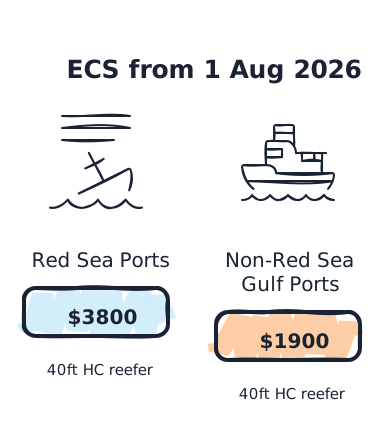
The two-tier structure breaks down by container type in the table below, which captures the full differential Maersk has published for Oceania–Middle East trade.
| Container type | Gulf ports (excl. Jeddah, King Abdullah, Jordan) | Red Sea ports (Jeddah, King Abdullah, Jordan) | Gap |
|---|---|---|---|
| 20-foot dry | 900 | 1,800 | 900 |
| 40/45-foot dry | 1,500 | 3,000 | 1,500 |
| 20-foot reefer | 950 | 1,900 | 950 |
| 40-foot high-cube reefer | 1,900 | 3,800 | 1,900 |
A single fact from Maersk’s own operations shows why the divergence is not inevitable. The carrier’s West Africa WAF6 service recently restored Suez transit, cutting its loop rotation from 70 days to 56 and allowing two vessels to be withdrawn. When security conditions permit, costs fall quickly — and surcharges can follow. The Red Sea has not reached that point.
The gap is now structural
The Oceania–Middle East surcharge split matters beyond this one trade lane because it marks the moment a temporary disruption becomes embedded in the pricing architecture. Maersk’s consolidated tariff table publishes the differential alongside standard rates, signaling to importers, freight forwarders, and competing carriers that the Red Sea premium is the baseline, not the exception.
Philip Damas of Drewry Supply Chain Advisors has tracked the operational fallout of Red Sea avoidance, noting that extended transit times add anywhere from one week to a month on key routes. This extension compels some shippers to use UAE ports and expensive overland links, in some cases more than doubling logistics costs.
What could reverse the two-tier structure is visible but not imminent. Naval security assessments covering the southern Red Sea and Bab el-Mandeb are expected over the next one to three months. If they signal sustained risk reduction, carriers could restore more Suez routings and begin trimming the ECS premium. If they do not, the split hardens — and the surcharge logic extends to other vulnerable trades.
The honest caveat is this: Maersk’s two-tier structure is, for now, one carrier’s pricing decision. Whether MSC, CMA CGM, and others follow with their own permanent differentials will determine whether this becomes an industry-wide repricing or remains Maersk’s alone.
Beyond the headline
The bigger picture
The two-tier surcharge is not a response to a Red Sea incident. It is a recognition that security volatility in maritime chokepoints has become semi-permanent — something insurers, carriers, and shippers now treat as a structural cost rather than a shock. That shift gradually embeds geopolitical risk premiums into baseline freight rates, reshaping how global supply chains allocate capacity even when individual lanes see partial improvement.
The money trail
The cost flows from shipowners paying higher war premiums to carriers imposing surcharges to importers who either raise prices or compress margins. The security bill for the Bab el-Mandeb corridor transfers, container by container, onto consumers and investors with no direct exposure to the region but significant exposure to trade-dependent sectors.
The reach
Persistent Red Sea surcharges add to goods price stickiness in global inflation baskets. If central bank economists interpret elevated shipping costs as durable rather than transitory, the rate-cut timeline extends — and sovereign and corporate bond markets in the US and Europe face a longer period of higher yields than investors have currently priced.
Who absorbs the 100% premium
With Maersk’s two-tier surcharge now published and applying from August 1, the premium is no longer hypothetical — it has to be paid, passed on, or routed around.
- Oceania-based exporter to the Middle East
The US$1,500 gap on a 40-foot container to Jeddah versus Abu Dhabi is a pricing decision you face before signing the next contract. Review Maersk’s customer advisories for your specific lanes on the Maersk website to quantify exposure by container type. Surcharge pass-through is already reshaping freight economics on other trades where buyers have limited leverage, and the same calculus applies here.
- Western investor with exposure to global shipping or logistics
The two-tier structure supports liner earnings visibility in the near term if surcharges stick, but it also signals that geopolitical risk is becoming a permanent cost input, not a cyclical one. Assess portfolio companies with significant Middle East exposure — listed carriers, marine insurers, and logistics real estate investment trusts — for how sustained surcharges affect margins and return forecasts over the next two quarters.
- Supply chain manager for Western companies importing from Oceania to the Middle East
The differential makes port selection a direct cost decision. Consider whether shipments destined for Red Sea markets can arrive via lower-cost Gulf ports with an inland leg, and negotiate contracts that explicitly address how emergency surcharges are allocated between shipper and carrier. Drewry Supply Chain Advisors and similar firms publish updated transit-time and surcharge assessments that inform these routing choices.
- Central bank economist monitoring global inflation
The 0.4-percentage-point increase in war risk premiums and the resulting near-fourfold rise in some container freight costs since the crisis began are not transitory signals. Incorporate persistent Red Sea-linked shipping costs into goods inflation assumptions, particularly for commodities routed from Oceania to Middle Eastern and European markets, when updating the inflation outlook that feeds into rate recommendations.
FAQ
How do emergency surcharges flow into retail prices?
Carriers bill emergency surcharges as a separate line item on freight invoices, but importers typically fold them into per-unit landed cost calculations. Low-margin goods — agricultural products, basic manufactured items — are most likely to trigger shelf-price increases. High-margin categories may absorb part of the surcharge without immediate consumer-facing adjustments.
What alternative routings exist for Oceania–Middle East cargo?
Carriers can transship through Southeast Asian or Indian Subcontinent hubs and route around the Cape of Good Hope, or use Gulf ports with overland legs to Red Sea destinations. These options add transit time and inland costs but reduce exposure to the highest-risk zones, shifting the trade-off toward security over speed.
Can shippers challenge emergency surcharges?
On US Federal Maritime Commission-regulated trades, surcharge changes must be filed in tariffs or service contracts, and shippers can lodge complaints if charges appear unreasonable. Oceania–Middle East lanes generally fall outside FMC jurisdiction, but multinational shippers should check which parts of their networks are covered to understand recourse options.
Explainer
- Bab el-Mandeb
- The narrow strait connecting the Red Sea to the Gulf of Aden, and one of the world’s most critical maritime chokepoints. Roughly 30 kilometres wide at its narrowest, it handles a significant share of global container traffic and oil tanker transits between Asia and Europe. Since late 2023, Houthi attacks on commercial vessels in the area have forced carriers to reroute thousands of ships around the Cape of Good Hope, adding substantial time and cost to major trade lanes.
RELATED STORIES