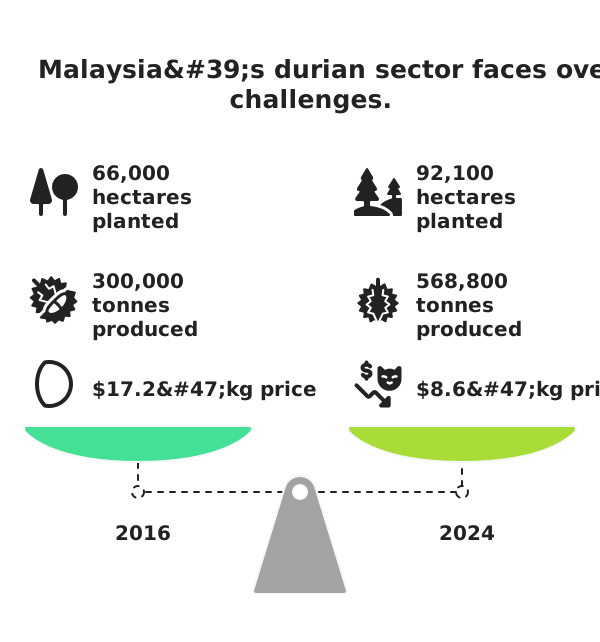
Malaysia’s durian-planted area swelled to 92,100 hectares in 2024, a 40% jump from 2016, while production surged 90% to 568,800 tonnes. In early July 2026, Grade A Musang King durians from grower Stephen Chow’s orchard sold for US$8.6 per kilogram—roughly half the price a year earlier and about a third of the 2024 peak.
The glut coincides with rising climate adaptation costs, from extra irrigation to more expensive pesticides. This is creating a split market where some growers see opportunity while others face losses. The next agricultural census will show whether the expansion persists.
For Stephen Chow, the numbers no longer add up. His Grade A Musang King durians fetched US$8.6 per kilogram in early July 2026—half the price of a year ago. He expects a loss.
Fifty kilometres away, Lim Chin Khee sees the same weather differently. The adviser to Malaysia’s Durian Academy tells growers that disaster is an opening: when heat or floods thin out competitors, prices can jump. The gap between Chow’s loss and Lim’s calculus defines the durian sector’s future. Climate volatility is not just squeezing margins. It is sorting winners from losers in a market that China’s appetite built.
The oversupply that unmasked climate winners
Farmgate prices for Malaysia’s premium durians have collapsed. Chow’s Grade A Musang King fruit dropped to US$8.6 per kilogram in early July 2026, down sharply from a year earlier. The price slide reflects a surge in supply that has outpaced demand even as China’s appetite for durians has grown. Between 2020 and 2022, China accounted for roughly 95 percent of global durian exports, according to the Food and Agriculture Organization of the United Nations. China imported 1.87 million tonnes of fresh durians worth US$7.5 billion in 2025, a six-fold volume increase over the past decade.
Malaysia’s acreage expanded to 92,100 hectares in 2024 from about 66,000 hectares in 2016. Production grew nearly 90% to 568,800 tonnes over the same period. The boom was fueled by China’s decision to permit whole frozen Malaysian durians in 2019, followed by fresh fruit in 2024, as part of what has been called “durian diplomacy.” But the opening of China’s market encouraged a planting surge that is now depressing prices across the sector.
Weather that favoured flowering—afternoon highs of 33–35°C and night-time rain—also boosted yields. Higher fuel and fertiliser prices, linked partly to the Iran conflict, raised Chow’s costs. Flooding in 2021 damaged about 100 of his trees and machinery. Persistent rain during flowering seasons from 2022 to 2024 caused pollination failures.
“Most likely there’ll be a loss this year,” Chow said.
The chart below captures the scale of a decade’s expansion—and the price collapse that followed.
Export data shows Malaysia’s premium positioning is not translating into volume. Vietnam’s durian exports to China reached about US$846 million in the first half of 2026. Malaysia’s were approximately US$30 million. Thai and Vietnamese growers, who harvest early, dominate shipments. Malaysian growers rely on varieties like Musang King and Black Thorn, which are picked only after natural ripening. That quality command has not stopped the price slide.
The Malaysian meteorological department reports a mean temperature rise of 0.24°C per decade in Peninsular Malaysia since 1969. That is about 1.4°C over the full period. More hot days exceed 33°C in inland farming belts.
Lim Chin Khee, the Durian Academy adviser, expects El Niño to push temperatures to record highs between March and May. He urges growers to expand water reservoirs or install tube wells. “When any disaster strikes, that is an opportunity,” he said.
Ooi Teik Hock moved his orchard from lowland Perak to the highlands a decade ago to escape rising heat. He says fruit quality problems were rarer two decades ago. Pest proliferation forces him to apply pesticides more often—costs jumped about 30% in three years. This season, for the first time, he saw no fruit bats, a key pollinator. He attributes the loss to possible extreme heat or pesticide use.
| Factor | Malaysia | Vietnam | Gap |
|---|---|---|---|
| Planted area, 2016 | ~66,000 ha | — | — |
| Planted area, 2024 | 92,100 ha | — | — |
| Production, 2016 | ~300,000 tonnes | — | — |
| Production, 2024 | 568,800 tonnes | — | — |
| Exports to China, H1 2026 | ~US$30 million | ~US$846 million | Multiple factor |
| Premium Musang King price | US$8.6/kg (Jul 2026) | — | Half 2025 level |
| Pesticide cost rise (3 years) | ~30% | — | — |
| Sources: Malaysian agricultural statistics, Vietnamese trade reports, grower interviews | |||
Adaptation costs are rewriting the balance sheet
Climate volatility demands investment that growers can ill afford when prices are falling. Kie Kim Hwa, who grows durians on Penang Island, has adopted technology to manage this uncertainty. His orchard deploys sensor networks positioned among trees and in soil to track rainfall, humidity and wind speed in real time. The data streams to a cloud drive, allowing him to monitor conditions remotely and respond quickly. He also uses a simpler method—checking buckets of water for insect presence—to gauge pest levels and time interventions. By matching output to market demand through early detection of problems, Kie has built a buffer against unpredictable weather.
The costs of that volatility are cascading. Higher diesel and electricity prices raise irrigation and transport costs. Nitrogen fertiliser, linked to global gas markets, has become more expensive after Middle East disruptions. Growers bear these input shocks immediately. Exporters and retailers preserve margins by squeezing farmgate prices. The result is a trade-off between orchard viability and competitive pricing in China.
Malaysia’s policy response is uneven. The National Adaptation Plan calls for improved irrigation and climate-smart farming support. Budget allocations since 2025 include funds for drainage upgrades and micro-credit. But implementation remains ad hoc. Most durian-specific help comes through extension programmes, not a dedicated scheme. Regional climate projections suggest that by the 2030s, extreme rainfall events could intensify by 10–20%, raising flood risks while warmer nights favour pests.
Western capital flows into this gap indirectly. European and North American investors back logistics and cold-chain firms that move premium Malaysian durians into Chinese cities. Western consumers buying durian-flavoured snacks drive sourcing from Southeast Asian orchards. The footprint is real, amplifying land-use change without on-farm visibility.
The next Malaysian agricultural census, expected in early 2027, will offer an answer. If durian area is still expanding despite falling prices, it means investors are discounting climate risk. If planted area plateaus, consolidation among well-capitalised growers will accelerate. The gap between Chow’s loss and Lim’s opportunity will widen into a permanent feature of the market.
Beyond the headline
The Bigger Picture
Malaysia’s durian story is part of a broader shift in tropical agriculture. Export-oriented specialty crops are pushed into climate-sensitive regions to chase high margins. As warming accelerates, these niche sectors become testing grounds for whether adaptation finance, agritech and risk-sharing can keep small producers competitive. The answer will shape supply chains far beyond durian.
The Money Trail
The real leverage in Malaysia’s premium durian trade sits with traders, packers and cross-border logistics firms that control access to Chinese buyers. Their investments in cold-chain routes and marketing determine which orchards stay plugged into high-paying urban markets. Growers shoulder the upfront costs of climate adaptation with limited ability to pass expenses on.
The Timing
Climate volatility is colliding with a cyclical oversupply just as China’s durian market matures and becomes price-sensitive. Growers who expanded aggressively after market-access deals now face thinner margins. Adaptation spending is rising. The next few seasons will test whether premium branding can withstand lower prices and higher physical climate risk.
What the durian squeeze means for four groups
With durian oversupply and climate costs rising, four sets of decisions take on new urgency.
- Western investor in Southeast Asian agriculture
Re-evaluate climate-sensitive asset strategies. Malaysia’s premium durian sector shows how fast returns can shrink when oversupply meets adaptation costs. Monitor the next agricultural census for acreage trends. If expansion continues, it signals discounted risk. If not, look for consolidation opportunities in tech-enabled orchards. Track policy sites like Malaysia’s Ministry of Natural Resources, Environment and Climate Change for resilience funding signals.
- Global food and beverage procurement manager
Assess sourcing resilience for tropical fruit ingredients. The gap between Vietnamese volume and Malaysian quality is widening. Long-term supply agreements that lock in premium varieties like Musang King may need price-floor adjustments. China’s customs data portal shows shifting supplier shares—watch it to anticipate cost volatility and diversify origins beyond Thailand and Vietnam.
- Agritech solutions provider for tropical farming
Sensor networks and pest-monitoring tools like those Kie Kim Hwa uses are moving from pilot to necessity. Heat-tolerant rootstocks and water-saving irrigation are next. Market directly to grower cooperatives in Perak and Penang, where climate stress is worst. Offer financing packages tied to crop cycles, since smallholders cannot pay upfront during price collapses.
- Policy analyst for climate resilience in developing economies
This case study exposes a gap. Malaysia’s National Adaptation Plan mentions agriculture, but implementation is uneven and durian-specific support is scarce. Compare with Vietnam’s Regional Planting Code model, which streamlines traceability. Analyse whether disaster-risk financing or micro-credit reaches smallholders effectively. The 2027 census will be a report card on current policy.
Explainer
- Musang King
- A premium Malaysian durian cultivar known for its bright yellow flesh and creamy texture. It commands higher prices than common varieties but is sensitive to rainfall during fruit development, which can cause discoloration. The variety was central to Malaysia’s push into China’s high-end market following market-access deals.
- El Niño
- A periodic warming of Pacific Ocean surface waters that shifts global weather patterns. For Southeast Asia, it often brings hotter, drier conditions during the March–May period. Lim Chin Khee of Malaysia’s Durian Academy has warned that upcoming El Niño events could push temperatures to record highs in durian-growing regions.
- Durian Academy
- A Malaysian training institution that advises durian growers on orchard management, pest control and climate adaptation. Its advisers, like Lim Chin Khee, promote techniques such as reservoir expansion and tube well installation to counter water shortages. The academy bridges research and practice for smallholders.
- Black Thorn
- Another high-value Malaysian durian cultivar, less common than Musang King and prized for its deep orange flesh and strong flavour. It shares similar climate sensitivities and has been part of the acreage expansion driven by Chinese demand. Its market niche is smaller but equally vulnerable to price swings.
RELATED STORIES