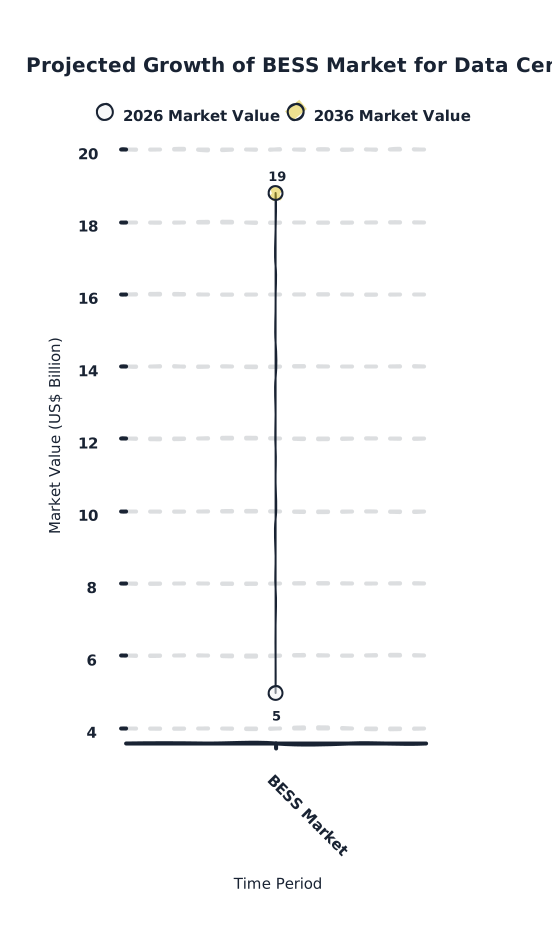
U.S. AI developers, facing interconnection queues that average nearly five years, are pouring billions into off-grid battery storage and microgrids. The battery energy storage system (BESS) market serving data centers is projected to grow from $4.96 billion in 2026 to $18.79 billion by 2036.
The shift is reshaping energy procurement and propelling equipment suppliers like Bloom Energy, whose stock jumped 12% on a $1.7 billion fuel cell deal. But the deeper disruption is to the traditional utility business model, as the largest electricity consumers build their own parallel power infrastructure.
The wait for a grid connection has become a structural problem that AI data centers are solving by walking away from the grid entirely. Hyperscalers are no longer waiting for utilities to expand transmission lines. They are building self-contained power systems—battery storage, solar arrays, and microgrids—that can run independently for years. In New Albany, Ohio, an AI campus is rising with a dedicated 350 MW microgrid and a 430 MWh battery system, operated by Veolia. It is designed to island itself from the regional grid whenever necessary. This is not a stopgap. It is a fundamental re-architecting of who builds and controls the electricity that powers the AI economy.
A queue that forces a parallel grid
New U.S. power projects now spend an average of nearly five years in interconnection queues before connecting to the grid, according to analysis from Lawrence Berkeley National Laboratory. For AI data centers that need gigawatts of power within months, that timeline is unworkable. The result is a parallel build-out: private microgrids and utility-scale battery storage that bypass the traditional utility entirely.
The New Albany campus shows the alternative. Its 350 MW microgrid and 430 MWh of battery storage, operated by Veolia, can disconnect and run on its own generation. The design treats the regional grid as a backup, not a primary source. Across the country, similar projects are stacking up. Modo Energy‘s Q2 2026 U.S. BESS Capital Markets Report tracked 12 transactions totaling 3.8 GW of battery capacity, with disclosed debt jumping to $14.3 billion from $2.7 billion in the previous quarter. Three solar-plus-storage mega-projects drove the surge, including Cypress Creek’s $3.5 billion Steel River financing.
Pete Tillotson, senior BESS analyst at Benchmark Mineral Intelligence, argues that hyperscalers are shifting from gas toward large renewable PPAs plus storage. According to Tillotson, while hyperscalers have historically looked to gas to power new load additions, renewable PPAs such as this demonstrate the relevance of clean power to the incoming wave of data centre capacity. Enverus Intelligence Research projects that hyperscalers will invest about $5 trillion through 2030 to add roughly 62 GW of off-grid natural gas-fired power for data centers. Separately, around 40% of all new data center capacity additions across fuel types are expected to be entirely off the main grid. The BESS market for data centers is projected to reach $18.79 billion by 2036, up from $4.96 billion this year, according to industry projections.
The trajectory is easier seen than read.
| Entity | Current rule | New rule | Effective date |
|---|---|---|---|
| Storage projects beginning construction 2026 | Full ITC eligibility without FEOC restrictions | At least 55% of project costs must come from non-prohibited foreign entities | 2026 |
| Storage projects beginning construction 2030+ | Same | Threshold rises to 75% | 2030 |
| All six major U.S. grid operators | Varied large-load interconnection processes | FERC ordered justification or overhaul of rules | Pending, late 2026 expected |
| Source: One Big Beautiful Bill Act; Federal Energy Regulatory Commission | |||
The regulatory and financial forces reshaping the grid
The off-grid shift is not just a procurement choice. It is being shaped by a mix of federal tax policy and grid governance. The One Big Beautiful Bill Act, enacted July 4, 2025, introduced foreign-entity-of-concern restrictions on investment tax credits for energy storage. For projects starting construction in 2026, at least 55% of costs must come from non-prohibited foreign entities to qualify; that rises to 75% for projects starting in 2030 or later. Meanwhile, FERC has ordered all six major U.S. grid operators to justify or overhaul their large-load interconnection rules, directly affecting how hyperscale data centers and associated storage connect to regional grids.
A July 2026 U.S. Geological Survey synthesis identified 771 AI data centers near federal lands and noted that agencies are exploring colocation of data centers with energy infrastructure on public lands. That signals federal land policy could influence where microgrid clusters emerge. For Western readers, the closest parallel to this off-grid model is the fast-growing U.S. microgrid approach for hyperscale data centers, exemplified by Veolia’s Ohio project. The key difference is intent: U.S. projects are increasingly designed to operate fully islanded for years because interconnection queues are so long, while many APAC sites still plan eventual grid integration. That divergence means Western utilities face a more direct threat to future large-load revenues and must adapt business models faster.
For regulated utilities, the risk is not theoretical. As hyperscalers lock in multi-billion-dollar off-grid deals, the traditional utility model—built on serving large, stable loads—faces erosion. The next FERC ruling on interconnection rules, expected in late 2026, will signal whether the grid can reclaim some of that load or whether the parallel build-out accelerates further.
Beyond the headline
The Bigger Picture
The move toward self-contained power systems for AI campuses signals a broader re-architecting of electricity systems around large digital loads rather than traditional residential and industrial demand. Instead of simply adding generation to existing grids, developers are building parallel, bespoke infrastructure that treats data centers as anchor tenants for dedicated microgrids. This shifts planning power from utilities and regulators toward hyperscalers and their financiers, with long-term implications for how future transmission and storage capacity is justified and deployed.
The Power Behind It
The ability to supply dedicated power to AI campuses is concentrating among entities that combine capital, site control, and technical expertise—large developers like NextEra, infrastructure funds such as Brookfield, and specialized operators like Veolia. Their advantage lies in locking in multi-decade, contracted revenues from mission-critical loads, often outside traditional rate cases. This shifts revenue streams and strategic leverage away from regulated utilities, which risk being sidelined as these new arrangements bypass conventional tariff structures.
The Reach
Washington is emerging as a decisive player in where AI-linked microgrids and battery storage clusters get built. Through land-use policies and tax-credit eligibility rules, federal agencies can steer development toward certain regions and domestic manufacturers. A July 2026 U.S. Geological Survey report identified hundreds of existing data centers near federal lands and outlined scenarios for colocating new centers with energy infrastructure on public property—a signal that federal land management may directly shape the geography of the AI-energy build-out.
Four groups facing the off-grid shift
With interconnection queues stretching toward the end of the decade and capital markets funding parallel power systems, four groups face immediate decisions.
- US-based AI Infrastructure Investor
Evaluate investment opportunities in companies like Bloom Energy, Vertiv, and BESS developers, while assessing the long-term impact on traditional utility stocks. The projected $18.79 billion BESS market by 2036 and recent $14.3 billion quarterly debt surge signal that capital is flowing to off-grid solutions. Monitor FERC’s forthcoming interconnection rule changes, as any streamlining could alter the pace of private microgrid adoption.
- US Data Center Operator or Developer
Assess the feasibility and cost-benefit of deploying behind-the-meter microgrids and large-scale BESS for new or expanding AI data center projects. The Ohio campus model shows a 350 MW microgrid with 430 MWh of storage can operate independently. Factor in the One Big Beautiful Bill Act’s foreign-entity restrictions on tax credits, which tighten in 2030, and watch state-level siting rules that may affect project timelines.
- US Utility Executive or Grid Planner
Develop strategies to adapt to the changing energy landscape, including potentially overhauling interconnection processes, offering new services for microgrid integration, or exploring partnerships with AI infrastructure developers. The Enverus projection that 40% of new gas capacity will be off-grid underscores the urgency. FERC’s pending large-load interconnection rule overhaul is a critical moment to shape whether utilities can retain some of this load.
- Western Energy Storage Equipment Manufacturer
Strategize to scale manufacturing capacity, enhance product offerings for high-density AI loads, and navigate foreign-entity-of-concern restrictions for tax credit eligibility in the U.S. market. Vertiv’s Malaysia expansion illustrates the global supply-chain response. The 24 GW of planned utility-scale battery additions in 2026 alone signals enormous near-term demand, but qualifying for U.S. incentives will require careful sourcing to meet the 55% cost threshold this year and the 75% threshold after 2030.
Explainer
- BESS
- Battery Energy Storage System. Large-scale batteries that store electricity for later use, often paired with solar or wind farms. In AI data centers, BESS can smooth rapid power fluctuations from accelerator-dense racks and enable microgrids to run independently for hours or days. The U.S. installed base surpassed 40 GW in early 2026, with another 24 GW planned for the year.
- Microgrid
- A localized energy system that can operate connected to the main grid or independently in “island mode.” For AI campuses, microgrids typically combine on-site generation, battery storage, and smart controls. The New Albany, Ohio project’s 350 MW microgrid is designed to disconnect entirely, making the regional grid a backup rather than a primary source.
- Interconnection queue
- The waiting list of power projects seeking permission to connect to the transmission grid. In the U.S., studies by Lawrence Berkeley National Laboratory show new projects now spend nearly five years on average in these queues. The backlog is a primary reason AI developers are building off-grid systems instead of waiting.
- FERC
- Federal Energy Regulatory Commission. The U.S. agency that oversees interstate electricity transmission and wholesale markets. In 2026, FERC ordered all six major grid operators to justify or overhaul their rules for connecting large loads like data centers, a process that could reshape how quickly hyperscalers can access the grid.
- Hyperscaler
- A company that operates massive, scalable data center infrastructure, typically for cloud computing and AI workloads. Examples include Google, Microsoft, and Amazon. Their power demands—racks pulling 40–100 kW—are driving the shift to dedicated microgrids and utility-scale battery storage.
RELATED STORIES