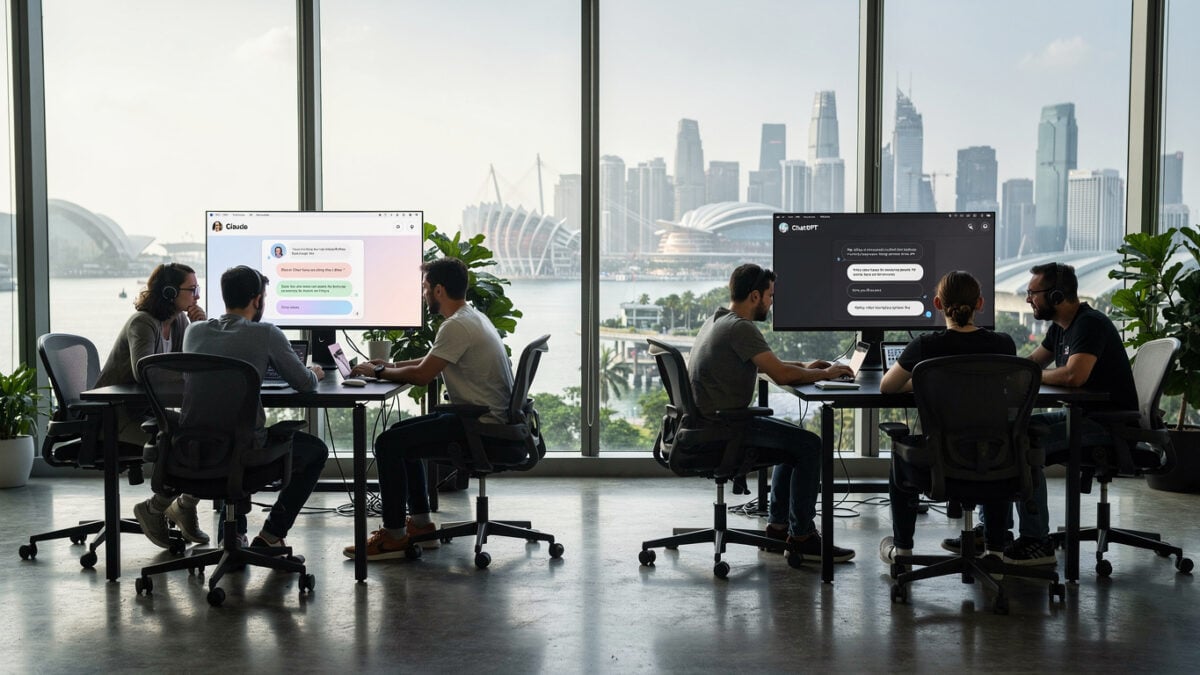
Anthropic will open its first Southeast Asia office in Singapore in October, its fifth Asia-Pacific location, as it moves to convert unusually high per-capita use of its Claude model into enterprise contracts. Singapore ranks second out of 121 countries for Claude usage per person, behind only Australia, according to the company.
The move intensifies a direct contest with OpenAI, which already runs an applied AI lab and a government partnership in the city-state. Anthropic has appointed Dale Finlay, a former OpenAI regional executive, to lead the expansion.
Singapore uses Claude more per person than almost any other country. On September 16, Anthropic said it will open an office there in October, turning that organic pull into a physical presence for the first time. The city-state is already the Asia headquarters for rival OpenAI, which signed a government deal in May and is reportedly leasing 100,000 square feet of new space. Anthropic is arriving late, but with a product that has already found an audience.
The office will be the company’s fifth in Asia-Pacific, after Tokyo, Seoul, Bengaluru, and Sydney. It lands in a market where the Singapore government has committed more than S$1 billion to public AI capabilities through 2030, and where enterprise adoption is accelerating. For Anthropic, the question is not whether Singapore wants Claude. It is whether the company can convert that demand into durable commercial relationships before OpenAI locks in the region’s largest buyers.
The usage numbers that made Singapore unavoidable
According to Anthropic’s data, Singapore’s Claude adoption is 5.81 times higher than population-based expectations would predict. The company has not released the methodology behind that figure, making independent verification difficult. Still, the ranking is consistent with the city-state’s broader AI intensity: more than 70 AI centres of excellence have been established there, and the government’s National AI Research and Development Plan channels over S$1 billion into fundamental and applied work from 2025 to 2030.
Chris Ciauri, Anthropic’s international managing director, called the Singapore office a natural next step, given the usage levels. The company has hired Dale Finlay, who spent six months as OpenAI’s regional go-to-market head and previously held senior roles at Google Cloud, to lead the ASEAN operation. His appointment signals that Anthropic intends to compete for the same enterprise customers OpenAI is already courting.
OpenAI’s own footprint is substantial. In May 2026, it signed a memorandum with Singapore’s Ministry of Digital Development and Information to launch an Applied AI Lab—its first outside the United States—and committed more than S$300 million to the effort. The lab plans to expand to over 200 technical roles. OpenAI has also hired Sandhya Devanathan, formerly Meta’s head for South Asia, as its ASEAN and Australia head.
For a Singaporean bank weighing which AI assistant to embed in its customer service, the choice between Claude and ChatGPT is no longer a remote decision made in San Francisco. It is a negotiation with a local team that understands local data rules. The office gives Anthropic a base to hire and sell, but the harder problem is converting Singapore’s Claude enthusiasm into multi-year enterprise contracts before OpenAI locks in the region’s largest buyers.
| Entity | Current rule | New rule | Effective date |
|---|---|---|---|
| Singapore Government | Prior AI research funding | National AI R&D Plan: over S$1 billion for fundamental and applied AI, talent | 2025–2030 |
| OpenAI | No formal government partnership | MOU with MDDI: S$300 million, Applied AI Lab, 200+ roles | May 2026 |
| Singapore (MDDI) | Sectoral oversight of AI | AI Verify toolkit and model governance guidance for voluntary adoption | Ongoing |
| Sources: Ministry of Digital Development and Information, Singapore EDB | |||
A coordination layer, not just a market
Singapore is becoming the region’s coordination layer for frontier AI: a place where corporate expansion, government funding, and enterprise demand reinforce one another. That structure turns a small domestic market into a gateway for multi-country sales, hiring, and policy engagement across Southeast Asia. OpenAI already has the deeper institutional lead—a government-linked partnership, a lab, and a larger announced hiring plan. Anthropic’s advantage is product pull, but it still has to convert that demand into local relationships and contracts.
The regulatory environment is lighter than the EU’s AI Act, relying on voluntary tools like AI Verify and sectoral oversight rather than binding risk categories. Compared with the US, Singapore is more centralized and strategy-driven, using national funding to attract firms. That makes it easier for companies to move fast, but also means government alignment matters more than it would in a purely commercial market.
Watch for OpenAI’s hiring and office-footprint updates over the next few months. If they expand as planned, it means the company is deepening its regional operating base beyond the lab. Singapore government announcements tied to the National AI Research and Development Plan are expected through 2026 and 2027; if they materialize, public money will continue pulling frontier AI firms into the market. The contest is not about who opens an office first. It is about who turns Singapore into a durable hub that shapes enterprise defaults across the region.
Beyond the headline
The Bigger Picture
Singapore is becoming the region’s coordination layer for frontier AI: a place where corporate expansion, government funding, and enterprise demand reinforce one another. That structure matters because it turns a small domestic market into a gateway for multi-country sales, hiring, and policy engagement across Southeast Asia.
The Reach
OpenAI’s Singapore footprint gives it a mechanism for locking in enterprise workflows through local deployment teams and government-facing relationships, which can spill into multinational procurement decisions. For Western enterprises, that raises the odds that Singapore-based AI standards become the defaults used across Asia-Pacific rollouts.
The Timing
This week matters because Anthropic is arriving just as Singapore’s public AI push and OpenAI’s local expansion are both already in motion. The market is not being opened; it is being contested now, which makes October a practical deadline for hiring, customer meetings, and partner signaling rather than a symbolic launch date.
The next 18 months will decide the regional default
With Anthropic’s office opening in October and OpenAI already scaling its local presence, the contest for Southeast Asia’s enterprise AI market is entering a decisive phase.
- US-based AI enterprise investor with APAC exposure
Evaluate how Anthropic’s Singapore entry affects the competitive dynamics for AI platform adoption in the region. The company’s organic usage advantage could accelerate revenue growth if it converts users into paying enterprise customers, but OpenAI’s institutional lead and government ties present a formidable barrier. Monitor Anthropic’s hiring pace and early customer announcements in the next two quarters.
- Western enterprise technology procurement manager with ASEAN operations
Assess your current AI vendor relationships. With both Anthropic and OpenAI establishing local teams, you may gain leverage in pricing and support negotiations. Request product roadmaps and data residency commitments directly from their Singapore-based sales teams, as local presence does not automatically change hosting or support arrangements.
- Western AI talent considering relocation to Southeast Asia
Research specific openings at Anthropic’s new Singapore office and OpenAI’s expanding Applied AI Lab. The government’s S$1 billion AI plan is also funding talent development programs, which could create additional opportunities. Check the Ministry of Digital Development and Information’s newsroom for updates on the National AI Research and Development Plan and related hiring initiatives.
- US AI startup founder eyeing international expansion
Study Singapore’s regulatory environment and funding landscape. The city-state’s use of voluntary governance tools like AI Verify and its centralized, strategy-driven approach offer a faster path to market entry than the EU’s binding rules. Investigate whether your product aligns with the government’s AI missions in public services, finance, and healthcare, as those sectors are receiving priority support.
FAQ
Where are Claude and ChatGPT available commercially in Southeast Asia?
Anthropic’s Singapore office announcement concerns regional operations, not a consumer launch restriction change. Businesses should verify product availability, data processing terms, and enterprise contracting terms directly with Anthropic and OpenAI sales teams, because local presence does not itself change hosting, support, or residency arrangements.
What does Singapore’s S$1 billion AI funding actually cover?
Singapore’s over S$1 billion AI plan runs from 2025 to 2030 and is aimed at research, applied deployment, and talent development. That means the money is not a single grant for one company or one office; it is a multi-year national envelope spread across programs and institutions.
How do AI firms typically enter Singapore’s market?
OpenAI’s Singapore partnership shows the market-entry pattern: local lab presence, technical hiring, and government-linked collaboration. For companies considering entry, the practical question is usually not incorporation alone but whether they can recruit specialized talent, secure local partners, and align with Singapore’s AI governance expectations.
Explainer
- Claude
- Claude is a family of large language models developed by Anthropic, designed to assist with tasks like writing, analysis, and coding. It competes directly with OpenAI’s ChatGPT and is known for a focus on safety and constitutional AI principles. In Singapore, Claude’s per-capita usage ranks second globally, which is a key reason Anthropic is opening a local office.
- AI Verify
- AI Verify is a voluntary governance toolkit developed by Singapore’s Infocomm Media Development Authority to help organizations assess the fairness, explainability, and robustness of their AI systems. It is part of Singapore’s lighter-touch regulatory approach, contrasting with the EU’s binding AI Act. The toolkit is used alongside sectoral oversight by agencies like the Monetary Authority of Singapore.
- ASEAN
- The Association of Southeast Asian Nations is a political and economic union of ten member states, including Singapore, Indonesia, and Thailand. It represents a combined market of over 660 million people and is a key growth region for technology adoption. For AI firms, Singapore often serves as a launchpad into the broader ASEAN market due to its connectivity and business-friendly environment.
- Applied AI Lab
- OpenAI’s Singapore Applied AI Lab, announced in May 2026, is its first such facility outside the United States. It focuses on deploying frontier AI in public services, finance, and healthcare, and plans to expand to more than 200 technical roles. The lab is part of a broader S$300 million commitment under a government partnership.
RELATED STORIES