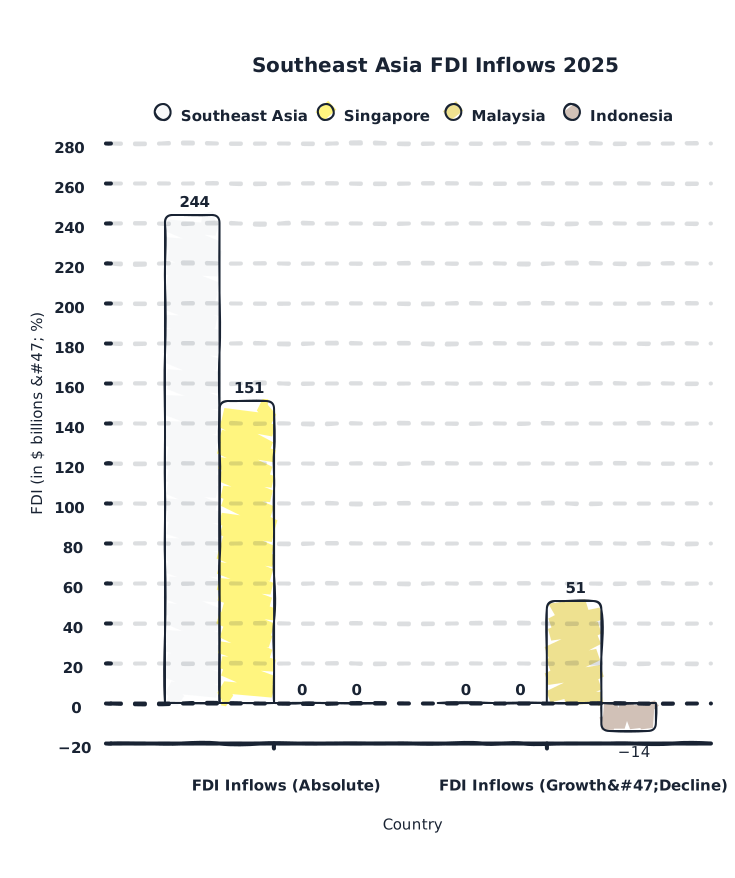
Southeast Asia drew a record US$244 billion in foreign direct investment in 2025, a 10% jump from the year before, according to UN Trade and Development data analyzed by UOB. Singapore captured US$151 billion of that total, making it the world’s second-largest FDI destination after the United States, while Malaysia’s inflows surged 51% on a wave of digital infrastructure spending.
Indonesia’s FDI fell 14%, but UOB economists say that headline masks continued long-term commitments by global investors—a pattern that challenges the simple narrative of winners and losers.
Southeast Asia’s record foreign direct investment in 2025 reflects a regional reallocation of capital across multiple channels—not a uniform surge or decline. The region attracted US$244 billion, up 10% year-on-year, outpacing the 6% global growth rate. But the headline figure conceals divergent patterns: Singapore dominated with US$151 billion, Malaysia accelerated at 51%, while Indonesia contracted 14%. That divergence tells a more complex story than the numbers alone suggest.
Indonesia’s decline, in particular, warrants closer examination. UOB economists Enrico Tanuwidjaja and Vincentius Ming Shen argued that the country’s falling headline FDI figure masks continued long-term commitments by global investors. The capital arrives through buyouts and project finance rather than greenfield announcements—a composition shift that takes longer to show up in employment and power demand but points to sustained investor confidence in the country’s infrastructure and acquisition opportunities.
The composition shift beneath the headline
Indonesia led Southeast Asia in three categories despite its 14% FDI decline: corporate acquisitions, industrial developments, and the largest share of large-scale infrastructure financing, according to UOB’s analysis. That mix points to money committed for longer-horizon projects—the kind that does not register in quarterly inflows but shows up later in construction contracts and power purchase agreements.
Singapore, meanwhile, pulled in US$151 billion, cementing its role as the region’s financial gateway and the world’s second-largest FDI recipient. The city-state’s professional, scientific, and technical investment reached US$22 billion in 2024, according to the Singapore Economic Development Board, underscoring its hub for headquarters and R&D activities.
Malaysia’s 51 per cent jump was the region’s fastest, driven largely by digital infrastructure. Approved investments in information and communication subsectors hit RM152.9 billion in 2025, much of it tied to data centres, AI, and cloud computing, according to the Malaysian Investment Development Authority.
The distribution is easier seen than read.
| Metric | Figure | Source | Date |
|---|---|---|---|
| Southeast Asia total FDI | US$244 billion | UN Trade and Development, via UOB | 2025 |
| Singapore FDI | US$151 billion | UN Trade and Development, via UOB | 2025 |
| Malaysia FDI growth | 51% increase | UN Trade and Development, via UOB | 2025 |
| Indonesia FDI change | 14% decline | UN Trade and Development, via UOB | 2025 |
| Source: UN Trade and Development, via UOB analysis | |||
A reallocation, not a retreat
The divergence in headline numbers reflects a regional reallocation of capital, not a loss of momentum. Singapore’s scale as a financial hub concentrates financing and headquarters functions, while Malaysia, Thailand, and Vietnam compete for the factories and data centres that follow. That dynamic means Malaysia is likely to keep winning digital infrastructure investment, Thailand can capture more industrial capacity, and Vietnam will push for higher-value manufacturing as firms diversify away from China.
Indonesia’s mix of acquisitions and infrastructure finance pressures neighbors to sharpen their own incentives. The country’s long-term commitments may not boost quarterly FDI figures, but they are already reshaping project pipelines. UOB’s analysis suggests the region’s structural drivers—digital infrastructure and green industries—remain intact, even as the composition of capital shifts.
The next UN Trade and Development regional FDI release, expected in 2027, will show whether the 2025 surge was sustained or a one-off reallocation. Malaysia’s and Indonesia’s 2026 investment updates, due through late 2026, will be the first test. If digital infrastructure and long-duration projects keep winning, the headline numbers will matter less than the commitments they conceal. If not, the region may revert to Singapore-led financial intermediation—and Indonesia’s 14 per cent decline will look less like a mask and more like a warning.
Beyond the headline
The Bigger Picture
The headline figures are not just a ranking of national winners and losers; they show a regional reallocation of capital from headline growth toward execution quality. Singapore keeps absorbing financial intermediation, while Malaysia and Vietnam are pulling in the physical assets that follow more specialized supply-chain and digital spending.
The Money Trail
The money is moving with firms that need redundancy, not just yield. That favors projects tied to data centres, electronics assembly, and industrial parks, where investors can place capital in smaller economies that are closer to production, while Singapore remains the place where the financing is often booked and structured.
What Isn’t Being Said
The under-discussed issue is that a falling headline FDI figure can still coexist with a stronger project pipeline if capital is arriving through acquisitions and infrastructure finance. That matters because the investors most exposed to Southeast Asia need to separate announced inflows from the slower-moving commitments that may show up in employment, power demand, and construction later.
What the numbers mean for your capital
With FDI flows reshaping the region’s investment landscape, Western businesses and investors face a more complex set of decisions than the headline figures suggest.
- Western investor with Southeast Asia market exposure Re-evaluate portfolio allocations in light of Indonesia’s hidden long-term commitments. The 14 per cent decline may mask a pipeline of acquisitions and infrastructure projects that will boost earnings in construction, energy, and industrial sectors over the next two to three years. Check Singapore EDB’s Southeast Asia investment analysis page for updated sector breakdowns within the next quarter.
- Western supply chain manager with APAC operations Assess how the shift in manufacturing relocation from China is affecting your supply chain. Malaysia’s digital infrastructure boom and Vietnam’s push for higher-value manufacturing offer new sourcing options, but also require due diligence on power availability and logistics. Track Malaysia’s MIDA investment releases for 2026 approved-project composition to identify emerging industrial clusters.
- Western business development manager for digital infrastructure Investigate specific opportunities in Malaysia’s digital infrastructure sector, where approved investments in AI, big data, and data centres reached RM152.9 billion in 2025. Prioritize market entry or expansion strategies that align with the government’s incentives for cloud computing and green data centres. Monitor MIDA’s project pipeline for partnership openings.
- Western policy analyst focused on ASEAN economic development Incorporate the nuanced FDI trends into policy analyses, advising on trade agreements and investment incentives that reflect the shift from greenfield announcements to acquisitions and infrastructure finance. The region’s ability to turn long-term commitments into job creation will depend on regulatory clarity and execution speed—factors that should feature in your next briefing.
Explainer
- FDI
- Foreign direct investment. A cross-border investment where a resident in one economy obtains a lasting interest in an enterprise in another economy, typically involving equity, reinvested earnings, or intra-company debt. UN Trade and Development’s framework distinguishes these components, which matters when comparing headline inflows across markets because acquisitions can inflate figures without new productive capacity.
- UOB
- United Overseas Bank Ltd, a Singapore-based bank and one of the largest financial institutions in Southeast Asia. Its economic research team regularly analyzes regional capital flows and trade patterns. In 2026, UOB economists highlighted that Indonesia’s FDI decline masked long-term commitments, a finding that reframed the narrative around the country’s investment outlook.
- UN Trade and Development
- The United Nations body responsible for trade and development issues, formerly known as UNCTAD. It publishes annual FDI data and the World Investment Report, tracking global investment trends. Its FDI framework separates equity, reinvested earnings, and intra-company debt, which helps analysts distinguish between financial flows and productive investment.
- ASEAN
- The Association of Southeast Asian Nations, a political and economic union of ten member states including Singapore, Malaysia, Indonesia, Thailand, and Vietnam. Its combined FDI stock reached US$3.6 trillion in 2024, more than the combined stock of Africa and South America, reflecting its growing role in global supply chains.
- Greenfield investment
- A type of foreign direct investment where a parent company builds a new operation in a foreign country from the ground up, as opposed to acquiring existing assets. In Malaysia, approved greenfield projects typically take 18 to 24 months to move through regulatory steps before implementation, according to the Malaysian Investment Development Authority.
RELATED STORIES