Flash floods in Afghanistan’s Nuristan province killed at least 23 people on Monday, July 21, and left more than 100 missing, according to the National Disaster Preparedness Authority. The same monsoon system caused at least 25 deaths in India and 27 in Nepal since mid-June, with forecasters warning of more extreme weather across 10 Afghan provinces.
The casualty counts are preliminary and could rise as rescue teams reach remote villages. The disaster exposes a regional pattern of vulnerability that no single country can manage alone.
The monsoon that tore through Afghanistan’s Nuristan province on Monday killed at least 23 people. Across South Asia, the same weather system has claimed at least 25 deaths in India on Monday and 27 deaths in Nepal since mid-June.
In Parun, the provincial capital, an unknown number of buildings collapsed into mud and rubble. Rescue crews searched for survivors and bodies through Tuesday night, while officials from the National Disaster Preparedness Authority said the number of missing—more than 100—was likely to change as damage assessments continued.
The meteorology department’s Monday evening warning covered heavy rain, thunderstorms, strong winds with sand, and flash floods across 10 of the country’s 34 provinces. For families in remote Nuristan settlements, where mud-built homes offer little protection, the forecast is not a statistic. It is the next few hours.
The floods in Nuristan are not an isolated event. They are part of a monsoon season that is testing the disaster-response capacity of three countries at once. The same weather system triggered landslides in India and Nepal, adding to a death toll that now spans the region.
The regional toll that one province cannot contain
Afghan officials said the floods killed at least 23 people in Nuristan province on Monday.
More than 100 others remained unaccounted for in Parun, the provincial capital, where buildings collapsed into mud and rubble. Qari Taj Mohammad Hemat, spokesperson for the National Disaster Preparedness Authority, said the casualty figures were preliminary and could change as search and rescue operations continued.
Yousaf Hammad of the National Disaster Management Authority said specialized teams had been dispatched to search for missing people and assess the damage. Local reports described widespread destruction of homes, shops, and vehicles.
In India, monsoon flooding and landslides killed at least 25 people on Monday.
Nepal has recorded 27 deaths since mid-June, with one person still missing and 69 injured.
The regional toll is easier to see than to read.
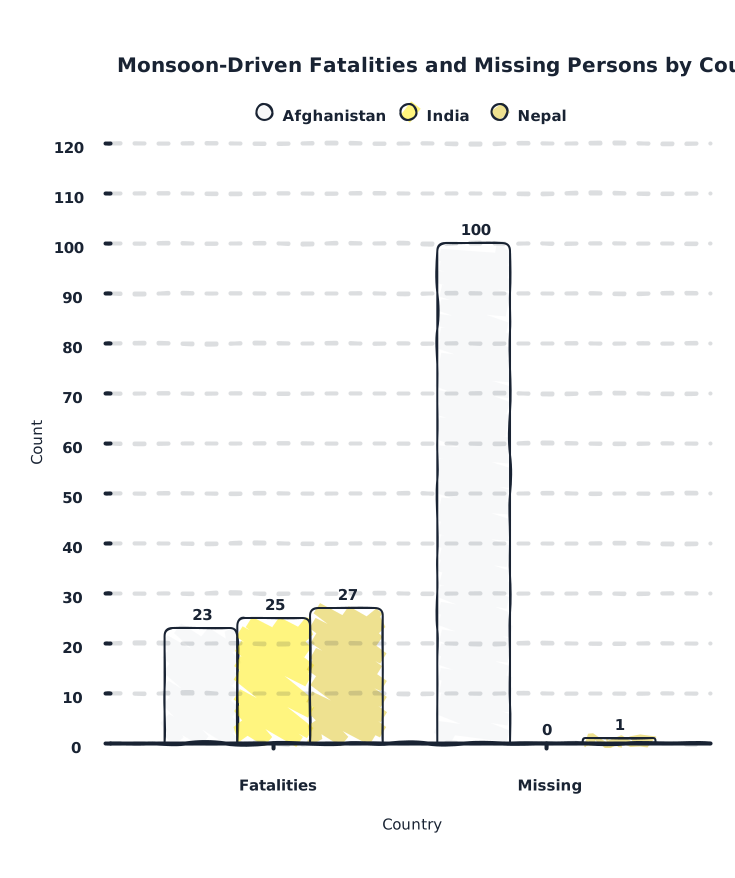
The meteorology department warned on Monday evening that heavy rain, thunderstorms, and flash floods could affect 10 of Afghanistan’s 34 provinces.
The warming atmosphere holds more moisture, making extreme rainfall events more likely. That physics does not respect borders.
| Region | Impact | Timeline | Key risk |
|---|---|---|---|
| Afghanistan (Nuristan) | 23 dead, over 100 missing | July 21, 2026 | Further flash floods in 10 provinces; blocked mountain roads |
| India (north/northeast) | At least 25 dead | July 21, 2026 | Landslides and river flooding disrupting transport |
| Nepal | 27 dead, 1 missing, 69 injured | Since mid-June 2026 | Continued monsoon rains triggering landslides in hill districts |
| Sources: National Disaster Preparedness Authority (Afghanistan); AP News (India, Nepal) | |||
A fragile country inside a warming system
Afghanistan ranks among the world’s least resilient nations to extreme weather. Decades of conflict have left roads, bridges, and housing unable to withstand sudden water surges. In remote areas, mud-built homes provide minimal protection, and deforestation has stripped hillsides of the root systems that once held soil in place.
Human-driven warming increases the atmosphere’s capacity to hold moisture, intensifying monsoon rainfall. The result is not more rainy days but heavier downpours that overwhelm drainage and trigger landslides. Specific climate data for Nuristan is not available, but the broader trend is clear: a warmer atmosphere loads the dice for events like this.
The same dynamics are at work across South Asia. India and Nepal are grappling with similar casualties from the same weather system, exposing a shared vulnerability that no single country’s disaster authority can address alone. No new international funding commitment has been confirmed in response to this event. The response remains domestic coordination of warnings and rescue, with the preparedness gap unchanged.
The meteorology department’s warning covers 10 provinces. For the families in Parun still waiting for news, the forecast is not a statistic. It is the next few hours.
Beyond the headline
The Bigger Picture
The floods in Nuristan are part of a regional weather system that does not stop at borders. When Afghanistan, India, and Nepal are hit in the same monsoon window, the relevant picture is the whole South Asian disaster environment, not a single province’s emergency response.
The Human Cost
In Nuristan, residents of remote settlements faced the flood with roads, housing, and communications already fragile. The missing count reflects families waiting for confirmation while rescue teams work through mud, rubble, and blocked access.
The Response Gap
The official response is centered on warnings, dispatches, and damage assessment. The forecast already covered 10 provinces, and the authorities’ current tools are focused on reacting after flooding begins.
Three decisions the disaster forces now
With more extreme weather forecast and rescue operations ongoing, the floods pose immediate choices for several groups.
- Humanitarian aid worker with Afghanistan operations
Check the UN OCHA Afghanistan page for emergency coordination updates and relief requests. Verify road access to Nuristan before deploying resources, as landslides may block mountain routes. Cash-based humanitarian funding is often more flexible than in-kind donations unless a local NGO names a specific shipment need.
- Western government official monitoring Afghanistan stability
Monitor the Afghanistan Humanitarian Fund for funding appeals and the UNHCR for displacement figures. The floods could accelerate internal migration from remote areas, adding pressure on urban centers already strained by economic collapse. Assess whether the Taliban-led government’s response capacity warrants direct engagement or channeling aid through NGOs.
- Climate change policy analyst focused on fragile states
Use this event as a case study for the need for climate adaptation funding in conflict-affected states. The lack of early warning systems and resilient housing in Nuristan illustrates the gap between global climate finance pledges and on-the-ground capacity. Track whether the Green Climate Fund or other mechanisms have active projects in Afghanistan.
- Investor with ESG focus on South Asia
Evaluate the exposure of South Asian supply chains to monsoon disruptions. Repeated flooding in India and Nepal can affect agricultural output and logistics, while Afghanistan’s instability adds a layer of political risk. Monitor insurance and reinsurance market responses to rising catastrophe losses in the region.
FAQ
How to send aid safely
Readers who want to help should verify whether any appeal is listed by OCHA Afghanistan or the Afghanistan Humanitarian Fund before donating. The practical issue is access: supplies can bottleneck at road-blocked mountain routes, so cash-based humanitarian funding is often more flexible than in-kind donations unless a local NGO names a specific shipment need.
Travel disruption and safety
For travel, the key practical question is not the province headline but whether local roads, bridges, and river crossings are passable. Because the flood zone is in mountainous Nuristan and the forecast extends to 10 provinces, travelers should check their own foreign ministry’s advisory and Afghanistan-based transport updates before moving between eastern districts.
When casualty counts may change
The counts are preliminary and can move quickly because missing people are counted separately from recovered bodies and injured survivors. In this case, officials said teams were still searching and assessing damage, so a later update may revise both deaths and missing numbers as access improves and more villages are reached.
Explainer
- Nuristan
- A mountainous province in eastern Afghanistan, bordering Pakistan. Its remote valleys and limited road access make it highly vulnerable to flash floods and landslides. The province has a history of being cut off during extreme weather, complicating rescue efforts.
- Parun
- The capital of Nuristan province, located in a valley at the confluence of several rivers. It was the hardest-hit area in the July 2026 floods, with buildings collapsing into mud. Parun’s infrastructure was already strained by years of underinvestment before this disaster.
- Monsoon
- A seasonal wind pattern that brings heavy rainfall to South Asia from June to September. Climate change is increasing the intensity of monsoon downpours by raising the atmosphere’s moisture-holding capacity. The 2026 monsoon has caused fatalities across Afghanistan, India, and Nepal simultaneously.
- Afghanistan’s government body responsible for coordinating disaster response and issuing casualty figures. It operates under the Taliban-led administration and works with the National Disaster Management Authority. The authority’s preliminary counts are often revised as rescue teams access remote areas.
RELATED STORIES