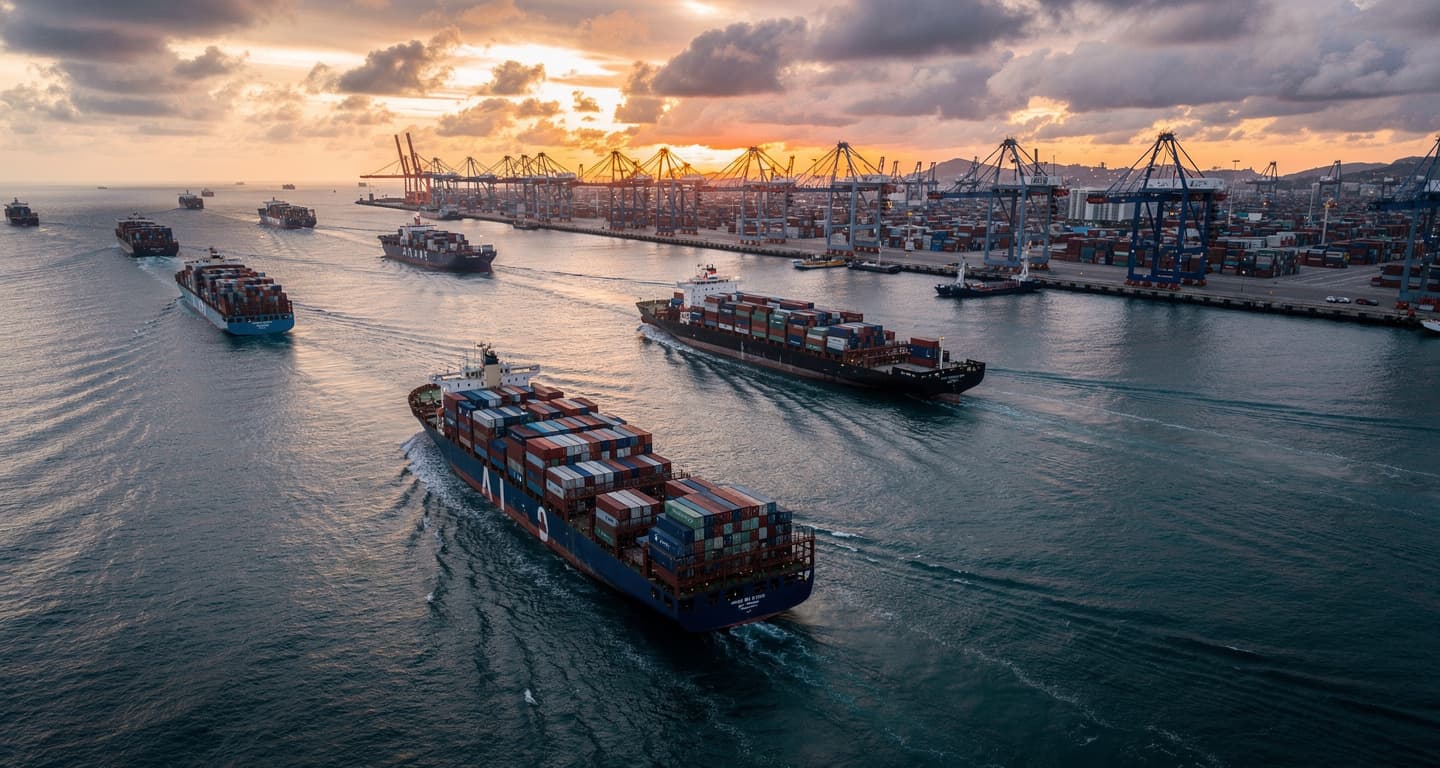
India will send its first cargo ship through the Northern Sea Route in 2027, joining China and South Korea in testing the Arctic corridor as a faster alternative to the Suez Canal. A shipping ministry official confirmed the pilot plan at the Arctic-Regions Forum in Arkhangelsk on August 13.
The move follows Sea Legend’s launch of the first scheduled weekly Arctic container service on August 15 and South Korea’s PanStar Group pilot departing Busan on August 22. The question is whether the economics survive beyond the summer ice window.
Sea Legend launched its China–Europe Arctic Express weekly service in mid-August 2026, with eight sailings scheduled through October 3, each advertising transit times of 18 to 20 days against roughly 40 days via Suez.
That is the number that matters. Not the route’s novelty, but the time saved — and what it costs to capture it. South Korea’s PanStar Group dispatched its own pilot vessel from Busan on August 22, bound for Felixstowe, Rotterdam, and Gdansk. India has now named 2027 for its first Arctic cargo voyage.
Three Asian economies are testing the same corridor in the same season. The experiment has moved from possibility to schedule.
The corridor is now a timetable
The Panstar Acro, a 2,758 TEU container vessel, departed Busan New Port at 8 p.m. on August 22. Its schedule is fixed: Felixstowe on September 9, Rotterdam on September 11, Gdansk on September 15, then back to Busan around October 5 — a 45-day round trip through the Northeast Passage.
Lee Su-ho, who heads South Korea’s Arctic Route Promotion Office, frames the voyage as data-gathering. Seoul wants to compare distance, time, fuel consumption, and operating costs against the Suez route. One figure already stands out: the Busan–Rotterdam distance could shrink by about 35%.
India’s plan is less detailed but no less concrete. S. Venkatesapathy, Joint Secretary in India’s Ministry of Ports, Shipping and Waterways, told the Arctic-Regions Forum on August 13: “In 2027, we are planning to have the first pilot vessel running through the Northern Sea Route.”
According to the Centre for High North Logistics, 103 transit voyages by 88 vessels occurred in 2025, up from 97 the year before. Those ships carried about 3.2 million tons of transit cargo. The numbers are rising, but they remain a rounding error against Suez volumes.
The sequence below shows how quickly the corridor has moved from trial to timetable.
| Date | Event | Significance |
|---|---|---|
| September 28, 2018 | Maersk completes trial container voyage via Arctic | Concludes NSR not yet viable for east-west trades |
| October 1, 2025 | Chinese vessel Istanbul Bridge completes Arctic voyage to UK | Demonstrates roughly 20-day transit, time savings over Suez |
| August 13, 2026 | India announces 2027 pilot plan at Arctic-Regions Forum | First South Asian commitment to NSR cargo voyage |
| August 15, 2026 | Sea Legend launches China–Europe Arctic Express | First scheduled weekly seasonal container service |
| August 22, 2026 | Panstar Acro departs Busan New Port | South Korea’s first NSR container pilot voyage |
| October 3, 2026 | Sea Legend’s seasonal program concludes | Eight weekly voyages completed in 2026 window |
| Source: Centre for High North Logistics; company and government announcements | ||
The fees that decide if this scales
The economics are unforgiving. Rosatom-linked permits, pilotage, and icebreaker support run roughly USD 300,000 to 700,000 per transit for large vessels. Arctic hull and war-risk insurance premiums typically run 30 to 50% higher than southern routes — adding USD 150,000 to 300,000 per voyage for a USD 200 million insured asset.
Set that against the alternative. Asia–Northern Europe Cape rerouting adds around USD 2 million in bunker costs and roughly 10 extra days per round trip for a 14,000-TEU vessel. Red Sea war-risk surcharges currently range around USD 50 to 100 per TEU in 2026, down from earlier peaks.
According to analysis from The Arctic Institute, the corridor remains a niche route constrained by sanctions, infrastructure limits, and seasonal ice. Most global trade, analysts argue, will stay on traditional east-west lanes despite the experimentation.
In its 2026 Arctic shipping risk report, Allianz Global Corporate & Specialty warns that sparse search-and-rescue coverage, difficult salvage operations, and sanctions compliance issues significantly raise risk premia. That is the honest caveat: the route works on paper for eight weeks a year, but the insurance market has not yet priced it as routine.
Russia is betting it can change that. Moscow plans ten additional icebreakers and 46 rescue vessels by 2035, targeting around 170 million tons of cargo by the mid-2030s. The infrastructure push is real. Whether Asian container lines will pay for it at scale is the question the 2027 Indian pilot will begin to answer.
Beyond the headline
The Bigger Picture
India’s entry into Arctic shipping is less about a single pilot voyage and more about a gradual rewiring of Asia–Europe logistics around resilience rather than pure cost. As Chinese and Korean experiments accumulate, the NSR becomes a laboratory where sanctions-era Russia trades corridor access for political and economic relevance, forcing Western actors to reassess assumptions that the Arctic will remain a peripheral theatre for global trade.
The Timing
This push north coincides with overlapping stress points: entrenched Red Sea insecurity, persistently high insurance surcharges on southern chokepoints, and impending 2026–2027 Polar Code obligations that will raise compliance costs just as Asian shippers seek alternatives. Announcing pilots now allows India, China and South Korea to lock in experience under the current regulatory and insurance landscape before a tighter environmental and safety regime further changes the economics.
The Reach
One non-obvious implication is for European environmental regulators, who must simultaneously police stricter Arctic emissions rules and accommodate new Asian-linked cargo flows into ports like Felixstowe, Rotterdam and Gdansk. The mechanism is subtle: as more seasonal Arctic calls appear on port schedules, European authorities gain leverage to condition access on green and safety standards, effectively exporting EU regulatory preferences into an Arctic corridor nominally controlled by Russia.
Three decisions before the 2027 season
With Sea Legend’s service running through October 3 and India’s pilot now 18 months out, Western actors face choices that will shape whether the NSR becomes a real corridor or stays a seasonal experiment.
- European Port Authority Official
Your port is already a named destination. Felixstowe, Rotterdam, and Gdansk appear on PanStar’s schedule for September. Review your Polar Code compliance procedures now — the IMO’s expanded safety and voyage-planning requirements for cargo ships took effect on January 1, 2026, with pre-2026 ships required to comply by January 1, 2027. Assess whether your infrastructure can handle ice-class vessels arriving on fixed schedules.
- Western Maritime Insurer for Arctic Risks
Re-evaluate your Arctic hull and war-risk models before the 2027 season opens. Current premiums run 30 to 50% above southern routes, but the entry of Indian tonnage adds a new counterparty risk profile. Check whether your existing policies treat NSR deviations as permissible or require explicit consent — charter disputes over liability are already a live concern.
- Supply Chain Manager for European Importers
The 18-to-20-day transit versus 40 via Suez is compelling, but only from July to October. Run the numbers on your specific lanes: the USD 300,000 to 700,000 in NSR fees per transit may offset bunker savings on high-value, time-sensitive cargo. Factor in your ESG commitments — Arctic routing carries environmental scrutiny that Suez does not.
- Western Government Sanctions Compliance Officer
Monitor NSR traffic data from the Centre for High North Logistics as the 2026 season closes. The key question is whether Indian and Korean operators route payments for Rosatom permits through compliant channels. Coordinate with European partners on port-level enforcement before the 2027 season opens.
FAQ
What sanctions and compliance risks do NSR users face?
Western sanctions on Russian entities complicate payments for NSR permits and icebreaker fees, with some banks unwilling to process transactions tied to Rosatomflot or related Arctic operators. Operators must map counterparties against sanctions lists, structure payments through compliant channels, and ensure that cargoes and vessels do not involve designated entities, or they risk secondary sanctions and insurance invalidation even if voyages technically comply with maritime safety rules.
What insurance and liability specifics apply to Arctic voyages?
Arctic voyages typically require separate ice-navigation and war-risk endorsements, with hull and machinery policies stipulating approved seasons, ice classes and routes. Underwriters may demand detailed voyage plans, Polar Code documentation, and higher deductibles, while P&I clubs often impose tighter pollution and wreck-removal conditions. Charterers should check whether existing contracts treat NSR deviations as permissible or require explicit consent to avoid disputes over liability if delays or damage occur.
How should shippers review contract and routing clauses for NSR-linked services?
Many long-term shipping contracts and bills of lading still assume Suez or Cape routings, so shippers considering NSR-linked services need to review how deviation, force majeure and safe route clauses are worded. Practical questions include who bears cost and delay if ice conditions force schedule changes, how cargo owners consent to Arctic routing, and whether freight rate formulas and demurrage terms account for the NSR’s shorter distance but higher fixed fees and insurance costs.
Explainer
- Northern Sea Route
- The Northern Sea Route is a shipping corridor running along Russia’s Arctic coast from the Kara Sea to the Bering Strait. It shortens the distance between East Asia and northern Europe by roughly a third compared with the Suez Canal route. The corridor is navigable without heavy icebreaker escort only during the summer window, roughly July to October, and Russia controls access through permits and fees administered by Rosatom.
- Polar Code
- The Polar Code is an International Maritime Organization framework setting safety and environmental standards for ships operating in Arctic and Antarctic waters. It bans the use and carriage of heavy fuel oil in Arctic waters from July 1, 2024. Expanded requirements for cargo ships of 300 to 499 gross tonnage and fishing vessels took effect on January 1, 2026, with pre-2026 ships required to comply by January 1, 2027.
- Rosatom
- Rosatom is Russia’s state nuclear energy corporation, which also serves as the infrastructure operator for the Northern Sea Route. It manages icebreaker escort services, navigation permits, and fee collection along the corridor. Western sanctions on Rosatom complicate payment processing for Asian shippers seeking NSR access, creating a compliance barrier even for non-sanctioned cargo.
- Polar Silk Road
- The Polar Silk Road is China’s strategic framing for developing Arctic shipping lanes as an extension of its Belt and Road Initiative. Beijing presents Arctic routes as a diversification tool that reduces dependence on the Suez Canal and the Strait of Malacca. Sea Legend’s China–Europe Arctic Express is the first scheduled weekly container service marketed under this framework.
- TEU
- TEU stands for twenty-foot equivalent unit, the standard measure of container shipping capacity. One TEU represents the volume of a standard 20-foot shipping container. The Panstar Acro, South Korea’s pilot vessel on the Northern Sea Route, has a capacity of 2,758 TEU, which is small by global standards but sufficient for a data-gathering voyage.
RELATED STORIES