
A $1 trillion selloff in Seoul’s memory-chip stocks has pushed the 60-day correlation between the Kospi and the Nasdaq 100 to 0.46, nearly three times the five-year average of 0.16. The move, triggered by a near-9% intraday plunge on Monday of the week ended July 19, erased roughly a quarter of the benchmark’s value from its June peak.
The selloff extended to Wall Street, where SK Hynix’s US-listed shares fell 9.3%. The episode cemented a new reality: global fund managers now treat the Kospi as the day’s first window into AI-sector risk appetite.
Tai Hui had never presented on South Korea to JPMorgan Asset Management’s global team. Not once in 14 years. That recognition—that Korea had become central to global AI risk discussions—crystallized last week, after the Kospi plunged nearly 9% in a single session and dragged US chip stocks with it. The selloff erased $1 trillion in market value from a benchmark that had been one of the world’s best performers. It also forced a recognition that had been building for months: the Kospi is now the first read on global AI risk appetite, and ignoring it is no longer an option.
“We are all Korean investors now,” says Hani Redha, a portfolio manager at PineBridge Investments. Redha now tracks SK Hynix’s American depositary receipts and Korea-themed ETFs almost around the clock. His routine is no longer unusual. Ivan Feinseth, chief investment officer at Tigress Financial Partners, says Korea has been absorbed into the same volatility ecosystem as the Nasdaq and the Philadelphia Semiconductor Index. For traders worldwide, the day now begins in Seoul.
The correlation that rewired global trading desks
The 60-day correlation between the Kospi and the Nasdaq 100 has climbed to 0.46, near a two-year high and almost triple the five-year average of 0.16. On July 7, the Nasdaq’s sensitivity to Kospi weakness reached its highest point since 1990, according to Bloomberg data. The MSCI World Index’s sensitivity to Korean moves hit a four-year high earlier this month.
The shift is easier seen than read.
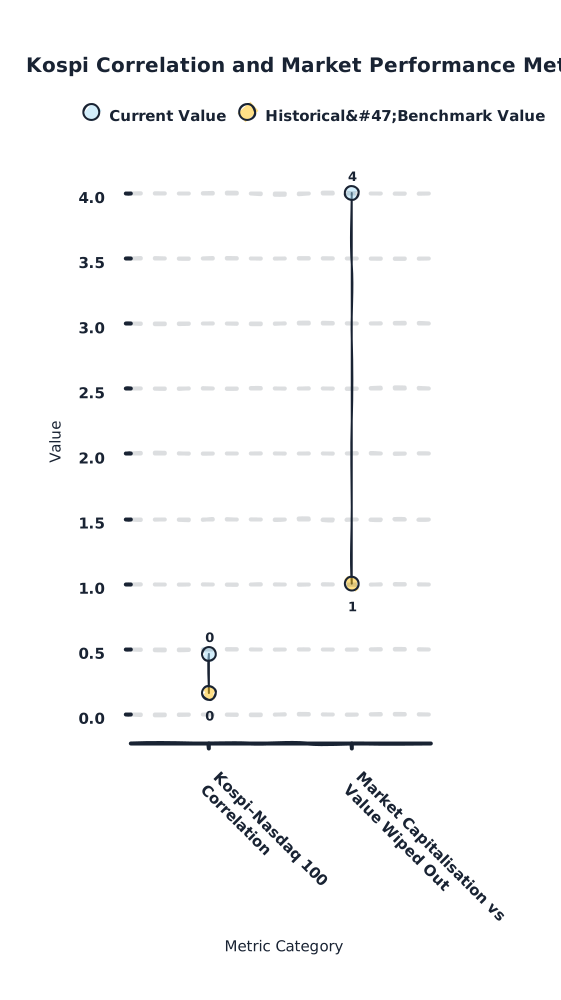
The selloff that began on Monday of the week ended July 19 was brutal. The Kospi dropped nearly 9% intraday. SK Hynix’s US-listed shares fell 9.3%, and the cascade hit other chip stocks. From its June peak, the index has shed 25%, wiping out roughly $1 trillion in market capitalisation. Samsung Electronics and SK Hynix have each surrendered at least 30% from recent highs.
Strip out the selloff and look at the year. The Kospi is still up 62% year-to-date. That figure matters because it reframes the rout as a correction inside a historic rally, not a collapse. The AI trade that drove those gains is not broken; it is being repriced.
Chisa Kobayashi, Japan equity strategist at UBS SuMi TRUST Wealth Management, warns that high leverage and an immature market structure mean sharp swings can detach from fundamentals. “The current interconnectedness is the new normal as long as the AI rally continues,” she says, but the leverage makes trading difficult when moves overshoot.
Seoul has moved to cool the speculation. Regulators temporarily halted new listings of single-stock leveraged exchange-traded products, a step aimed at dampening volatility in Samsung and SK Hynix without banning existing products.
A bellwether built on two stocks and a theme
The Kospi’s new role is not a mystery. South Korea supplies the high-bandwidth memory chips that power AI data centres. Samsung and SK Hynix together account for a dominant share of the global market. When SK Hynix listed American depositary receipts, it extended Seoul’s trading day into US hours. Leveraged exchange-traded products then magnified every move, turning routine corrections into liquidation cascades.
The closest Western precedent is the Philadelphia Semiconductor Index during the PC and smartphone cycles. But that benchmark reflected broad tech hardware demand. The Kospi’s signal is narrower: two memory giants at the centre of AI infrastructure build-outs. That concentration makes the signal sharper and more prone to overshooting.
Angelo Kourkafas, senior global investment strategist at Edward Jones, has noted that recent chip volatility reflects position-driven swings rather than a collapse in underlying demand. Patrick Moorhead of Moor Insights & Strategy compares the reaction to Chinese AI breakthroughs to earlier overreactions that later reversed. The pattern suggests sentiment, not fundamentals, is driving the correlation.
The next few weeks will test that link. South Korea’s Financial Services Commission is expected to issue guidance on single-stock leveraged ETFs. If it tightens rules, speculative swings could moderate. If it stays light, leverage-driven volatility will persist. Meanwhile, earnings and capex commentary from major US and Chinese AI firms will either reaffirm memory demand or deepen doubts. The Kospi’s status as the day’s first window depends on which signal arrives first.
Beyond the headline
The Bigger Picture
Korea’s new status as a global sentiment barometer highlights how thematic flows can overpower traditional geographic distinctions. AI infrastructure spending has effectively fused a once-peripheral market into the core of the world’s tech risk cycle, turning a narrow memory-chip trade into a proxy for broader confidence in the AI build-out. That structural shift matters more than any single selloff because it redefines where investors must look for early stress signals.
The Reach
One underappreciated consequence of Korea’s new role is its impact on risk models at large Western asset managers. As Kospi swings feed directly into VaR calculations and stress-testing for global tech portfolios, risk committees in New York or London may adjust limits or hedging strategies based on overnight moves in Seoul. This extends Korea’s influence from traders’ routines into formal governance frameworks for capital allocation.
The Timing
Kospi’s rise as an AI bellwether is arriving just as concerns about overcapacity and competitive threats from Chinese model developers peak. That coincidence amplifies every data point from Seoul, because investors are already primed to question the durability of the AI capex cycle. If this moment had occurred earlier in the rally, Korea’s volatility might have been dismissed as noise rather than a potential turning signal for global tech risk.
What the Kospi’s new role means for your portfolio
With the Kospi now a daily checkpoint for global AI risk, investors face three immediate decisions.
- Western institutional investor with AI/tech portfolio exposure
You need to integrate Kospi monitoring into your daily risk management. Track the Kospi’s opening and its correlation with your tech holdings, and review your exposure to Samsung and SK Hynix ADRs. Adjust hedges if the correlation spikes further, and watch for regulatory changes from South Korea’s Financial Services Commission that could alter volatility patterns.
- Global semiconductor procurement manager
Kospi swings now signal potential pricing shifts for memory chips. Monitor the index alongside SK Hynix and Samsung ADR movements to anticipate supply-side sentiment. Use this intelligence to time contract negotiations and adjust inventory levels, especially if leveraged-driven selloffs disconnect from actual chip demand.
- Western retail investor with South Korea ETF or ADR holdings
Review your positions in vehicles like the iShares MSCI South Korea ETF or individual ADRs. The recent selloff shows how quickly these can move. Consider whether your risk tolerance aligns with the new volatility regime, and if necessary, reduce exposure or set stop-loss levels. Keep an eye on the FSC’s English-language website for rule changes that could affect leveraged products.
- Financial regulator or policy analyst focused on market stability
Analyze South Korea’s halt on new single-stock leveraged ETF listings as a case study in curbing speculative excess without banning products. Assess whether similar measures could apply in your own market, and monitor how the Kospi’s global signalling power evolves if leverage rules tighten. The episode offers a live test of cross-border contagion management.
FAQ
How can I access Korean chip exposure through Western instruments?
Western investors typically gain exposure to Samsung Electronics and SK Hynix through American depositary receipts and ETFs such as broad emerging-market funds or Korea-specific products. Each vehicle differs in currency risk, diversification and liquidity. Checking product factsheets and recent holdings disclosures helps investors understand how much of their portfolio is effectively tied to Korean memory-chip performance.
Do Korean leverage rules affect foreign investors?
South Korea’s temporary halt on new single-stock leveraged ETF listings mainly targets local speculative trading, but changes can still affect foreign investors who use these products via international brokers. If regulators later extend restrictions or adjust margin rules, global platforms may alter product availability, margin requirements or borrowing costs, influencing how overseas traders implement short-term Kospi strategies.
How should I interpret correlation data in portfolio risk management?
Correlation metrics such as the 60-day Kospi–Nasdaq figure of 0.46 inform how shocks in one market may propagate to another. Investors using risk tools should recognise that correlations can spike during stress periods and then fade. Incorporating scenario analysis that distinguishes normal and selloff regimes helps avoid over-reliance on a single recent correlation reading when adjusting portfolios.
Explainer
- Kospi
- The Korea Composite Stock Price Index, South Korea’s main equity benchmark, heavily weighted toward technology and manufacturing giants. It includes over 800 companies but is dominated by Samsung Electronics and SK Hynix, which together account for roughly a third of its value. The index’s concentration in memory-chip makers has turned it into a proxy for global AI infrastructure spending.
- American depositary receipt (ADR)
- A negotiable certificate issued by a US bank representing shares in a foreign company, traded on American exchanges in dollars. SK Hynix’s ADR listing extended its trading into US market hours, allowing American investors to react to Korean news without waiting for the local market to open. ADRs also expose holders to currency risk between the won and the dollar.
- Leveraged exchange-traded product
- A fund that uses derivatives and debt to amplify the daily returns of an underlying index or single stock, often by two or three times. In South Korea, single-stock leveraged products tied to Samsung and SK Hynix magnified price swings during the recent selloff. Regulators temporarily halted new listings to curb speculative excess without banning existing funds.
- Philadelphia Semiconductor Index
- A benchmark of 30 US-listed semiconductor companies, widely used as a barometer for the chip industry’s health. During the PC and smartphone eras, it served as the primary global signal for tech hardware demand. The Kospi’s current role is narrower, driven by two memory giants at the centre of AI data-centre build-outs rather than broad chip spending.
- Correlation
- A statistical measure of how two assets move in relation to each other, ranging from -1 to 1. A 60-day correlation of 0.46 between the Kospi and Nasdaq 100 means they have moved in the same direction nearly half the time recently. During stress periods, correlations can spike sharply and then revert, making them a fragile basis for long-term portfolio decisions.
RELATED STORIES


