Moonshot AI released its Kimi K3 model on July 16, 2026, at the World Artificial Intelligence Conference in Shanghai. The 2.8‑trillion‑parameter open‑weight system triggered a global semiconductor selloff that erased an estimated $3.3 trillion in market value across the sector over multiple sessions, with the Philadelphia Semiconductor Index falling 12.5% for the week and declining more than 20% from its late‑June peak to bear-market territory.
The rout was immediate. The harder question — whether Western enterprises can safely use a model built inside China’s intelligence‑law perimeter — will define enterprise AI spending for years after the stock charts recover.
The semiconductor rout that followed Moonshot AI’s Kimi K3 launch was dramatic. It is also a distraction. The selloff — $3.3 trillion in value wiped across the sector — was the market pricing what everyone already suspected: frontier AI is getting cheaper, and the hardware boom that bet on scarcity suddenly looks fragile.
The more durable problem sits one layer deeper. Kimi K3 is not just a cheap model. It is a cheap model built by a Beijing company. And under Chinese law, the data that flows through it — code, financial projections, M&A documents — carries a legal exposure Western procurement contracts were never written to handle.
That tension — between dramatic cost savings and state‑access risk — is what the market selloff missed. It is also what will outlast the quarter.
The cost advantage that broke the semiconductor trade
Kimi K3 arrived on July 16 with 2.8 trillion parameters and a one‑million‑token context window, landing at No. 3 on Artificial Analysis’s leaderboard, according to Unite.AI and other coverage. The model’s open‑weight release, planned for July 27, will let anyone run it locally — provided they have roughly 1.5 TB of GPU memory at full precision.
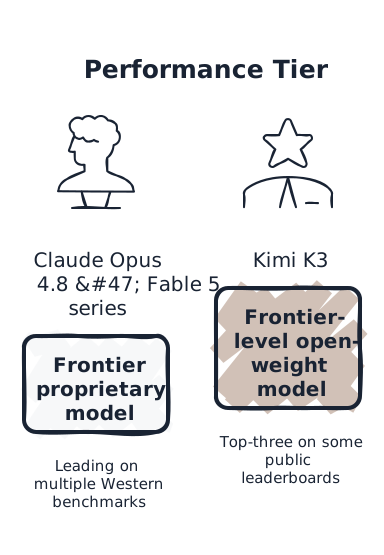
The per‑task cost is where the business case shifts. Moonshot’s stated API pricing places per-task costs at roughly $0.94 per task, according to the company’s launch materials, undercutting Anthropic’s Claude Opus 4.8 at about $1.80 and matching OpenAI’s GPT‑5.6 Sol at $1.04. Independent verification of those figures is not yet available, and the benchmarks themselves — hallucination rates, reasoning accuracy — remain unconfirmed by third‑party labs.
The comparison below shows what is known and what is still claimed.
Alibaba launched its own open‑weight Qwen 3.Max the same weekend, with 2.4 trillion parameters, intensifying the pressure. Two Chinese frontier models, both with aggressive pricing, in the span of four days.
Yet the cost story has a sharp edge. Patrick Moorhead, CEO of Moor Insights & Strategy, called the market reaction “an over-reaction shockingly similar to the DeepSeek panic,” arguing that cheaper models accelerate inference demand rather than killing it. Alex Liu at Bank of America noted that Kimi K3 shows large‑scale pre‑training still delivers step‑change gains — even under China’s hardware constraints.
Behind the benchmarks, the data trail is less flattering. According to the OECD’s AI Incidents Monitor, Kimi exposed a user’s resume to an unrelated user during a translation task in April 2026. China’s National Cyber Security Information Centre had previously flagged the service in 2025 for collecting user data unrelated to its core functions. According to Harmonic Security research, Kimi generated roughly 3.5 times more shadow AI traffic than DeepSeek in early 2026, with code, financial projections, and M&A data among the most commonly shared categories.
That brings the IPO calculus into view. According to Bloomberg reporting cited by multiple outlets including Unite.AI and Seoul Economic Daily, Moonshot circulated a shareholder resolution on July 19 seeking approval for a Hong Kong listing within six months. The company’s annual recurring revenue reached $300 million by June, up from $200 million in April — a rapid climb that, if sustained, clears the HK$250 million threshold under Chapter 18C of Hong Kong’s listing rules for specialist technology firms.
According to Bernstein Research analysts, Moonshot is now ranked as the temporary leader among Chinese AI labs on open‑weight capabilities, ahead of Zhipu, Alibaba’s Qwen series, and DeepSeek. That ranking alone, independent of any one benchmark, is shifting how investors price the sector.
| Entity | Current structure | Required change | Effective date |
|---|---|---|---|
| Moonshot AI (operating company) | VIE/red‑chip: Cayman Islands holding controls Hong Kong subsidiary via contractual arrangements | Convert to joint venture model with direct onshore incorporation | Before IPO filing |
| China Securities Regulatory Commission | Overseas listing review under 2023 tightened rules | Clearer onshore control; discourage purely contractual foreign‑investment circumvention | Ongoing |
| Hong Kong Stock Exchange | Chapter 18C Specialist Technology Company regime | Enhanced disclosure on risks, governance, R&D spending; pre‑profit listing permitted | In force |
| Source: Hong Kong Stock Exchange listing rules; CSRC overseas‑listing guidelines | |||
The jurisdiction trap no benchmark measures
China’s AI firms operate under three overlapping laws: the National Intelligence Law, the Data Security Law, and the Cybersecurity Law. Together they give state authorities broad access to corporate data — including the content flowing through a model’s API — regardless of where the servers sit. For a Western enterprise, using Kimi K3 means accepting that access as a legal risk.
The June semiconductor selloff was already a warning about how debt‑funded AI infrastructure can crack. Kimi K3 adds a second layer: if the hardware thesis was fragile on the financing side, it is equally exposed on the demand side if enterprises decide the legal exposure of Chinese models is simply too high.
Moonshot’s push toward an IPO — with CICC and Goldman Sachs reportedly engaged as potential underwriters, according to Seoul Economic Daily and The Next Web — will test that logic directly. If the listing happens, it means regulators and bankers judge its revenue run‑rate and governance strong enough for public markets. If it stalls, the implied message is that Beijing is comfortable letting the legal risk remain unpriceable, and that will be priced into every Chinese AI company that follows.
What Kimi K3 really exposes is the cost Western enterprises pay for legal certainty — a premium that feels invisible until a model like this one forces boards to write it down. The next six months will determine whether that premium shrinks or becomes the defining wedge between the two AI ecosystems.
Beyond the headline
The money trail
The economics behind Kimi K3 are less about one Chinese startup and more about who captures value in the AI stack. If open‑weight frontier models reset pricing, margin power shifts away from GPU vendors and proprietary model labs toward integrators, compliance specialists, and application providers that can ride cheaper inference. For Western investors this is a pivot point: the winners may be in middleware and sector‑specific AI tools, not in the headline model providers that dominated the first wave of AI euphoria.
What isn’t being said
Most coverage focuses on headline capabilities and market turbulence, but the quiet issue is jurisdiction. Even with self‑hosting, any operational or contractual tie to a Chinese AI lab can pull foreign enterprises into China’s security and data regimes, creating conflicts with US, EU, or sectoral rules. The missing conversation is how boards will reconcile fiduciary duties and compliance obligations with the temptation of drastically lower AI costs — a governance challenge, not just a technology choice.
The reach
One overlooked actor is global pension and sovereign wealth funds that hold broad semiconductor and tech allocations. Their rebalancing decisions, driven by internal risk committees rather than retail sentiment, can transmit AI‑driven repricing into Western retirement portfolios. If these institutions conclude that frontier AI margins will migrate from hardware to software and services, they could gradually tilt benchmark indices away from heavy chip exposure, reshaping how long‑term Western savings participate in the AI boom.
A legal risk that rewrites the AI procurement checklist
With Moonshot’s IPO filing expected within six months and Kimi K3’s open weights going live on July 27, Western enterprises and investors face decisions they have not had to make before.
- Western Enterprise AI Procurement Manager
You must evaluate whether the claimed $0.94 per‑task cost justifies the data exposure. Start with Moonshot’s published privacy and data‑handling policies, then map those against your own jurisdiction’s rules. For regulated data — financial records, trade secrets — keep it off Chinese‑linked models entirely, even self‑hosted ones. Contractual and technical controls that prevent logs or telemetry from transiting Chinese jurisdictions are a minimum, not a recommendation.
- Global Semiconductor Investor
Reassess your exposure to AI‑linked hardware names, especially those with valuations built on the assumption that only Western labs can sustain frontier capability. Kimi K3 and Alibaba’s Qwen 3.Max show that assumption is softening. Track updates from index providers and ETF issuers benchmarked to the Philadelphia Semiconductor Index to see how they adjust holdings and commentary. The repricing may not be over.
- US-based AI Startup Founder/Executive
The pricing pressure is real. If your model is not materially better than an open‑weight alternative that costs half as much, enterprise buyers will test that gap. Your differentiator must now be integration depth, compliance guarantees, or a vertical focus that generic open‑weight models cannot match. Price alone is no longer a lever you control.
- Compliance Officer for Multinational Corporations with China Exposure
Conduct a risk assessment that assumes, for the purpose of the analysis, that data processed through any Chinese‑linked AI model is accessible to state authorities under the National Intelligence Law. Implement data‑classification policies that strictly separate regulated datasets from Chinese AI workflows, and ensure your board understands that this is not a technology risk — it is a legal one.
FAQ
Using Kimi K3 while managing cross‑border data risk
Western enterprises typically restrict Chinese‑linked models to non‑sensitive workloads, apply data‑loss‑prevention tools, and ensure logs are stored in jurisdictions aligned with corporate compliance policies. Legal teams often map model providers against GDPR, HIPAA, or financial‑sector obligations before any production deployment.
Moonshot AI IPO process and investor access
Moonshot’s path to a Hong Kong listing would involve board approval, CSRC filing under tightened overseas‑listing rules, HKEX vetting under Chapter 18C, and publication of a prospectus. Foreign investors typically access such offerings through international brokerages with Hong Kong market access or via funds that specialise in Chinese tech IPOs once the shares begin trading.
Impact of cheaper open‑weight models on cloud spending
Cloud customers often reassess which workloads need frontier proprietary systems and which can move to cheaper alternatives, shifting budgets from GPU‑intensive training toward application development and integration. Analysts watch cloud‑provider earnings disclosures on AI‑related capex, utilisation rates, and customer migration patterns to gauge the effect.
Explainer
- Moonshot AI
- Moonshot AI is a Beijing‑based artificial intelligence company founded by Yang Zhilin, a former researcher at Tsinghua University. Backed by Alibaba, Tencent, Meituan, HongShan Capital, IDG Capital, and state-backed China Mobile, it builds large language models and agentic AI systems. Its Kimi series of models has drawn international attention for matching Western frontier performance at lower cost, accelerating debate about China’s AI competitiveness.
- Kimi K3
- Kimi K3 is Moonshot AI’s latest frontier model, released in July 2026 with 2.8 trillion parameters and a one‑million‑token context window. It is the successor to Kimi K2, which launched in late 2025, and is offered as an open‑weight model — meaning its trained parameters are publicly downloadable. The release triggered a global semiconductor selloff and sharpened debate about the trade‑offs between AI cost and data sovereignty.
- VIE structure
- A variable interest entity (VIE) is an offshore corporate structure used by Chinese companies to attract foreign investment in sectors restricted by Beijing. A Cayman Islands holding company controls a Hong Kong subsidiary, which in turn manages a Chinese operating company through contractual agreements rather than equity ownership. Chinese regulators have been tightening oversight of VIEs since 2023, requiring clearer onshore control for overseas listings.
- Chapter 18C
- Chapter 18C is a listing regime introduced by the Hong Kong Stock Exchange in March 2023 for Specialist Technology Companies, allowing pre‑profit tech firms to list if they meet a minimum revenue threshold. It requires enhanced disclosure on risks, governance, and research‑and‑development spending. Moonshot AI’s reported $300 million in annual recurring revenue would clear the HK$250 million threshold.
- National Intelligence Law
- China’s National Intelligence Law, enacted in 2017, mandates that all organisations and citizens support and assist in national intelligence work — including, in practice, providing access to data held by private companies. It sits alongside the Data Security Law and Cybersecurity Law to expand state authority over corporate data. For foreign enterprises using Chinese AI services, the law creates a legal obligation that can conflict with GDPR, US sectoral rules, and other Western privacy frameworks.
RELATED STORIES