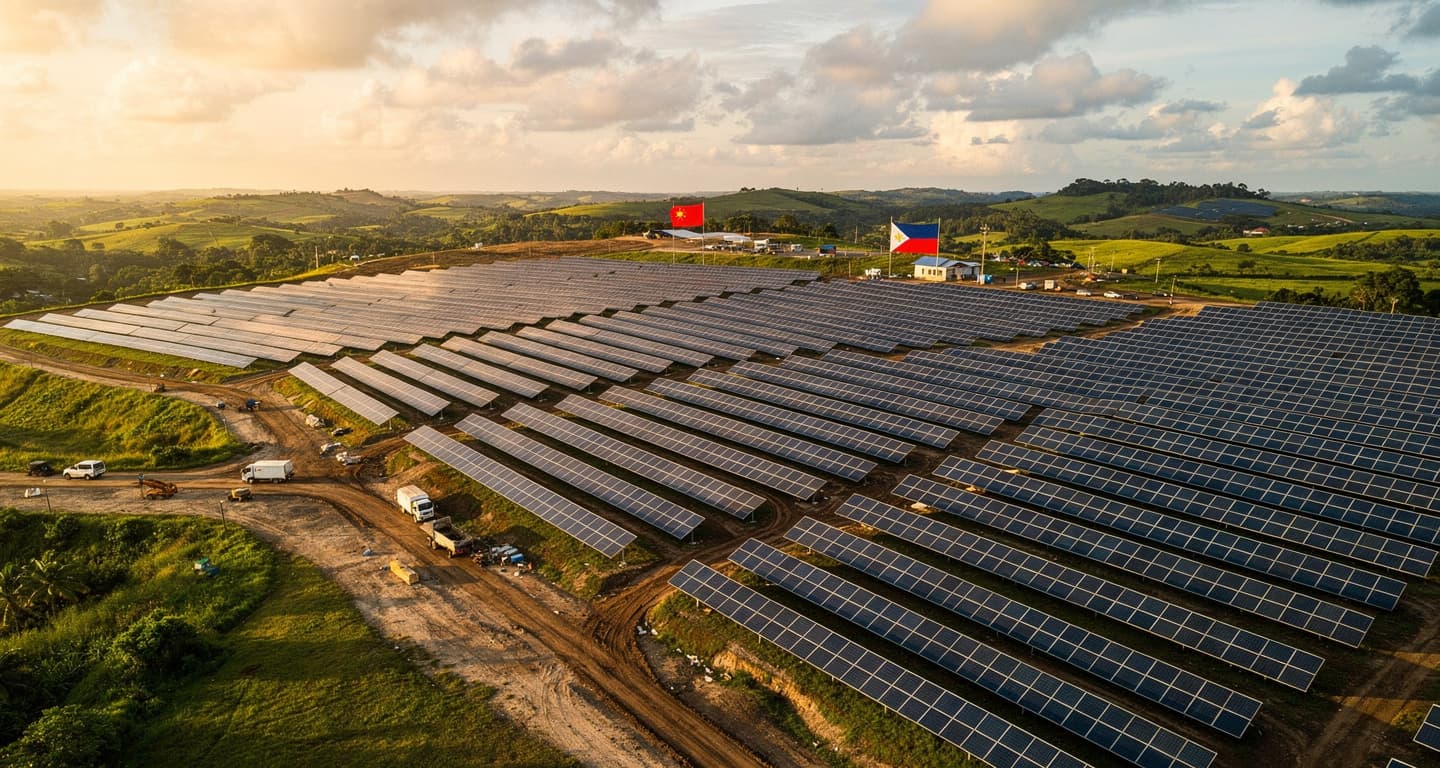
The Philippines imported more than 4,000 megawatts of Chinese solar panels in the first four months of 2026, becoming China’s second-largest solar export market after the Netherlands. The surge is driven by the highest residential power prices in Southeast Asia, where households pay ₱12 to ₱15 per kilowatt-hour. The government targets renewables at 35% of generation by 2030, up from 22.4% of installed capacity in 2023.
Nearly all of that hardware comes from a single country. The transition that promises energy independence is being built on a supply chain Manila does not control.
The Philippines is trying to escape one form of energy dependence by deepening another. For decades the country leaned on imported crude oil and refined fuel, exposed to every price shock from the Gulf. Now it is buying its way out — with Chinese solar panels.
In March and April 2026 alone, more than 3,000 MW of Chinese modules crossed into Philippine ports. Of all solar hardware imported in 2025, 98% came from China. The country that wants cheaper, homegrown power is sourcing the means to generate it from a single supplier abroad.
This is the part of the renewable story that the megawatt counts obscure. The economics are real: rooftop solar now pays for itself in just over two years for many businesses. The policy push is real. But the leverage sits in Chinese factories, not Filipino utilities — and that distinction will matter when industrial policy in Beijing shifts, as it does.
The price gap doing the political work
The driver is cost, measured plainly. Residential consumers pay between ₱12 and ₱15 per kilowatt-hour, among the steepest rates in Southeast Asia. On the Luzon grid, the average system-wide rate reached PHP 9.54 per kWh in 2023, up from PHP 6.63 in 2020.
That gap rewrites the maths for anyone with a roof. Payback periods for commercial rooftop systems have fallen to just over two years; industrial users recover their costs in about three. The government’s net metering program lets owners export surplus power for bill credits, which sharpens the case further.
Dave Jones, Global Insights Lead at the energy think tank Ember, puts it directly: “The economics of rooftop solar are more attractive than ever, and its rapid rise is inevitable.” He adds that “the government has an opportunity to carve its own path on rooftop solar, to bring the Philippines out of fossil dependency, and onto a path of cheap, abundant electricity.”
The policy spine is the Renewable Portfolio Standards, which require obligated utilities to raise their renewable share by 2.52 percentage points each year from 2023. Western demand shaped the supply side, too. Net-zero pledges and cheap-hardware appetite in Europe and the United States helped scale Chinese manufacturing, lowering the module prices now flooding Manila’s market.
The hardware is arriving. What is less settled is whether the system underneath it can absorb the load.
The reforms moved faster than the grid
The opening came from a single legal change. In November 2022, the Department of Energy amended the rules of the Renewable Energy Act to allow 100% foreign ownership of solar, wind and hydro projects. Energy Secretary Raphael Lotilla has called full foreign ownership central to meeting capacity targets and securing supply.
The policy worked. Capital came. But the build-out is colliding with limits the announcements do not mention.
| Measure | Previous rule | New rule | Effective date |
|---|---|---|---|
| Foreign ownership (DC2022-11-0034) | Capped at 40% | Up to 100% for solar, wind, hydro | November 2022 |
| Renewable Portfolio Standards | 1% annual increase | 2.52 percentage points annually | 2023 |
| Renewable share target | 22.4% installed (2023) | 35% of generation | 2030 |
Monalisa Dimalanta, chairperson of the Energy Regulatory Commission, has argued that pricing and grid rule reforms are needed alongside renewables for power to become genuinely affordable. Maria Teresa Diokno-Sicat of the Philippine Institute for Development Studies warns that high prices erode industrial competitiveness — and that renewables only help if grid upgrades and regulation come with them.
So the Philippines escapes the fuel importer’s trap and walks into a manufacturer’s one. The savings are domestic; the hardware, the financing terms, and a share of the dividends are not. That is a different dependency, not the end of dependency.
Beyond the headline
The money trail
The renewable surge is framed as green ambition, but the financial architecture points to a deeper dependency: Chinese manufacturers dominate module supply while foreign equity and lenders, many from Europe, shape which projects get built and at what cost of capital. That combination externalises both technology control and financing decisions, leaving Manila exposed to shifts in Chinese industrial policy and Western investors’ risk appetite alike.
The bigger picture
This is less an isolated boom than a test case for how developing economies decarbonise while still industrialising under volatile fuel prices. The country is re-wiring its power system precisely as it tries to grow export manufacturing and digital services, revealing how energy security, trade and climate targets are now interlocked rather than sequential choices for middle-income states.
The response gap
Headlines emphasise auction rounds and liberalised ownership, yet grid reinforcement, community engagement and safeguard enforcement lag behind generation announcements. The gap between megawatts awarded on paper and projects reaching operation reflects constrained transmission budgets, under-resourced regulators and consultations that begin too late — each delayed project signals a systemic shortfall, not a one-off glitch.
What to track as the next plan update lands
With the Department of Energy expected to revise its renewable targets in late 2026, three groups face concrete decisions now.
- Infrastructure funds and lenders
Read the Philippine Energy Plan 2020–2040 at doe.gov.ph/pep to map official targets and the indicative project pipeline. If the 2030 solar and wind goals rise, it signals confidence in permitting and grid upgrades; if they hold flat despite faster demand, bottlenecks are slowing bankability.
- Utilities and equipment suppliers
Track the Energy Regulatory Commission’s published rate data at erc.gov.ph. Wholesale and retail price trends drive the business case for rooftop solar and corporate power purchase agreements, and they tell you how durable the demand surge actually is.
- Developers entering joint ventures
Watch which contested projects near Mount Banahaw, Northern Luzon and the Guimaras Strait reach operation versus cancellation. Social-safeguard enforcement and benefit-sharing terms, not auction wins, increasingly decide whether awarded megawatts become operating ones.
Explainer
- Net metering
- A billing arrangement that lets consumers with solar panels export surplus electricity to the grid in exchange for bill credits. In the Philippines it is a core incentive making rooftop systems pay for themselves within two to three years. The scheme caps eligible installations at 100 kilowatts, which limits its reach for larger industrial users despite their strong economic case.
- Renewable Energy Act
- The 2008 Philippine law establishing the framework for incentives, targets and rules governing renewable power. Its implementing rules were amended in November 2022 to permit full foreign ownership of solar, wind and hydro projects. The change reversed a constitutional reading that had treated sunlight and wind as protected natural resources reserved for Filipino-controlled firms.
- Ember
- A global energy think tank that publishes data and analysis on electricity systems and the shift away from fossil fuels. Its research on the Philippines documented the rooftop solar economics now reshaping demand. Ember’s open datasets are widely used by regulators and investors who lack independent access to granular national generation figures.
RELATED STORIES