
China and Indonesia will hold their first joint naval drill east of Taiwan in mid-August 2026, the Chinese defence ministry announced on 11 August. The People’s Liberation Army Navy frigate Honghe and Indonesia’s KRI I Gusti Ngurah Rai will run communications and replenishment exercises — the first time the PLA has joined a foreign navy in waters Taipei considers part of its security perimeter.
Indonesia’s navy described the manoeuvres as routine “passing exercises” without combat intent, in keeping with Jakarta’s non-aligned stance. Taiwan’s Mainland Affairs Council called them a military provocation that creates a false impression of Chinese jurisdiction east of the island.
Beijing has spent the past two years layering naval exercises around Taiwan. Each cycle expanded the map a little further — the Strait, the outlying islands, then the waters east of the island where the PLA previously operated alone. What changed in August 2026 was not another exercise, but a partner. On 11 August the Chinese defence ministry announced a joint navigation drill with Indonesia east of Taiwan, the first time a foreign frigate would train alongside the PLA in a zone Taipei asserts as part of its security perimeter. The drill couples a familiar PLA practice — testing boundaries, widening the geographic envelope — with a new element: a Southeast Asian partner whose presence Beijing can cite as evidence that even non-aligned governments accept its operational space.
Taipei’s response was swift and sharper than the routine protests. Its Mainland Affairs Council labelled the exercise a military provocation and said it would monitor the manoeuvres — language that signals diplomatic escalation without crossing into an operational countermove. The drill, scheduled for mid-August, is designed around communications protocols and at‑sea replenishment, but its location matters more than its menu.
The drill is not about combat — it’s about precedent
“The exercise is aimed at enhancing the two navies’ capabilities for joint operations, deepening practical cooperation and contributing to the maintenance of peace and stability in the region,” the Chinese Ministry of National Defense said in a statement on 11 August. Chinese officials framed such drills as normal cooperation consistent with Beijing’s position that Taiwan is part of its own territory.
Taipei saw exactly the opposite. The Mainland Affairs Council called the exercise “exercises in name, expansion in reality” — a direct charge that Beijing is manufacturing facts on the water. The council said the drill created a false impression of jurisdiction east of Taiwan and pledged to monitor it. China did not disclose how far from Taiwan’s coastline the ships would sail.
Indonesia’s navy stressed that the drills are “passing exercises” — brief, non‑combat encounters that let ships practise communications and manoeuvring. The framing is essential: it lets Jakarta uphold a non‑aligned foreign policy that has long balanced relations with Beijing, Washington, and other powers. The two‑ship operation carries no landing craft, no air‑defence drills, no simulated strikes. Yet the political signal is carried mainly by the coordinates, not the task list.
The pattern of expanding operations is easier to see across time than in a single announcement.
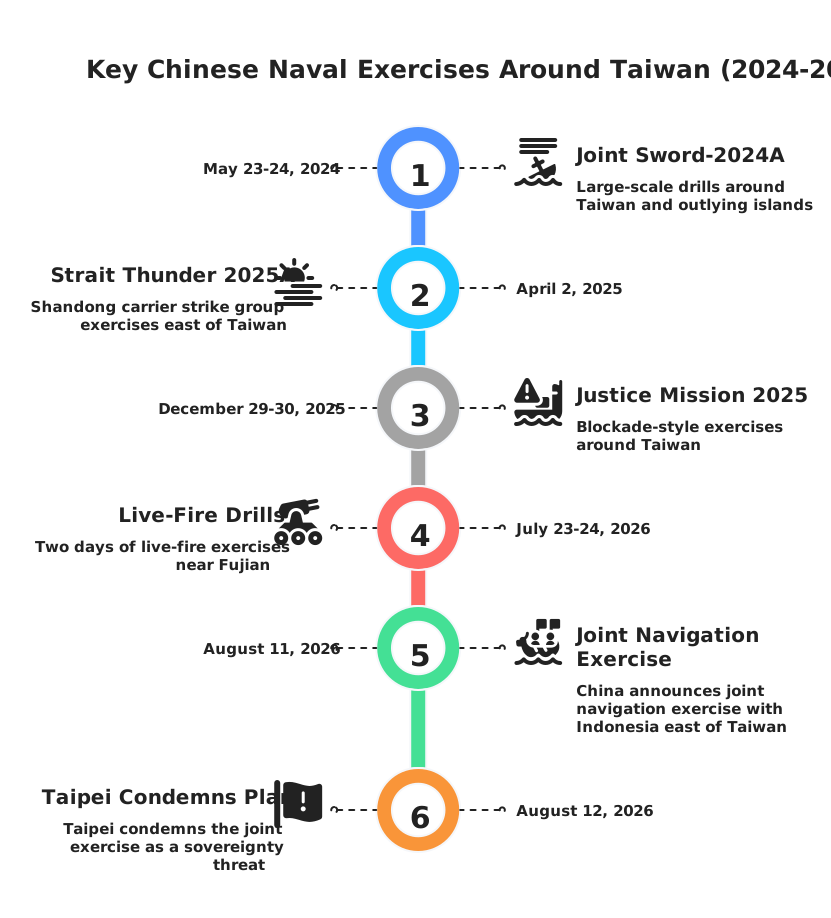
China began coast guard patrols off Taiwan’s east coast in June 2026, building a new presence months before any navy drill. By August, the Indonesian frigate was operating in a zone where, two years earlier, no PLA joint exercise had ever been staged. The history matters because Beijing tends to widen the geographic envelope once the political cost of the last step proves manageable. The question for Taiwan — and for the allies who watch the first island chain — is whether a partner exercise east of Taiwan becomes a fixture, and then a platform for something larger.
The logic of testing boundaries one partner at a time
A direct precedent was Joint Sword‑2024A, the PLA multi‑service exercise that encircled Taiwan for two days in May 2024, three days after President William Lai Ching‑te’s inauguration. The map then covered the Taiwan Strait and outlying islands. Later exercises stretched further. By 2026, the PLA was staging live‑fire drills in the Strait near Fujian and blockade‑style missions around the island — always alone, always watched.
Adding Indonesia changes the register. A non‑aligned Southeast Asian navy offers Beijing a different kind of diplomatic cover. If a country like Indonesia accepts the operational space as sufficiently routine to join, Beijing can frame its presence as administratively normal rather than politically exceptional. The mechanism is not a treaty: it is the slow accumulation of precedent, one partner exercise at a time, until the contested waters look like any other training area.
The Indonesian frigate’s passage east of Taiwan is a one‑time event — for now. If Beijing finds the international reaction manageable, the next step could be inviting another ASEAN navy, or running the same exercise again next year. The test is not whether the drills provoke a crisis this August; it is whether they quietly become unremarkable.
Beyond the headline
The Bigger Picture
This is less about a one‑off drill than about China turning military cooperation into a sovereignty narrative. By pairing a foreign navy with its own ships east of Taiwan, Beijing is testing whether repeated access can make waters that Taiwan asserts as its own look administratively normal rather than politically exceptional.
The Timing
The timing matters because Beijing has already increased maritime pressure around Taiwan this year, so a partner exercise now carries more signalling weight than the same drill would have six months ago. It lands when the operating environment is already being reshaped by regular Chinese activity, making any foreign participation easier for Beijing to present as precedent.
The Regional Split
Taipei sees the exercise as a direct challenge to its claims and security perimeter, while Jakarta can frame it as evidence of strategic autonomy and balanced diplomacy. That divergence matters because the same manoeuvre can be read in Taiwan as coercion and in Indonesia as non‑alignment, which gives Beijing room to exploit differences in regional threat perception.
Four ways to read the same ship movements
With the drill set to begin within days, the same set of ship movements is being read in sharply different ways across the region.
- Taiwanese government official or policy analyst
You need to assess whether this marks the start of a new pattern of partner exercises east of the island. The Mainland Affairs Council has already named the drill a provocation. Your next step is watching whether any foreign navy joins the PLA in this zone again before year‑end — and preparing a diplomatic counter‑narrative that frames the exercise as an intrusion, not routine cooperation.
- US or allied Indo‑Pacific military strategist
Monitor whether the United States Indo‑Pacific Command or Japan’s Ministry of Defense issues even a brief statement in the next 48 hours. If they do not, the operational lesson for Beijing is that a partner exercise draws less pushback than a unilateral one. An absence of an official reaction can itself set the precedent the drill is designed to test.
- International maritime shipping or insurance executive
Increased military activity east of Taiwan does not yet close sea lanes, but repeated exercises can raise the risk profile assigned to transits through the Western Pacific. Track how often such manoeuvres recur; if they become quarterly, underwriters will start pricing the east‑side route differently, and larger operators may begin adjusting voyage plans pre‑emptively.
- Indonesian foreign policy or defense analyst
Jakarta’s characterisation of the drill as a routine passing exercise upholds its non‑aligned posture, but the test will be whether Beijing cites Indonesia’s participation as proof that the waters are de‑facto uncontested. Watch for Chinese diplomatic language in the weeks after the drill: if it begins to reference “joint patrols” rather than “passing exercises,” the reputational cost for Jakarta will rise.
Explainer
- Exclusive Economic Zone (EEZ)
- A maritime zone extending 200 nautical miles from a coastal state’s baseline, where that state has sovereign rights over natural resources and certain economic activities. It does not grant full territorial sovereignty, but states can claim jurisdiction over marine scientific research, environmental protection, and security in some interpretations. Taiwan asserts an EEZ east of the main island, which is why a Chinese‑led drill in those waters triggers a sovereignty protest even when the exercise is in international waters.
- Non‑aligned foreign policy
- Indonesia’s doctrine of avoiding formal military alliances with major powers, inherited from the 1955 Bandung Conference and the Cold War. It means Jakarta pursues pragmatic security cooperation with China, the United States, and others without entering binding defence pacts. In practice, that lets Indonesia host a Chinese partner exercise while continuing regular drills with the US and Australia, as long as each is framed as a stand‑alone, non‑combat activity.
- Passing exercises
- A naval term for short, ad‑hoc drills conducted when two ships meet at sea, typically focusing on communications, manoeuvring, and sometimes replenishment. They require no prior treaty and carry no combat connotation, which is why Indonesia uses the phrase to stress that the August 2026 drill with China is not an alignment shift. Their low‑profile nature makes them diplomatically useful, but the political weight they carry depends entirely on where they happen.
RELATED STORIES


