
An international team of 24 scientists warns that more than 1,500 commercial vessels stranded in the Persian Gulf since February 28, 2026, could trigger a global marine bioinvasion super‑spreader event when they resume voyages. The warning, published in mid‑July, comes after the ships have idled for nearly five months — far longer than the International Maritime Organization’s 30‑day intervention threshold.
The risk travels beyond shipping: hull‑borne invasive species can devastate fisheries, clog port infrastructure, and impose tens of billions of dollars in economic damage on coastal communities worldwide.
A geopolitical standoff in the Strait of Hormuz has done more than paralyse oil shipments. It has set the stage for what marine scientists call an extraordinary biosecurity threat: the largest marine biofouling‑driven invasion event in history. Since the US‑Iran conflict closed the strait on February 28, 2026, more than a thousand commercial ships have remained motionless in the warm Gulf waters. Their hulls have steadily accumulated algae, barnacles, and mussels. When diplomatic progress eventually allows sailings to resume, those hulls will become biological bridges, capable of releasing millions of invasive larvae into ports across Europe, the Americas, and the Indo‑Pacific.
The ships have been stationary for roughly 40 times longer than a typical port call. The IMO advises intervention after 30 days. The gap is already measured in weeks, and the high‑reproduction Gulf summer is still unfolding. The study, published in Biological Invasions by researchers led by the University of Maryland Center for Environmental Science, frames the situation as a “super‑spreader” scenario — one that most port security planning has not seen coming.
Five months of growth, a single point of departure
The idle fleet represents about 5 per cent of the 30,000 commercial transits the strait normally handles each year. According to UMCES citing IMO data, as of mid‑July the IMO estimated 300‑400 stranded ships with 6,000 seafarers still aboard, acknowledging that spoofing and AIS blackouts make precise numbers elusive. What matters for invasion risk is not the exact count but the duration — lay‑up periods at least 40 times longer than the 1‑3 days vessels normally spend in‑port. That stretches far past the IMO’s 30‑day benchmark for urgent hull‑cleaning action.
The mechanism is straightforward. A stationary hull develops a biofilm within days, then a fouling community of algae, barnacles, mussels, and tubeworms. Warm temperatures spur reproduction; a single heavily fouled ship can release millions of larvae. The process by which a stationary hull turns into a biological bridge is outlined below.
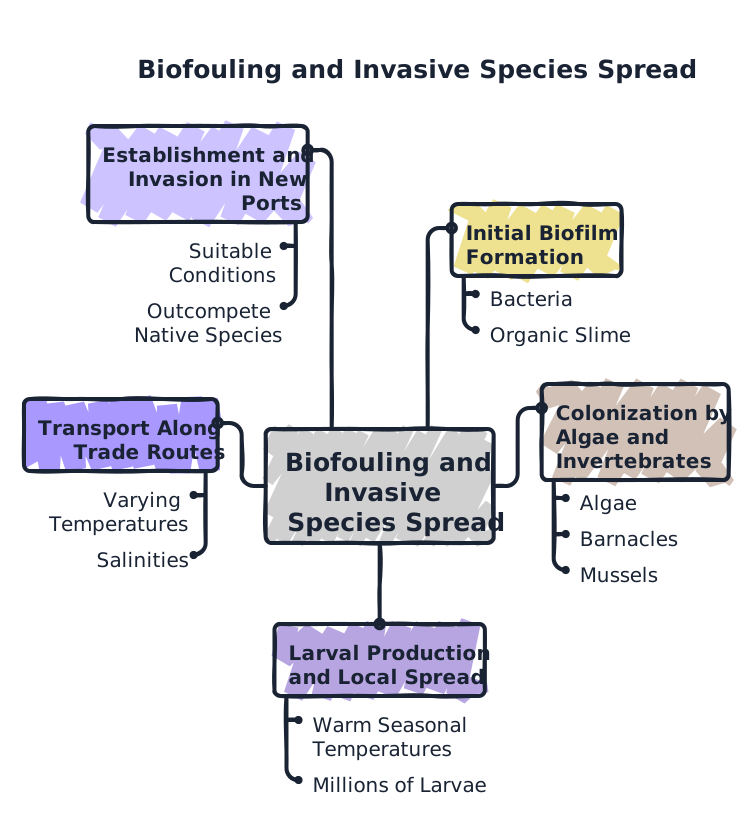
Even a thin slime layer raises a ship’s fuel consumption by 20‑25 per cent, according to industry data cited by the IMO. A light barnacle coating can push that past 50 per cent. About one‑tenth of all maritime fuel is burned purely to overcome drag from hull organisms — a hidden emissions penalty sitting on top of the ecological hazard.
Mario Tamburri, the study’s lead author and a professor at the Chesapeake Biological Laboratory, has spent two decades researching ship‑borne invasions. He now calls the lay‑up an “extraordinary biosecurity threat.” His team urges pre‑departure hull cleaning, forecasting of first ports of call, and rapid monitoring at high‑risk destinations. “Marine invasive species have profound ecological and economic impacts on coastlines across the globe,” said Carolyn Tepolt, a biologist at Woods Hole Oceanographic Institution. Once established, she noted, they are nearly impossible to eradicate.
The cost of partial mitigation is already climbing. Divers in Gulf ports are cleaning hulls at nearly $8,000 per vessel, close to a 60 per cent increase. But the number of ships needing treatment far exceeds the available capacity. The IMO’s biofouling guidelines — written in 2011 — strongly encourage flag states to require management plans and record‑keeping, yet they remain voluntary. According to IMO guidance notes, shipping is identified as a dominant vector for non‑indigenous species introductions, and standards need strengthening as global trade volumes grow.
The demand that turns a hull into a weapon
The global shipping fleet that serves Western consumer and energy markets is the same fleet now incubating invasive species. Modern trade, much of it moving goods to North America and Europe, is identified by the IMO as the dominant pathway for marine aliens —via both ballast water and hull growth. Once invaders reach Western coasts, they damage ports, marinas, and shellfish farms, raising maintenance costs for waterfront infrastructure and insurance claims for municipalities. The connection between a geopolitical crisis in the Gulf and a fouled marina in Florida is not theoretical; it is a matter of vessel trajectory.
Tourism adds another layer. Coastal leisure industries depend on intact ecosystems, yet invasive species transported by vessels can degrade beaches, reefs, and fish communities that support recreational diving and fishing. Port expansions financed by Western capital also increase ship traffic into sensitive regions, raising the odds that heavily fouled hulls will eventually arrive at smaller harbours where biosecurity measures may be weaker than at major commercial ports.
The risk is well‑documented in financial terms. Industry analyses cited by the IMO indicate that marine invasive species cause tens of billions of dollars in direct economic damage each year, with heavy burdens on North America and Europe. The Asian green mussel, originally from Indo‑Pacific waters, has already hitched rides on hulls to the Caribbean and South Atlantic, displacing native mussels and damaging port equipment.
The standoff has exposed a structural gap between security planning and environmental risk management. Conflict planners focus on oil flows and naval access; the biological cargo accumulating beneath the waterline rarely enters the calculus. The next move — whether an IMO circular arrives before diplomats agree on a reopening timetable — will determine how much of that cargo makes it to sea.
Beyond the headline
The bigger picture
The Hormuz lay‑up exposes how global trade infrastructure itself can become an ecological hazard: shipping routes designed for efficiency turn into vectors for biological exchange when conflict immobilises vessels for months. This is not only about one strait, but about a system in which geopolitical shocks routinely create new pathways for species and pollutants, revealing a structural gap between security planning and environmental risk management.
The science gap
Scientists can model likely invasion pathways and high‑risk ports, but they still lack empirical data on exactly which organisms are colonising the stranded hulls and how many will survive long‑distance transit. Without systematic sampling of the idle fleet and coordinated monitoring at first ports of call, predictions about invasion magnitude remain bounded by assumptions, making it easier for policymakers to underestimate the threat or delay precautionary measures.
The reach
One critical actor here is the global shipping industry whose fleets serve Western energy and consumer markets. Its decisions on how aggressively to manage biofouling before the Hormuz vessels depart will determine whether invasive species quietly arrive at European and North American ports. For Western coastal economies reliant on fisheries, tourism and maritime trade, this translates into a non‑obvious vulnerability: distant conflict‑driven lay‑ups can materially alter local ecosystems and infrastructure risks years later.
The decisions that will shape the next invasion
With the strait’s reopening tied to diplomatic progress and no firm timeline in sight, four groups face concrete actions.
- Western Port Authority or Coastal Regulator
Review and enhance biosecurity protocols for incoming vessels, especially those arriving from the Persian Gulf. Consult your national environmental agency’s invasive‑species guidance and the IMO’s biofouling management circulars. Consider rapid‑response surveillance at first ports of call, targeted sampling around berths, and requirement for proof of pre‑departure hull cleaning where capacity exists.
- Marine Insurance Underwriter
Reassess risk models for vessels that have been idle in the Gulf. Biofouling now carries potential liabilities for ecological damage, hull cleaning costs, and invasive‑species claims. Examine policy terms and consider new clauses tied to IMO‑compliant biofouling management. Monitor Allianz and other marine insurers for guidance on how premiums may adjust for ships transiting from high‑risk anchorages.
- Global Shipping Company Executive
Develop a pre‑departure hull‑cleaning strategy for your stranded fleet. Engage with Gulf port authorities and regulators to secure cleaning slots now, before departure windows open. Factor increased operational costs and potential delays into logistics planning. Early compliance with IMO biofouling guidelines will reduce the risk of costly port‑state detentions later.
- Coastal Tourism or Aquaculture Operator in Western Countries
Advocate for stricter biosecurity at local ports and marinas. Monitor coastal waters for unusual mussels, algae, or invertebrates and report sightings through national invasive‑species portals or citizen‑science platforms. Understand that a long‑distance invasion can take years to manifest, but the vector is already idling in the Gulf.
FAQ
How can I identify common coastal invasive species?
Many marine agencies provide field guides for common invaders such as Asian green mussels, zebra mussels and shipworms, often with photos, size ranges and habitat notes. These guides highlight distinguishing traits like shell colour, clustering patterns and preferred substrates. Western readers can use national biodiversity or invasive‑species portals to compare local finds against documented non‑native species and check current distribution maps.
How do I report a suspected invasive species?
Most Western countries maintain online reporting tools or hotlines for suspected invasive marine species, typically run by environment ministries or fisheries agencies. Reports usually request photos, location coordinates, date observed and abundance estimates. Some systems integrate with citizen science platforms, allowing follow‑up by local scientists or conservation officers and helping authorities prioritise rapid field surveys at marinas, ports or natural habitats where new arrivals may be spreading.
What can local ports do to reduce the risk?
Port authorities in many coastal states apply biosecurity protocols such as hull inspection requirements, restrictions or permits for in‑water cleaning, and quarantine or treatment procedures for vessels arriving from high‑risk regions. These measures may include increased surveillance at first ports of call, targeted sampling around berths, and collaboration with shipping lines to schedule cleaning. Western readers can consult their national port authority websites for current biofouling and invasive‑species management rules.
Explainer
- Biofouling
- The accumulation of microorganisms, algae, plants, and animals on submerged surfaces such as ship hulls. A slime layer forms within days, followed by larger organisms that increase drag and fuel consumption. Even a thin coating can raise emissions by 20–25%, while barnacles can drive that figure past 50%.
- Strait of Hormuz
- The narrow waterway connecting the Persian Gulf to the Gulf of Oman and the Arabian Sea. It is the sole maritime exit for major oil producers including Saudi Arabia, Iran, Iraq, Kuwait and the UAE. At its narrowest point the strait is just 21 nautical miles wide, channeling roughly $600 billion in annual energy trade.
- Asian green mussel
- A fast‑growing marine mussel native to the Indo‑Pacific that has spread globally on ship hulls and in ballast water. It outcompetes local species for space and food, and can clog intake pipes and damage port infrastructure. The species has established populations in the Caribbean and South Atlantic.
- Ballast water
- Water taken on by a ship to maintain stability, often discharged at a different port along with any organisms it contains. It is one of the two main shipping vectors for marine invasive species, alongside biofouling. The IMO’s Ballast Water Management Convention requires ships to treat ballast water before release.
RELATED STORIES


![Top 10 Volcanoes to Climb in Indonesia [Prices & Trekking Experience] - Uncategorized () - October 2026 - Indoneo](https://www.indoneo.com/wp-content/uploads/2024/06/polina-kuzovkova-Bjr5aSbHeSI-unsplash.jpg.webp)


