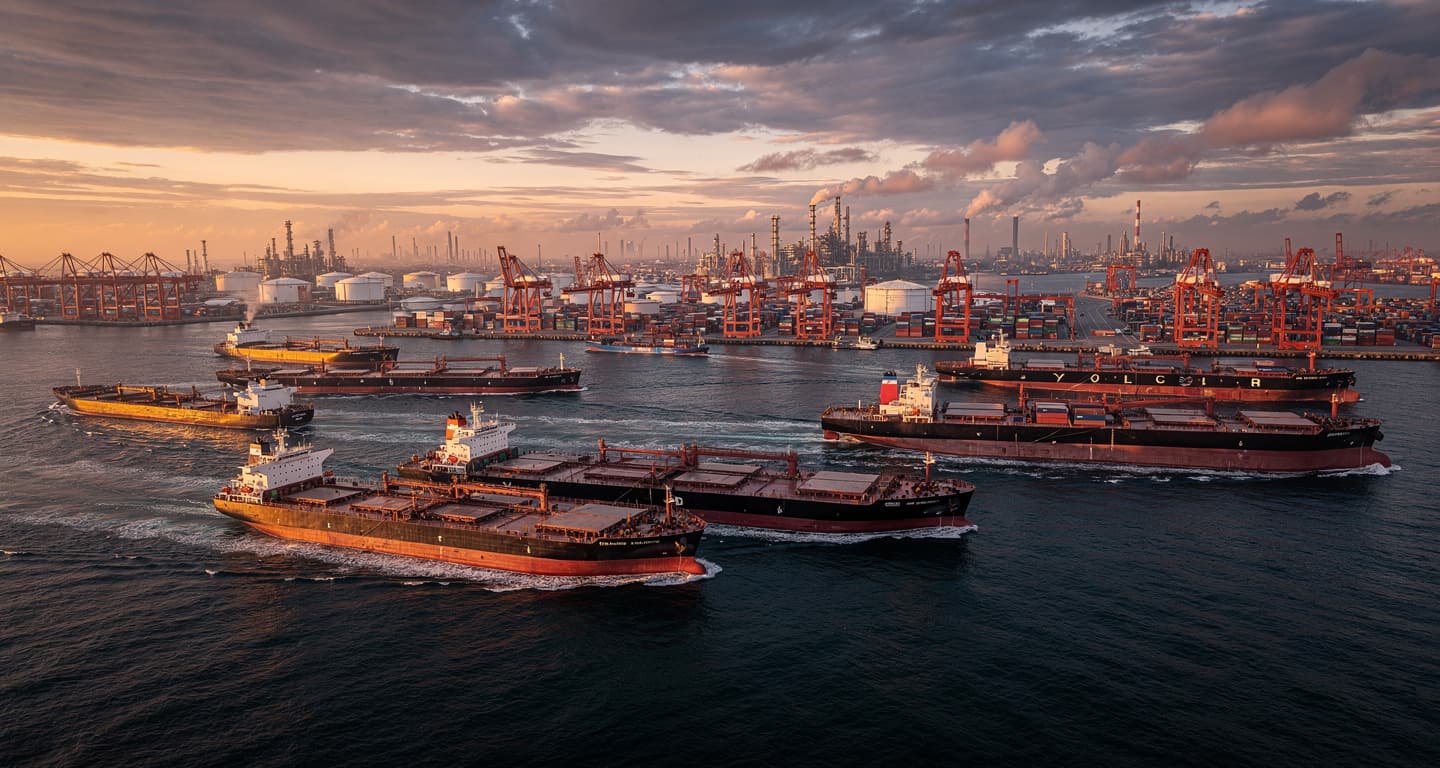
A sanctioned Russian tanker, the Caroline Bezengi, carrying roughly one million barrels of crude has grounded near Oman’s Hallaniyat Islands nature reserve, releasing an oil slick. Oman’s Environment Authority estimated the slick at 390 square kilometres on August 10, though satellite analyses from other sources have placed it as high as 800 square kilometres by early August. The vessel belongs to the shadow fleet used to move Russian oil around Western sanctions.
Oman ordered the removal of the vessel on July 23, but it remains in place. The spill threatens a newly protected ecosystem and raises questions about liability when sanctions create environmental hazards.
The Hallaniyat Islands, designated as a nature reserve in 2025 by Sultan Haitham bin Tarik of Oman, shelter some of the world’s most isolated whale populations and rare seabirds. In mid-2026, an oil slick began spreading across waters near the reserve—the result of a grounded tanker carrying sanctioned Russian crude. The incident exposes how Western sanctions on Russian oil have redirected trade into older, less-transparent vessels that operate outside normal insurance and oversight, transferring spill risk to coastal states that had no role in designing the sanctions regime.
The Caroline Bezengi, a 274-metre tanker built in 2001, loaded a million barrels of Russian crude at Novorossiysk in April and transited the Suez Canal in late May. On June 8 off Yemen, maritime security sources reported that the vessel experienced an onboard explosion, though the cause and responsibility remain under investigation. The tanker subsequently grounded near Qibliyah Island, inside the marine reserve. The slick has been expanding for weeks, and while Oman’s Environment Authority has begun monitoring and technical response planning, active physical containment efforts have not yet been deployed.
Tracking the spill and the reserve at risk
Measuring the slick’s size has proven difficult, with estimates varying significantly depending on the source and date. Oman’s Environment Authority reported on August 10 that the slick covered about 390 square kilometres, roughly seven kilometres from the coast. However, satellite analyses from other organizations tell a different story.
On July 26, the slick measured just 45 square kilometres, according to AP’s analysis of satellite data. By August 7, AP’s tracking showed it had grown to nearly 800 square kilometres. Greenpeace’s analysis placed it around 600 square kilometres on August 4. The differences reflect the challenge of tracking a drifting slick with multiple sensors and the time lag between satellite passes.
The slick is now drifting near a reserve established in 2025 to protect the Arabian Sea humpback whale, Socotra cormorant, and other species. Any oil reaching the shallows or coastline would put those populations at risk. Tony Gutierrez, a professor of environmental microbiology and biotechnology at Heriot-Watt University, noted that keeping the oil offshore would greatly reduce impact compared to shoreline contact, as coastal incursion risks decades-long persistence in ecosystems, as demonstrated by the 1989 Exxon Valdez incident in Alaska.
The Caroline Bezengi belongs to Russia’s shadow fleet—older vessels that operate outside Western insurance and regulatory systems to move sanctioned crude. The ship was originally flagged under Cameroon but was de-listed in June. It currently faces sanctions from the European Union, Ukraine, the United Kingdom, Canada, and Switzerland. Registered ownership lies with Rentoor Shipmanagement Ltd; Villar Shipmanagement Ltd serves as manager. Both are reportedly based in China, and Reuters was unable to reach either company.
The mechanics of this parallel fleet are easier to see than to regulate.
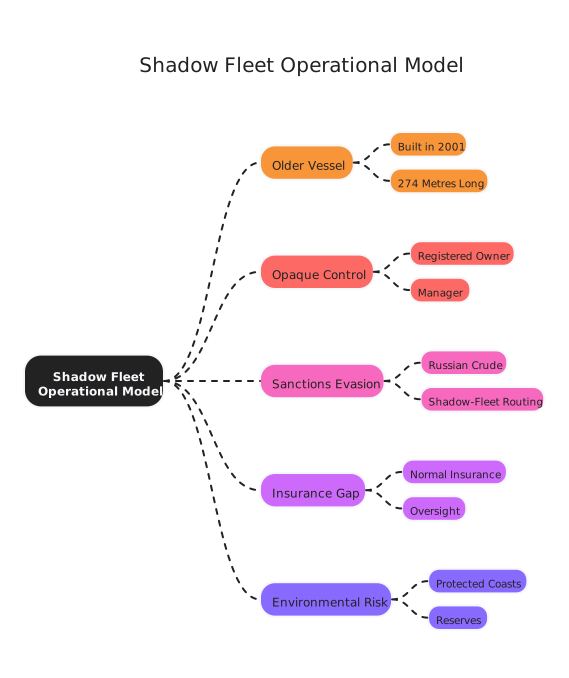
The spill’s scale is documented. Less clear is who can be compelled to stop it—and who pays if they cannot.
Sanctions create the risk but cannot contain the spill
The sanctions framework that pushed the Caroline Bezengi into the shadow fleet was designed to restrict Russia’s oil revenue, not to ensure safe transport of the crude that still moves. The vessel was sanctioned by the EU and Britain for carrying Russian oil, yet it loaded at Novorossiysk, transited Suez, and was only de-flagged after the incident. The practical gap is plain: sanctions can restrict trade but do not guarantee the condition of the ships that remain in service.
Oman’s Ministry of Transport ordered the ship’s owners to remove the vessel and its cargo on July 23. The order has not been carried out, and it is unclear who has the legal or practical capacity to act. Ownership is split across two entities in China, both unreachable. The ship’s insurance status is unknown. Under international maritime conventions, liability for cleanup typically falls on the shipowner or insurer. When those entities are opaque or beyond reach, the coastal state may be left with the bill.
What happens next depends on Oman’s next steps. The Environment Authority is using satellite imagery, field surveys, and technical modelling to guide a response. If authorities can still control the leak before further shoreline impact, the ecological damage may be limited. If they cannot, pressure will build for outside assistance—and for a broader reckoning with the environmental cost of sanctions-circumvention shipping.
Beyond the headline
The Bigger Picture
This is a sanctions-enforcement failure that becomes an environmental emergency at sea. When trade is pushed into older, less transparent tankers, the risk is not only evasion of oil restrictions but the transfer of spill liability onto coastal states that did not design the system and cannot easily police it.
The Money Trail
The beneficiary is the transport chain that keeps sanctioned crude moving despite higher friction costs. The combination of opaque ownership, split management, and reliance on aging hulls lets the cargo move when normal commercial channels would reject the voyage, shifting the hidden cost into insurance, cleanup, and ecological damage.
What Isn’t Being Said
The dominant frame focuses on the tanker and the spill, but the missing issue is enforcement capacity once a sanctioned vessel is already disabled. The critical question is not only who caused the grounding, but who can compel removal, fund cleanup, and recover losses when the shipping structure is deliberately layered across jurisdictions.
The spill has not stopped, and neither has the shadow fleet
With the tanker still grounded and the slick expanding, the incident has exposed gaps that will affect insurers, regulators, environmental groups, and legal experts in different ways.
- Western maritime insurer with shadow fleet exposure
You are underwriting vessels or their cargoes in a region where shadow-fleet operations are now a demonstrated environmental liability. Re-evaluate risk models and policy terms for any vessel with opaque ownership, aging hulls, or de-listed flags—these are the markers of sanctions-circumvention exposure. The Caroline Bezengi’s spill is a costly reminder that cleanup liability may land on whoever insured the cargo or the port call, even indirectly.
- EU/UK sanctions enforcement policymaker
The incident shows that sanctions on Russian oil are working well enough to force the trade into shadow channels, but not well enough to prevent environmental damage when those channels fail. Assess whether current enforcement can compel safe transport or if new measures—port state controls, insurance mandates, flag-state accountability—are needed to close the gap. The next enforcement test is whether Oman can compel removal; if it cannot, the limits of sanctions-only approaches will be plain.
- Global environmental NGO operating in marine conservation
The Hallaniyat Islands reserve, created just last year and home to endangered whale populations, is now the site of a spill that research on past incidents suggests may persist for decades. Use this case to press the International Maritime Organization and regional bodies for stricter rules on aging tankers and mandatory spill-response plans for all vessels, including those operating outside normal insurance. Mobilizing now could also support Oman’s response and long-term monitoring.
- International maritime law and liability expert
This case presents a liability puzzle: a sanctioned vessel with split ownership, flagged and de-flagged, grounded in a protected area. Analyze which jurisdictions—flag state, coastal state, owner’s domicile, or insurer—could be compelled to fund cleanup, and whether sanctions complicate claims under international conventions like the Bunkers Convention or the International Oil Pollution Compensation Funds. The answer will set precedents for a fleet that is growing.
Explainer
- Shadow fleet
- A network of older tankers that move sanctioned oil outside Western insurance and regulatory oversight. These vessels often use opaque ownership, flag-hopping, and split management to avoid detection. The fleet has grown rapidly since Western sanctions on Russian crude began in 2022.
- Hallaniyat Islands nature reserve
- A marine protected area established by Sultan Haitham bin Tarik of Oman in 2025. The reserve shelters the Arabian Sea humpback whale, one of the world’s most isolated whale populations, and the Socotra cormorant. Its designation came after years of advocacy by environmental groups.
- Caroline Bezengi
- A 274-metre oil tanker built in 2001 that is part of Russia’s shadow fleet. It was originally flagged under Cameroon but was de-listed after it grounded near Oman’s Hallaniyat Islands in mid-2026. The vessel is sanctioned by the EU, UK, Canada, Switzerland, and Ukraine for transporting Russian crude.
- Exxon Valdez
- The oil tanker that ran aground in Alaska’s Prince William Sound in 1989, spilling 11 million gallons of crude. The spill contaminated over 2,000 kilometres of coastline, and oil residues can still be found in some beaches decades later. It remains a benchmark for the persistence of marine oil pollution.
RELATED STORIES