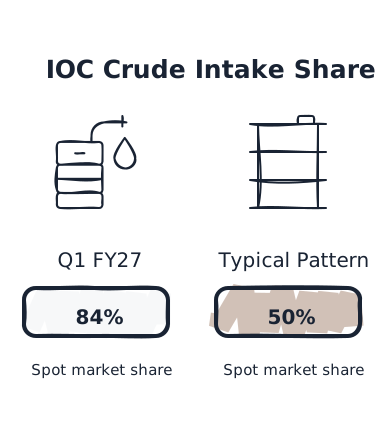
Indian Oil Corp. sourced 84% of its crude from the spot market in the April–June 2026 quarter, a record high, while Russian crude rose to 54% of its imports — also a peak — as US–Iran tensions disrupted tanker traffic through the Strait of Hormuz.
The shift, which forced India’s largest refiner to abandon decades-old long-term Gulf contracts, has redrawn global crude flows in weeks. Whether it marks a permanent realignment or a temporary detour depends on the next round of US–Iran diplomacy.
India’s crude import bill hit an all-time quarterly high of $49.66 billion between April and June. The surge was not just a price spike — it was the cost of a fundamental restructuring at Indian Oil Corp., the country’s largest refiner, which tore up its long-term Gulf supply contracts and turned instead to the spot market and Russian crude.
Indian Oil’s pivot, forced by US–Iran tensions that have upended tanker traffic through the Strait of Hormuz, has redrawn global crude flows in weeks. It has also left the company’s chairman insisting the shift is temporary — while the data suggests something more durable is taking shape.
The supply model that came apart in one quarter
Indian Oil’s finance director, Anuj Jain, described the speed of the shift to analysts: spot crude purchases rose from around 50% to nearly 84% of total sourcing in the April–June quarter as Middle East supply disruptions intensified. The message was clear: a refiner that once relied on predictable Gulf term contracts was scrambling for cargoes every few days.
India’s overall crude import bill for the quarter reached $49.66 billion, up 61% year-on-year, according to the Petroleum Planning and Analysis Cell. Even as imports cost more, Indian Oil ran its refineries at over 109% of capacity, signalling it would pay whatever necessary to keep domestic supply flowing.
Russian crude, mostly Urals, accounted for more than half of its intake — a peak that analysts at Kpler attribute to aggressive bidding for discounted cargoes, even as the discount itself has narrowed. For an Indian refinery planner, the shift meant replacing predictable monthly Gulf deliveries with a race to secure a fresh cargo every few days.
Yet Indian Oil’s chairman, Arvinder Singh Sahney, indicated during a media briefing that once shipping lanes stabilise, the company will return to Gulf term contracts, citing the proximity of suppliers. The company is even preparing alternative routes, such as via the Cape of Good Hope, for Saudi crude if Red Sea transit remains blocked.
Even as it reassures on supply, Indian Oil is spending to add 347,000 barrels per day of processing capacity by December across three refineries. The expansion will boost crude requirements at a time when its sourcing model is still in flux.
The contrast between its old sourcing model and the one it ran last quarter is sharper than any spreadsheet can capture.
A temporary fix, or the new blueprint?
The mechanism that undid Indian Oil’s supply chain is not an isolated shock — it is a geopolitical standoff that shows no sign of easing. US–Iran tensions have effectively raised the cost of insuring tankers through Hormuz, making Gulf term deliveries too unpredictable for a refiner that runs flat out. Western governments have focused on containing broader market fallout rather than challenging India’s Russian purchases, publicly stressing freedom of navigation while maintaining sanctions on Iranian and selected Russian oil flows.
Global crude benchmarks and tanker rates have absorbed the shift. Brent futures and Asian-refined product cracks are sensitive to India’s heavier Russian intake and Gulf disruptions that reroute trade flows. Listed tanker operators with Middle East–Asia exposure face higher freight earnings but also elevated operational risk over the next two quarters.
The real signal will come in late October, when Indian Oil reports Q2 earnings. If spot purchases still dominate above 70%, the company will have institutionalised its crisis sourcing model — a move that would lock in Russian crude and spot cargoes as structural pillars, not stopgaps. The next round of US‑Iran diplomacy, expected within a month, could either ease freight costs or entrench the spot‑heavy, Russia‑leaning pattern well into 2027.
Beyond the headline
The Bigger Picture
Indian Oil’s pivot exposes how energy security now depends less on long‑term contracts and more on the ability to rewire logistics at short notice. Refiners that can rapidly arbitrage between Russian, Gulf and Atlantic barrels — and absorb higher freight and financing costs — will shape the next phase of global oil trade, often faster than producers or diplomats can adjust.
The Timing
Indian Oil’s new refining capacity, coming online by December, will need a steady stream of crude. The company must now decide, in a market where spot still dominates, which suppliers to lock into long‑term deals — a choice that will shape its procurement for years.
The Reach
Increased Indian exports of diesel and gasoline, refined partly from Russian crude, add to competitive pressure on European refineries already facing high costs. The risk is not just short‑term market share loss, but a structural erosion of margins if the sourcing shift persists.
Where Western capital sits as Indian Oil rewires
With US–Iran tensions in the Strait of Hormuz unresolved and Indian Oil waiting on its next quarterly earnings in late October, Western market participants face three sets of decisions.
- Western investor in global oil and gas majors
Evaluate portfolio exposure to companies with Middle East–Asia shipping interests and refining margins sensitive to discounted Russian crude. Monitor Indian Oil’s investor relations page for its Q2 filing to see whether spot and Russian crude shares stay elevated — a signal that global crude flows may stay redrawn for longer.
- European refiner and product exporter
Assess the potential for greater Indian refined product volumes entering key export markets. Benchmark your cost base against Indian refiners running on discounted Russian feedstock and prepare for sustained margin compression if the current sourcing pattern holds through 2027.
- US or European maritime insurance underwriter
Review risk models for tankers transiting the Strait of Hormuz and those lifting Russian crude. Premiums for both routes are likely to stay elevated, and any further US‑Iran escalation will demand a rapid recalibration. Track the US Department of State’s Middle East briefings for the next threat assessment.
Explainer
- Strait of Hormuz
- The narrow waterway between Iran and Oman that connects the Persian Gulf to the Gulf of Oman and the Arabian Sea. Roughly 21 million barrels of oil pass through it daily, making it the world’s most important oil transit chokepoint. Disruptions here immediately raise tanker insurance costs and can force buyers to seek alternative, longer routes.
- Urals crude
- A medium sour crude oil blend exported from Russia’s Baltic and Black Sea ports, serving as the country’s main export grade. It has historically traded at a discount to Brent, a gap that widened sharply after Russia’s invasion of Ukraine. Indian refiners have been the largest buyers of the discounted barrels.
- Cape of Good Hope
- The southern tip of Africa, a shipping route that tankers use to bypass the Red Sea and Suez Canal when those waters become too dangerous or expensive. The detour adds about 3,400 nautical miles to a voyage from the Middle East to Asia, raising freight costs and delivery times substantially.
- Brent crude
- The global benchmark for oil prices, based on crude produced in the North Sea. Brent prices directly influence the cost of most internationally traded crude, including Russian Urals and Gulf grades. Movements in Brent ripple through fuel prices at pumps and industrial energy costs worldwide.
RELATED STORIES