Nepal’s Foreign Ministry confirmed on September 6 that 1,341 bodies have been recovered and roughly 5,000 people remain missing—including about 600 foreign nationals from 35 countries—after an ice-rock avalanche on August 26 sent the Bhote Koshi River raging through northern and central Nepal. 37 motorable bridges were damaged across the flood zone, 55 kilometres of roads were damaged, and 783 megawatts of hydropower capacity was knocked offline.
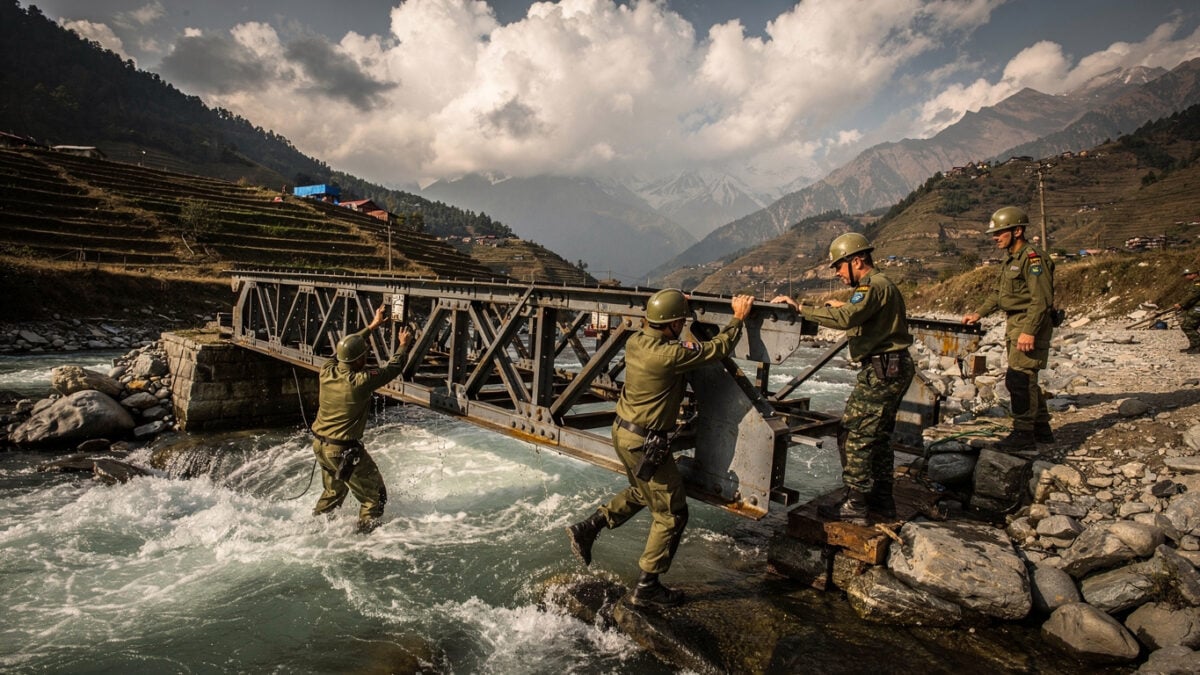
The government has turned to India, China, and the United Kingdom for emergency Bailey bridges to reconnect severed districts. China delivered two 100-metre bridges to the Korala border crossing by September 3. The repair bill for roads and bridges alone is estimated at NPR 30 billion.
Nepal’s disaster response is now a diplomatic test. The same August afternoon that an ice-rock avalanche tore through the Bhote Koshi valley, killing 1,341 people and sweeping away the roads that connect Kathmandu to its northern border, set in motion a quieter competition over who would help rebuild—and on whose terms.
China delivered two 100-metre Bailey bridges to the Korala border point in Mustang by September 3. India has offered its own bridges and technical assistance. The United Kingdom, with hundreds of its nationals among the missing, has pledged support through Prime Minister Andy Burnham’s office. For Nepal, the question is not whether aid will arrive. It is how to accept it without becoming the stage on which larger powers perform their generosity.
The numbers are stark, but the geometry of the response is what will shape the weeks ahead. Reconnecting Rasuwa to Nuwakot, restoring the link between Dhadingbesi and the Prithvi Highway, reopening the trade corridor to Tibet—each repaired crossing is also a geopolitical marker, laid down in steel and timber.
The damage runs deeper than the bridges
The Rapid Damage and Needs Assessment, cited by Nepal’s Foreign Ministry on September 6, documented 7,570 damaged houses affecting about 32,933 people, 68 suspension bridges destroyed, and 48 government offices rendered unusable. The assessment also found that 13 hydropower projects, two transmission lines, and one solar plant were affected—idling 783 megawatts of generation capacity.
A separate compilation drawing on Nepal Electricity Authority figures puts the total closer to 748 megawatts across 14 facilities: nine operating plants and five under construction. Among them, the 216-megawatt Upper Trishuli-1, the 120-megawatt Rasuwa Bhotekoshi, and the 111-megawatt Rasuwagadhi project. The discrepancy between the two figures is small in percentage terms. In absolute terms, it is the difference between several hundred thousand households with power and without.
Of the 63 bridges along the Rasuwa–Chitwan corridor, 41 motorable crossings were destroyed and four partially damaged. The concrete bridge at Furke Khola, which linked the Dhading district headquarters to the national highway, is gone.
“Even where Bailey bridges are available, there is no road to transport them to the sites,” said Sushil Babu Dhakal, joint secretary at the Ministry of Physical Infrastructure and Transport. The Department of Roads has 11 Bailey bridges in its inventory, each up to 48 metres long. Their access routes have been washed away.
Finance Minister Swarnim Wagle has estimated that the disaster damaged roughly one-tenth of Nepal’s economy. Infrastructure losses, hydropower disruption, and border-trade interruption, he argued, amount to a macroeconomic shock that will require significant reconstruction finance. The UN and its partners launched a flash appeal for approximately USD 49.6–50 million to assist over 84,000 affected people before winter sets in.
Prime Minister Andy Burnham called the scenes along the Nepal-China border “devastating” and committed to supporting British nationals and working with local authorities. The Foreign Ministry in Kathmandu has established an Emergency Control Room with dedicated contact lines to centralise international assistance requests.
The figures below capture what was lost in a single afternoon.
The Nepali Army is separately installing an Acrow bridge at Devighat in Nuwakot. Road-clearing crews have begun reopening stretches of washed-away highway to allow temporary bridge installation, according to Shubharaj Neupane, spokesperson for the Department of Roads. But the timeline is unforgiving.
| Metric | Figure | Source | Date |
|---|---|---|---|
| People rescued | 13,104 | Nepal Foreign Ministry | 6 Sep 2026 |
| People missing | About 5,000 | Nepal Foreign Ministry | 6 Sep 2026 |
| Bodies recovered | 1,341 | Nepal Foreign Ministry | 6 Sep 2026 |
| Roads damaged | 55 kilometres | RDNA assessment | 6 Sep 2026 |
| Motorable bridges damaged (total flood zone) | 37 | RDNA assessment | 6 Sep 2026 |
| Hydropower capacity affected | 783 megawatts | RDNA assessment | 6 Sep 2026 |
| Source: Nepal Ministry of Foreign Affairs; Rapid Damage and Needs Assessment. Note: Along the Rasuwa–Chitwan corridor specifically, 41 motorable bridges were destroyed and 4 partially damaged. | |||
A corridor built on unstable ground
The Bhote Koshi valley is not an accident of geography—it is a deliberate concentration of Nepal’s development. Hydropower tunnels, customs posts, and highways were layered into a single river corridor beneath glacial peaks that climate change has made increasingly unstable. The August 26 avalanche was extreme. The placement of so much valuable infrastructure in its path was a choice.
Foreign Minister Shisir Khanal has briefed diplomats that Nepal needs more than bridges: LiDAR systems, high-capacity drones, and DNA testing kits to identify the dead. Only 98 bodies had been identified and returned to families as of Monday, September 2. Decomposition, partial remains, and the distance bodies travelled downstream have made the work slow. For the roughly 5,000 still missing, including the 600 foreign nationals, the window for recovery is narrowing.
Global emissions patterns connect indirectly but unmistakably to this disaster. The glacial melt that primes Himalayan valleys for ice-rock collapses is driven by warming that industrialised economies set in motion. At the same time, Western trekking traffic and multilateral hydropower investment have raised the stakes along these corridors, concentrating assets and people in places where a single event can produce systemic damage. The 783 megawatts offline is not only a local power cut; it is a disruption to energy finance models that assumed stable hydrology.
China’s foreign ministry spokesman Guo Jiakun stated on September 3 that additional aid batches are being prepared, including more Bailey bridges, epidemic-prevention materials, and teams of DNA identification experts from the Xizang Autonomous Region. India is expected to follow with its own bridge deliveries and road-support offers. What looks like humanitarian relief is also a scramble for influence along the same border where Gyirong Port, Tibet’s main trade gateway, was severed on August 26.
For a family in Rasuwa district, the bridge that once carried them to a clinic in 20 minutes is now a cable pulley over moving water. The question is not whether Nepal will rebuild. It is whether the reconstruction will distribute risk differently—or simply pour concrete back into the same exposed corridor and call it recovery.
Beyond the headline
The Human Cost
In Rasuwa, Nuwakot, and Dhading, families have lost relatives and the roads that connected them to food, medicine, and income. Where concrete bridges stood two weeks ago, communities now rely on improvised zip lines and helicopter drops. A trip to a district hospital that once took half an hour now demands hours of travel and real physical risk.
The Bigger Picture
Nepal’s development model concentrated critical infrastructure along a few multi-use valleys beneath unstable glaciers. Hydropower tunnels, trade checkpoints, and highways sit directly in the path of ice-rock collapses that climate change is making more frequent. Each new project layered into these corridors amplifies the stakes, turning what might have been a local landslide into a systemic shock to energy, trade, and state capacity.
The Reach
European insurers and reinsurers holding exposure to Himalayan hydropower and adventure tourism are now recalculating their risk models. If glacial-related infrastructure and trekking coverage is repriced, the shift will feed into higher costs for future energy finance and travel packages, altering how European capital and consumers engage with high-altitude regions.
The decisions that follow the flood
With winter approaching and 5,000 people still missing, governments, investors, and operators face immediate choices.
- Western insurer of Himalayan infrastructure or tourism
Reassess your risk models for glacial-related infrastructure and trekking coverage. The 783 megawatts of offline hydropower capacity and the destruction of 37 motorable bridges across the flood zone represent a claims environment that existing underwriting may not have priced. The UK government’s travel advice and the Foreign Ministry’s daily situation updates are your primary sources for tracking reinstatement timelines.
- European tour operator with Nepal trekking packages
Review the accessibility of affected routes in Rasuwa, Nuwakot, and Dhading districts. The Department of Roads is prioritising temporary bridge installation, but access roads to many sites are themselves destroyed. Consult the Nepal Tourism Board and the Foreign Ministry’s Emergency Control Room for corridor-specific updates before committing to autumn itineraries.
- Western investor in Nepalese hydropower projects
Evaluate the financial exposure of damaged assets, particularly Upper Trishuli-1 (216 megawatts), Rasuwa Bhotekoshi (120 megawatts), and Rasuwagadhi (111 megawatts). The NPR 50 billion reconstruction estimate signals a fiscal burden that may delay or reprice project timelines. Engage with the Ministry of Energy and the developers directly for damage assessments and restart schedules.
- Policy professional tracking India-China influence in South Asia
Monitor the type, volume, and timing of bridge deliveries and reconstruction offers from Beijing and New Delhi. China’s delivery of two bridges to Korala by September 3 sets a baseline. Whether India matches or exceeds that commitment—and how quickly—will signal its appetite for competing on humanitarian terrain in Nepal. The next phase of announcements is likely within weeks.
Explainer
- NDRRMA
- The National Disaster Risk Reduction and Management Authority is Nepal’s central agency for coordinating disaster response, casualty tracking, and rescue operations. It reports directly to the Prime Minister’s Office and became operational in 2019 after Nepal’s transition to a federal disaster management framework. Following the Bhote Koshi floods, it has been the primary source for confirmed death tolls, missing-person counts, and body-identification figures released through the Foreign Ministry.
- Bailey bridge
- A portable, prefabricated truss bridge originally designed for military use during the Second World War, now widely deployed in disaster zones where permanent crossings have been destroyed. The modular panels can be assembled by hand and launched across gaps without heavy equipment. Nepal’s Department of Roads holds 11 Bailey bridges of up to 48 metres, but even these cannot be installed where access roads have been washed away.
- RDNA
- Rapid Damage and Needs Assessment is a structured methodology used by governments and international institutions to quantify losses immediately after a disaster. It covers housing, public infrastructure, transport, energy, and agriculture. Nepal’s RDNA for the Bhote Koshi floods, cited by the Foreign Ministry on September 6, 2026, will form the basis for a more detailed Post-Disaster Needs Assessment and subsequent reconstruction financing discussions.
- Gyirong Port
- Tibet’s main trade gateway to Nepal, located in the Xizang Autonomous Region at an altitude of about 2,800 metres. The checkpoint handles the largest volume of overland trade between China and Nepal, including essential goods and construction materials. It was severed on August 26, 2026, when the same ice-rock avalanche that devastated the Bhote Koshi valley also struck the Chinese side of the border, killing at least 43 people and leaving more than 500 missing.
RELATED STORIES