Deep tech investment volume in Singapore rose 31% in 2023 while total startup funding fell 20%, pushing deep tech’s share of deal value to 25% — well above the global average of around 20%. A*STAR has spun out over 40 medtech companies since 2010 worth more than S$1 billion, and the government is funding R&D at roughly 1% of GDP through its RIE2025 plan.
The surge reflects a structural pivot away from software venture models, but the region’s funding infrastructure remains calibrated for consumer apps. A new investment playbook is taking shape in Singapore — one that concentrates capital, demands operational control, and steers research through commercialisation. Its success will decide whether Southeast Asia becomes a technology producer or stays a consumer.
A deep tech startup has a working prototype and a pilot-scale demonstration. Venture investors pass. They see a hardware bet with no established customers, a decade-long path to revenue, and geopolitical risk — export controls and national security reviews — that venture portfolios were never designed to absorb. The problem runs deeper than any single deal. For three decades, venture capital optimized for software: small positions across many companies, minimal ownership stakes, returns driven by outliers. That model routed capital away from anything requiring factories, regulatory approval, or long-term offtake contracts.
One data point from Singapore now shows a different pattern. In the middle of a regional funding drought, investment in deep tech not only held — it grew. The city‑state is reorganising its science‑to‑commercialisation pipeline around the demands of semiconductors, climate hardware, and industrial AI. The question is no longer whether the old venture playbook fails for deep physics. It is whether the new one, being assembled in real time, can scale before the valley of death claims another generation of research.
A funding model built for software cannot handle heavy engineering
Singapore’s deep tech investment volume rose 31% year‑on‑year in 2023 while overall startup investment fell 20%, according to data from DealStreetAsia and Enterprise Singapore. Deep tech accounted for 25% of local deal value, up from 17% in 2022. That 25‑percentage‑point swing in share — in a year when total funding contracted — is not a market cycle. It is a signal that capital is being forced to adapt.
The sequence below maps the stages where capital dries up — and where Singapore’s new models are being deployed.
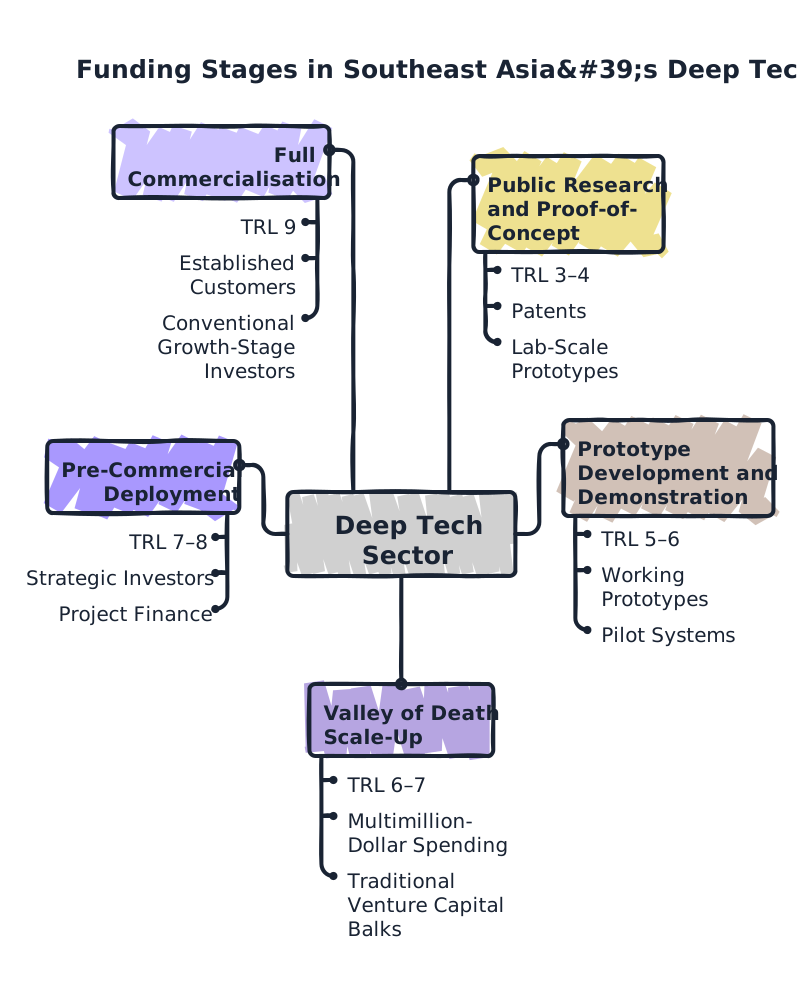
The government‑backed institution at the centre of this push, A*STAR, has generated more than 40 medtech spinoffs since 2010, collectively valued at over S$1 billion. Those companies came through dedicated commercialisation engines like the Diagnostics Development Hub and MedTech Catapult. Separately, late‑stage investor Temasek partnered with NTU and NUS to commit S$75 million to deep tech venture creation, while A*STAR and Flagship Pioneering aim to invest up to S$100 million over five years in biotech spinouts from Singapore research institutes.
The data is limited to Singapore — the region’s main deep‑tech hub — and deep tech’s absolute share remains small. But the direction is set. Deputy Prime Minister Heng Swee Keat told a Temasek‑backed deep tech arm’s office opening that “deep tech has the potential to transform industries and address shared global challenges like climate change and public health.” He added that it requires “different players from across the research, innovation and enterprise landscape to work together.”
That coordination is now being formalised. A*STAR’s plans under RIE2030 show a shift toward build‑to‑buy models and a coordinated financing continuum that pulls early‑stage grants through to government‑linked capital. Irene Cheong, assistant chief executive of A*STAR’s innovation and enterprise division, said the agency is “moving towards a coordinated financing continuum” and creating “globally investible deep tech assets.” Keng Hui Lim, who leads A*STAR’s Science and Engineering Research Council, said the semiconductor, advanced manufacturing, and connectivity portfolios will now prioritise “deep collaborations with quality partners — both multinational companies and promising growth companies.”
| Entity | Current rule | New rule | Effective date |
|---|---|---|---|
| RIE Framework | RIE2025 allocated around S$25 billion over five years, focused on broad R&D domains. | RIE2030 sharpens priority on AI, semiconductors, biomedtech, and decarbonisation; integrates venture‑building schemes directly into each domain. | 2026 onward |
| A*STAR Medtech Commercialisation | Generic technology transfer with limited follow‑on financing. | “Build‑to‑buy” model with a coordinated financing continuum from grants to government‑linked capital, through DxD Hub and MedTech Catapult. | Under implementation |
| Semiconductor RIE Flagship | No dedicated national programme for semiconductor deep‑tech startups. | Co‑led by A*STAR and the Economic Development Board, aimed at growing globally competitive local firms and deep tech startups in advanced packaging and related technologies. | Launched under RIE2030 |
| Temasek Venture Creation | Ad‑hoc investments in spin‑offs. | Structured S$75 million partnership with NTU and NUS to jointly spin off research projects. | Announced 2023 |
| Source: A*STAR, EDB | |||
What is still missing is a standardised playbook for private investors. As Takeshi Ebihara of Rebright Partners noted, Singapore is pushing for greater self‑sufficiency in chipmaking — a national security calculus that also opens commercial space. Yet the valley of death remains the point of highest failure. That is where the new models are being tested.
The real competition is state‑directed, not just market‑driven
The mismatched funding structure is not a Singaporean anomaly; it is a global fracture. The US leads in venture scale and frontier AI. China commands state‑directed industrial build‑out and hardware manufacturing. Japan and South Korea dominate memory and advanced manufacturing tools. In deep tech, sovereign funds and industrial policy rarely wait for a term sheet.
Europe’s predicament is instructive. Like Southeast Asia, European universities produce strong deep tech research but firms drown in long timelines and heavy capex. The difference is that Europe deploys large public instruments — IPCEI schemes, the European Innovation Council — while Southeast Asia leans much more on sovereign funds and export‑oriented industrial policy. For Western corporates, this means a Singapore‑backed deep tech partnership is often tied to supply‑chain relocation and state‑controlled manufacturing, not just a subsidy cheque. The model affects who holds the IP and how quickly a factory gets built.
Singapore governs deep tech through horizontal R&D and data frameworks like RIE2030 rather than a standalone AI statute. That contrasts with the EU’s risk‑based AI Act and a patchwork of US guidance. The predictability helps hardware projects that need multi‑year regulatory certainty. It also leaves gaps in dedicated financing rules, though the build‑to‑buy concept aims to fill that void with institutional muscle.
If deep tech’s share of total deal value stalls or drops when the next DealStreetAsia‑Enterprise Singapore report lands, the pressure on sovereign funds to anchor every capital‑intensive venture will intensify. The alternative — a region that produces patents but no products — would cement Southeast Asia’s role as a technology consumer, just as global supply chains are being redrawn. The bet being placed now is that the new playbook, concentrated and state‑linked, can turn lab‑scale prototypes into factories. The next twelve months will show whether that bet is large enough.
Beyond the headline
The Bigger Picture
The push for new deep tech investment models in Southeast Asia reflects a wider global shift from asset‑light software toward capital‑intensive physical infrastructure and sovereign AI capacity. As governments treat chips, data centres and scientific AI as strategic utilities, private capital can no longer rely solely on rapid‑scaling app economics. Instead, investors must weigh national security, industrial policy and export controls alongside returns, redefining what constitutes a successful technology portfolio.
The Money Trail
Behind the rhetoric about innovation sits a reallocation of serious capital: sovereign wealth funds, development banks and state investors are moving billions into semiconductors, data centres and industrial AI rather than consumer apps. These actors seek technology control and supply‑chain leverage, not just financial upside. Understanding who underwrites Southeast Asian deep tech — Temasek, regional sovereign funds, and multinational industrials — reveals whose strategic priorities will shape which technologies leave the lab and whose markets they serve.
The Timing
This call for a new deep tech playbook arrives as global FDI into manufacturing and digital infrastructure is being re‑routed by geopolitical tension and export controls, and as AI hardware demand fuels an upcycle in semiconductors. The conjunction of a funding downturn in traditional consumer tech with rising strategic capital for chips, data centres and climate hardware makes 2025–2026 a narrow window: regions that can quickly align policy, capital and commercialisation pathways now are likely to lock in long‑term advantages in the emerging industrial AI order.
The supply chain shift depends on Singapore’s lab‑to‑fab pipeline
As the mismatch between software‑era funding and hardware‑era demands widens, four groups must recalibrate.
- Western semiconductor procurement manager
Singapore’s state‑backed push into advanced packaging and the Semiconductor RIE Flagship programme creates new fabrication and assembly nodes outside China and Taiwan. You should request capability roadmaps from A*STAR’s Science and Engineering Research Council and track pilot‑line announcements from EDB’s official site. Early‑stage partnerships with local deep‑tech firms may offer preferential access to capacity before the wider market notices.
- US‑based investor with APAC emerging market exposure
The software‑era return profiles do not apply. Deep tech demands longer holds, operational governance, and partnerships with sovereign funds. Review Temasek’s portfolio reports and deep tech arm disclosures for signals of where state capital is concentrating. Funds that align with the build‑to‑buy model are more likely to produce exit‑ready assets, but you will need to factor in regulatory reviews and export‑control shifts as part of the underwriting, not an afterthought.
- European industrial deep tech executive
Singapore’s model is not the subsidy‑heavy European system. It is a state‑manufacturing nexus where IP and equity often sit alongside government‑linked entities. If you are evaluating a Singaporean deep‑tech partner, ask for the RIE2030 domain roadmaps and make clear which parts of the IP chain you need to control. Manufacturing‑heavy joint ventures in semiconductors or medtech can access a coordinated financing continuum that European programmes do not easily replicate, but the governance terms will be different.
- Western policy analyst tracking global tech sovereignty
The success or failure of Singapore’s build‑to‑buy model will be a leading indicator for other mid‑sized economies attempting to create deep‑tech pipelines without a massive domestic market. Monitor A*STAR’s spinoff valuation trajectories and the share of local deep‑tech firms that scale beyond Series B. If the model stalls, expect more aggressive industrial policy across ASEAN — and a faster consolidation of critical technology supply chains into a handful of state‑backed hubs.
Explainer
- Deep tech
- Deep tech refers to ventures rooted in advanced science or engineering, spanning domains like novel semiconductors, quantum devices, new materials, and climate hardware. Unlike software, these companies require expensive labs, specialist talent, and regulatory approvals long before they generate revenue. The term marks a departure from asset‑light internet models and signals a return to physics‑bound innovation.
- Valley of death
- The valley of death is the funding gap between publicly financed research and a commercially viable product. At this stage, prototypes exist but manufacturing scale, customer validation, and regulatory compliance are not yet demonstrated, making the venture too risky for standard venture capital. In hardware‑heavy deep tech, crossing this gap typically demands millions in engineering and testing, often over a timeline that exceeds the ten‑year life of a conventional VC fund.
- A*STAR
- A*STAR is Singapore’s lead public science and technology agency, driving mission‑oriented research and supporting industrial innovation. It runs a pipeline of IP creation and spin‑off companies through units like the Diagnostics Development Hub and MedTech Catapult, and has generated over 40 medtech spinoffs. The agency is now integrating venture‑building programmes directly into its domain strategies under the RIE2030 plan.
- RIE2030
- RIE2030 is the latest iteration of Singapore’s five‑year Research, Innovation and Enterprise plan, allocating roughly 1% of GDP to strategic R&D domains. It sharpens the focus on AI, semiconductors, biomedtech, and decarbonisation, and for the first time embeds innovation and enterprise funding directly into each research domain rather than as a separate horizontal budget line.
- TRL
- Technology Readiness Level (TRL) is a scale originally developed by NASA to assess a technology’s maturity, running from TRL 1 (basic principles observed) to TRL 9 (proven in operational environment). In deep tech investing, the valley of death typically sits around TRL 6‑7, where a working prototype exists but full‑scale manufacturing and customer validation remain incomplete. Singapore’s new models target this band precisely, using public‑research pipelines to generate ventures that are already at TRL 7‑9.
RELATED STORIES