
Washington has set a September 24 date for the first formal US-China AI dialogue under President Trump, with Treasury Secretary Scott Bessent leading the American delegation. The summit arrives as Chinese firms DeepSeek, Zhipu AI, and Moonshot AI have released models that match Western benchmarks at a fraction of the cost.
The talks are framed around risk management and intellectual property. Beijing reads them as a containment tactic, pointing to 28 new AI partnerships with Global South nations announced in Shanghai on July 17 as evidence that its influence is expanding faster than Washington can manage.
The benchmark scores are real, and they are no longer exclusively American. In recent months, three Chinese AI labs—DeepSeek, Zhipu AI, and Moonshot AI—have shipped models that perform comparably to OpenAI’s ChatGPT and Anthropic’s Claude on standard tests. US officials allege they did so using knowledge distillation from Western systems; Chinese firms dispute this, citing original architectural changes. Both approaches employ sparse attention mechanisms that reduce chip dependency. The cost gap is what forced Washington to schedule a September 24 summit it had not planned to hold.
The parity Washington did not expect
The summit, confirmed by Trump on July 23, places Treasury Secretary Scott Bessent opposite a Chinese delegation still being assembled. Bessent stated on July 21 that evidence points to Chinese AI models being derived from American technology and rejected what he called intellectual property theft.
The timing is not accidental. On July 17, at the Shanghai World Artificial Intelligence Conference, Chinese officials announced 28 AI partnerships with Global South countries. The accords, which remain light on public detail, signal Beijing’s intent to build an alternative distribution channel for its models—one that does not depend on Western cloud infrastructure or regulatory approval.
The competitive dynamics below the diplomatic surface are sharper than the agenda suggests. A visual breakdown of the actors and their competing leverage points makes the structure clearer than any communiqué will.
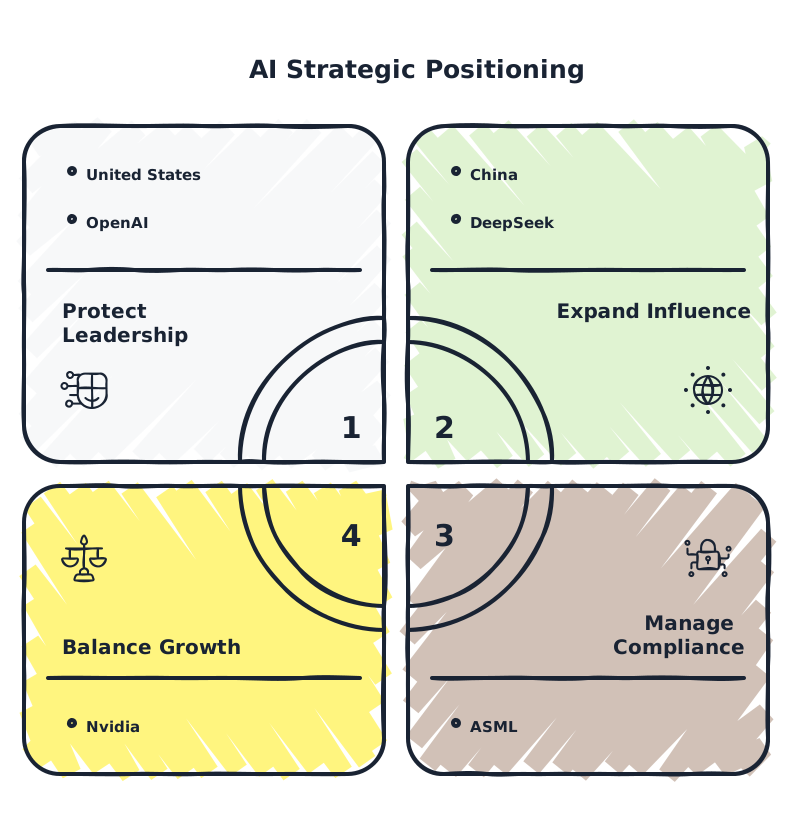
Zhu Min, former deputy governor of the People’s Bank of China, argued at a June World Economic Forum panel that China’s advantage is not model architecture but industrial deployment. He predicted that integration and deployment vendors will capture more value than model developers, pointing to manufacturing yield gains as a direct path to profit. The thesis shifts the contest from who builds the best model to who embeds AI into the most factory floors.
The controls that shaped the race
Since October 2022, US export controls have barred Nvidia’s high-end GPUs from reaching China. Since 2019, US export controls have barred ASML from selling extreme ultraviolet lithography equipment to China, with restrictions extended to deep ultraviolet equipment in October 2023. The constraints were designed to slow Chinese AI progress. Instead, they redirected it.
In response to these controls, Chinese chipmakers are believed to have acquired second-hand mid-range DUV equipment, sourced Nvidia chips through smuggling networks and shell entities, and established AI training operations in Southeast Asian jurisdictions where oversight is lighter. The result is a parallel supply chain that is less efficient but harder to interdict—and the models emerging from it are competitive enough to force Washington into a dialogue it frames as risk management but cannot fully control.
The next four weeks will reveal whether the September meeting is a real channel or a pre-election placeholder. If the guest list and agenda are confirmed by late August, both sides still want a controlled forum. If they are not, expect the summit to shrink into lower-level technical contacts and more public escalation on export controls. The political clock is running: the US midterm campaign hardens soon after, and restraint becomes more expensive for both capitals.
Beyond the headline
The Money Trail
The incentive structure is bigger than a single summit. According to US officials, Washington is seeking to protect the value of US AI intellectual property while preserving leverage over the chips and cloud stack that turn models into revenue. Beijing benefits when cheaper models and overseas partnerships make Chinese systems harder to isolate commercially.
The Power Behind It
The real control point sits with the institutions that can permit or deny access to advanced compute, semiconductor tools, and cross-border deployment. Treasury, Commerce, and allied export-control partners matter more than the public choreography of a leaders’ meeting.
The Timing
The political clock matters because this is landing before the US midterm campaign fully hardens. That creates an incentive for both sides to keep the channel open long enough to claim restraint, while leaving room for a tougher line once domestic politics becomes more expensive.
Three decisions before the summit lands
With the September 24 dialogue approaching and both sides signalling incompatible goals, Western businesses and policymakers face choices that will outlast whatever communiqué emerges.
- Western Semiconductor Procurement Manager
Monitor the US Commerce Department Bureau of Industry and Security export-controls page over the next 30 days for any China-related AI or chip rule updates. New licensing requirements or entity-list additions could disrupt supply chains or sales to Chinese clients with little warning. The pattern since 2022 has been escalation, not relaxation.
- US-based Investor with APAC Tech Exposure
Assess how potential new restrictions or collaborations could affect portfolio companies’ market access, R&D costs, and competitive positioning. Chinese AI firms gaining Global South distribution channels may erode the addressable market for US model providers faster than current valuations reflect.
- Western Cloud Services Provider Executive
Evaluate current service offerings and data handling practices for Chinese clients. The IP and data governance disputes at the center of the talks could produce new rules on cross-border data flows, model training, and service provision. Separate sensitive workloads and review vendor data-retention terms now, before compliance becomes mandatory.
- European AI Policy Advisor
Analyze the implications of any agreements or escalations for European AI policy, particularly regarding technology access, data privacy, and international standards. The EU’s AI Act implementation updates from the European Commission will intersect with whatever framework—or confrontation—emerges from Washington.
FAQ
Will the summit change export controls?
The practical question is whether the dialogue produces any change to US licensing or enforcement. If no new Commerce Department action follows, the meeting is likely only a political signal. If Washington pairs it with a sanctions or controls announcement, the policy effect is immediate and measurable for chip, cloud, and model vendors.
What can Western businesses do now?
Companies handling proprietary code, customer records, or R&D prompts should review AI vendor terms for retention, training reuse, and cross-border processing. Where possible, route sensitive workloads through enterprise environments with opt-out or no-training terms, and keep a separate policy for China-facing operations and confidential data.
What should analysts watch after the meeting?
The most useful indicators are whether Treasury or Commerce issues follow-on guidance, whether China responds with new model-access rules, and whether allied controls tighten. Those decisions will show whether the dialogue is a real negotiating channel or just a pause before broader tech confrontation resumes.
Explainer
- Knowledge distillation
- A technique where a smaller “student” model is trained to replicate the outputs of a larger “teacher” model, often reducing computational cost. It is widely used in AI research but becomes contested when the teacher model’s outputs are accessed without authorization. The US alleges Chinese firms used it to derive competitive models from Western systems.
- Mixture of experts
- An AI architecture that activates only a subset of a model’s parameters for each input, rather than the entire network. This reduces the compute needed for training and inference. Chinese labs have used it to build capable models despite restricted access to high-end chips.
- Export controls
- US regulations administered by the Commerce Department’s Bureau of Industry and Security that restrict the sale of certain technologies to specific countries. Since October 2022, they have barred Nvidia’s advanced GPUs from export to China, and since October 2023, they have covered ASML’s deep ultraviolet lithography equipment.
- Global South
- A term referring broadly to developing countries in Africa, Latin America, Asia, and Oceania. In the context of AI competition, China’s 28 partnership agreements announced in July 2026 aim to establish these nations as early adopters of Chinese AI standards and infrastructure, creating an alternative to Western-dominated distribution channels.
RELATED STORIES


