A multi-nation investigation led by the Asia Pacific Group on Money Laundering and the UN Office on Drugs and Crime has detailed how Indian job seekers are trafficked into Southeast Asian cybercrime compounds, where they face systematic torture and forced fraud. The study, which debriefed 15 repatriated Indian nationals, found that victims were controlled through electric shocks, beatings, and confinement while running investment and romance scams.
The report identifies a critical domestic infrastructure: Indian mule accounts and SIM cards, sourced from unemployed youth and drug users, form the operational backbone of a criminal economy generating up to USD 114.1 billion in annual losses. The findings shift the focus from foreign compounds to the recruitment and financial networks operating inside India itself.
According to the Asia Pacific Group on Money Laundering and the UN Office on Drugs and Crime investigation, the scams that drain billions from Western bank accounts each year do not begin in the guarded compounds of Myanmar or Cambodia. They begin in Indian towns, with a young man who cannot find work and a recruiter who offers him a way out. The job is fake. The passport will be taken. But the bank account he leaves behind — opened in his name, handed over for a few thousand rupees — will become the quiet engine of a transnational fraud machine.
A new investigation by the Asia Pacific Group on Money Laundering (APG) and the UN Office on Drugs and Crime (UNODC), released on August 3, maps this pipeline in unprecedented detail. It traces the route from nine Indian states through Thai transit hubs to guarded compounds where electric shocks and dark-room confinement enforce 14-hour workdays. But its most consequential finding is not about the brutality inside the compounds. It is about the infrastructure that makes the brutality profitable: a network of mule accounts and SIM cards sourced from India’s own unemployed and addicted, without which the entire operation would stall.
The domestic backbone of a transnational crime
The APG-led team, which included 24 officials from 11 countries, debriefed 15 Indian nationals repatriated from Myanmar, Lao PDR, and Cambodia during 2023 and 2024. According to the study, young men aged 20 to 35, drawn largely from Punjab, Haryana, and six other states, paid recruiters Rs 50,000 to Rs 70,000 upfront for promised customer-service or IT jobs abroad. Once delivered to compounds run by Chinese-speaking syndicates, they were stripped of passports and told they owed a debt for travel costs.
According to the APG and UNODC reports, control was maintained through fines, isolation, and beatings, with electric shocks documented as a routine enforcement tool. The study found that workers were transferred between compounds like inventory. The debt was never cleared. Instead, it was used to justify captivity.
The pipeline that feeds these compounds is easier seen than read.
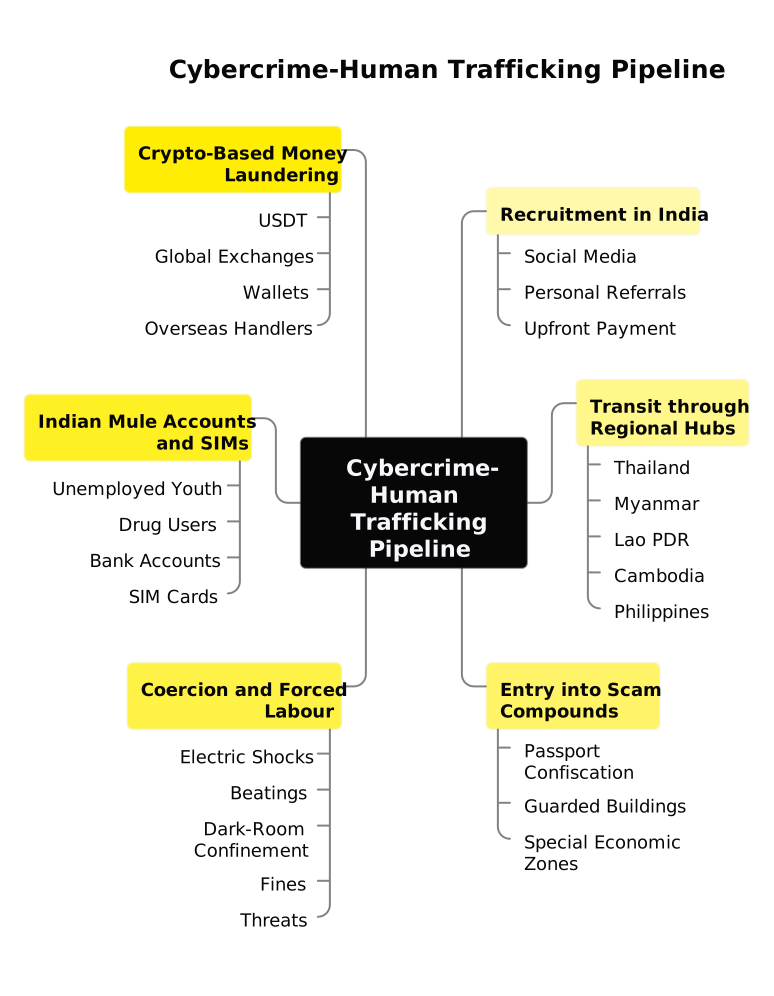
But the workers themselves were only one part of the machine. The other part never left India. Unemployed youth and drug users were recruited to open bank accounts and register SIM cards, which were then routed to scam operators in the Philippines and elsewhere. One documented case traced Punjab-based accounts and cards to Philippine scammers, generating over Rs 40 crore in fraud proceeds. These domestic networks are the circulatory system of the scam economy — moving victim funds from rupee deposits into cryptocurrency, often USDT, and then through global exchanges.
“Their operating model looks like corporate franchising,” said Delphine Schantz, UNODC Regional Representative for South-East Asia and the Pacific. The comparison is precise. The compounds provide the infrastructure and enforcement. The Indian recruiters and account providers function as local franchisees, earning reliable commissions without ever crossing a border.
A crisis of governance, not just crime
The numbers are staggering. UNODC’s 2026 regional report estimates combined annual losses from scam offences across East Asia, South-East Asia, Australia, and New Zealand at between USD 88.3 billion and USD 114.1 billion for 2025 alone. U.S. authorities estimate Americans lost at least USD 10 billion to these operations in 2024, a 66 percent increase from the previous year. The International Organization for Migration assisted more than 3,500 trafficked victims from 39 nations between 2022 and 2025.
Yet the official response remains fragmented. Most narratives stress foreign traffickers and heroic rescues, but underplay the complicity and capacity gaps within origin and host states. According to the APG findings, local brokers, weak labour-migration oversight, and unregulated special economic zones have turned recruitment fees and tourist visas into routine gateways into captivity. “Interception operations and large-scale rescues have revealed victims from a variety of nationalities and regions,” the APG report notes, “suggesting that recruitment practices have expanded beyond solely regional contexts.”
Amy Pope, Director General of the IOM, argues that people trapped in these compounds are trafficking victims forced to commit crimes under coercion. “They deserve protection, not punishment,” she said. But the legal frameworks in both source and destination countries rarely reflect that distinction. Victims often return home with criminal records that bar them from formal employment, locking families into long-term insecurity.
The honest caveat here is one of scale. Rajasthan Police data suggests more than 500 people from that state alone have travelled to scam compounds in Cambodia, Laos, Myanmar, and Vietnam — many not yet returned. But no centralised Indian government tally exists. The true number of Indian nationals still in captivity is unknown, and the rehabilitation programmes available to those who escape are thin. The evidence points to a pipeline that is accelerating faster than the policy response can follow.
Beyond the headline
The human cost
Behind the financial figures is a pipeline that converts economic desperation in Indian towns into prolonged captivity in foreign compounds. Young men who thought they were securing modest middle-class jobs instead spend months or years working 14-hour days under threat of electric shocks and beatings, then return home with trauma, debts and criminal records that can bar them from formal employment, locking entire families into long-term insecurity.
The money trail
The scams’ profitability hinges less on individual frauds than on the infrastructure of mule accounts, SIM farms and crypto channels rooted inside India. Recruiters and local intermediaries who never set foot in Southeast Asia earn reliable commissions by supplying accounts and trainees, while overseas handlers convert rupee deposits into stablecoins and feed them into sprawling laundering networks. Understanding these domestic financial incentives is crucial to disrupting the transnational flows that keep the compounds running.
What isn’t being said
Official statements tend to emphasise foreign traffickers and dramatic rescues while downplaying failures within both origin and host states. Local brokers, corrupt officials, and inadequate labour-migration rules allow recruitment fees, tourist visas, and lightly regulated special economic zones to become standard entry points into captivity. Acknowledging that reality reframes the problem as systemic governance failure, implying that lasting solutions demand uncomfortable reforms at home as much as pressure abroad.
The decisions that follow the report
With the APG and UNODC findings now public, and an Indian Home Ministry briefing expected within weeks, four groups face specific choices.
- Western investor targeted by Southeast Asia-based scams
Review your online investment practices immediately. Verify the legitimacy of any platform or opportunity before transferring funds, especially those promising unusually high returns or requiring cryptocurrency transfers to unknown entities. Preserve all messages and transaction records if you suspect you have been targeted — these are essential for cross-border investigations coordinated through portals like the FBI’s Internet Crime Complaint Center.
- Western financial institution or crypto exchange compliance officer
Enhance due diligence and transaction monitoring protocols to identify funds originating from or linked to these cybercrime operations. Strengthen KYC and AML frameworks specifically around mule-account patterns and rapid conversions from fiat to privacy coins or stablecoins. Collaborate proactively with law enforcement on tracing illicit crypto flows, as the laundering chains increasingly intersect with Western financial systems.
- Western government policy advisor on human trafficking or cybercrime
Assess current policies on combating human trafficking and cybercrime in light of the report’s findings. Consider diplomatic pressure or targeted sanctions against entities facilitating these compounds, particularly where state-linked special economic zones are involved. Explore international cooperation mechanisms — including UNODC technical assistance missions — to dismantle recruitment networks and strengthen victim protection frameworks.
- Indian national considering overseas employment in Southeast Asia
Exercise extreme caution with overseas job offers, especially those demanding upfront fees or providing vague job descriptions. Thoroughly verify recruiters and employers through official channels before travel. Be alert to trafficking indicators: demands for passport surrender, promises that seem too good, or pressure to depart quickly on tourist visas. Consult the Ministry of External Affairs’ advisories before accepting any position abroad.
Explainer
- Asia Pacific Group on Money Laundering
- The APG is a Sydney-based intergovernmental body modelled on the Financial Action Task Force, coordinating anti-money laundering and counter-terrorism financing efforts across more than 40 Asia-Pacific jurisdictions. It conducts mutual evaluations of member countries’ financial systems and publishes typology reports on emerging money-laundering methods. Its August 2026 study on Indian trafficking victims represents one of the first systematic examinations of how human trafficking, forced labour, and cryptocurrency-enabled money laundering intersect within Southeast Asian scam compounds.
- Golden Triangle
- The Golden Triangle refers to the border region where Thailand, Myanmar, and Laos meet, historically known as a major hub for opium and heroin production. In recent years, the area has transformed into a digital crime epicentre, with guarded compounds operating inside special economic zones that provide regulatory gaps. These compounds now house tens of thousands of trafficked workers forced to run online scams targeting victims globally.
- Mule accounts
- Mule accounts are bank accounts opened by individuals — often recruited from vulnerable populations — and then handed over to criminal networks to receive and move illicit funds. In the context of Southeast Asian scam compounds, Indian mule accounts serve as the first layer of the money-laundering chain, receiving rupee deposits from fraud victims before the proceeds are converted into cryptocurrency. The account holders typically receive small payments while bearing the legal risk.
- USDT
- USDT, or Tether, is a stablecoin — a type of cryptocurrency designed to maintain a value pegged to the US dollar. It has become the preferred instrument for laundering proceeds from Southeast Asian scam compounds because it offers the speed and pseudonymity of crypto without the price volatility of assets like Bitcoin. Proceeds are typically moved from Indian mule accounts into USDT, then layered through multiple wallets and exchanges to obscure their origin before reaching overseas handlers.
RELATED STORIES