AI-generated child sexual abuse material has surged across Southeast Asia, transmitted through encrypted channels that make detection nearly impossible. Inshik Sim, researcher and coordinator at the United Nations Office on Drugs and Crime, confirmed the finding in a report released July 21, 2026.
The same networks orchestrated between $88.3 billion and $114.1 billion in global scam losses in 2025. The UNODC warns that criminal groups are preparing to deploy agentic AI systems capable of autonomous victim targeting and money laundering.
The migration from fraud to synthetic abuse imagery took less than eighteen months. Criminal networks in Southeast Asia, already running industrial-scale scam compounds from Cambodia to Myanmar, have added generative AI models to a technology stack that now produces child sexual abuse material on demand. The images circulate through the same encrypted messaging platforms used to coordinate phishing campaigns. Law enforcement agencies across the region, the UNODC report makes clear, have not built the capability to intercept either one.
The financial toll alone—$114.1 billion in scam losses during 2025, compared to $18–38 billion in 2023—would mark a crisis. The UNODC’s finding that AI-generated abuse imagery has become a primary vector for child exploitation adds a dimension that Western parents and platforms have not yet priced in. The networks building these systems operate like franchises, with specialised departments for laundering, trafficking, and data harvesting.
The supply chain behind a $114 billion machine
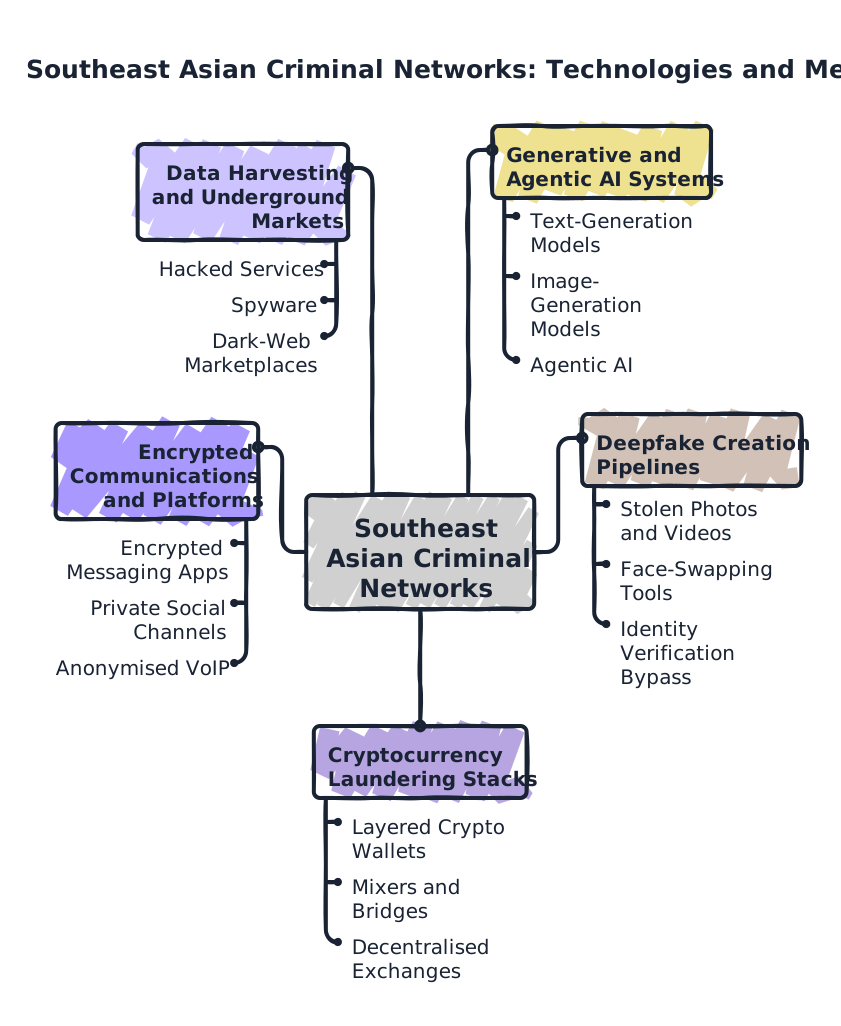
Delphine Schantz, UNODC’s regional representative, offered the comparison that most clearly captures the operational model. “Their operating model looks like corporate franchising: imagine specialised departments for laundering money, trafficking people, smuggling migrants and harvesting data, all plugged into the same service-based, interconnected network,” she said. The structure is modular. One unit harvests personal data from breached platforms and dark-web broker markets—identity documents, voice notes, crypto wallet credentials. Another runs the deepfake pipeline. A third manages the cryptocurrency layering that moves proceeds through mixers, cross-chain bridges, and underground banking networks.
The software stack itself is not particularly exotic. Off-the-shelf face-swapping tools, real-time translation models, and generative text systems—much of it commercially available—provide the technical base. What distinguishes the Southeast Asian syndicates is integration. They have built end-to-end pipelines that connect data harvesting to scam execution to money laundering without friction points that law enforcement can exploit. The breakdown below maps each layer.
The Sulu-Celebes maritime triangle—bounded by Indonesia, Malaysia, and the Philippines—has emerged as a transit corridor that moves more than narcotics. Latin American cocaine, wildlife products, and small arms traverse the same waters, sometimes concealed within legitimate tea shipments. In a single record operation, Sabah authorities confiscated over 3 metric tons of methamphetamine, ketamine, and ecstasy. The logistics networks overlap with the digital ones, sharing infrastructure and, the UNODC notes, corrupt enablers in border and regulatory agencies across several jurisdictions.
The honest caveat belongs to Seong Jae Shin, the UNODC analyst who examined post-crackdown relocation patterns. “They were destroyed, but none of the operations stopped,” Shin said. Syndicates dispersed into villas and private residences—smaller, harder to map, and in jurisdictions with weaker oversight. The enforcement win is real. The strategic effect is displacement, not disruption.
Corruption writes the rules the criminals ignore
The UNODC report identifies corruption as the primary enabler—not a contributing factor, but the mechanism that lets AI-enhanced scam centers, underground banking, and crypto laundering flourish despite nominal legal prohibitions. When a syndicate relocates from a Myanmar crackdown zone to a Cambodian villa or a Pacific Island jurisdiction with no digital-crime statutes, it is not hiding. It is shopping. The term UNODC uses is “jurisdiction shopping,” and it depends on officials who will accept payment to look away.
The regulatory asymmetry is stark. Thailand and Vietnam have licensing rules and AML duties for digital-asset businesses, but limited AI-specific law. Cambodia and Myanmar have substantially weaker oversight. The gap is not just legal. It is operational—a structural feature that syndicates have learned to exploit with the same precision they apply to victim targeting.
The forward signal to watch is whether the US, EU, UK, and Australia impose coordinated sanctions or asset freezes on named scam bosses and associated crypto wallets before the end of 2026. If they do, it indicates the political will to disrupt money flows exists. If they do not, the syndicates will deepen their presence in permissive states, and the agentic AI systems the UNODC warns are coming will find an operating environment already prepared for them.
Beyond the headline
The Bigger Picture
The UNODC findings reveal a shift from isolated cyberfraud rings to an integrated criminal services industry built on shared infrastructure for data, money, and logistics. This mirrors the broader digital-platform economy: once groups automate recruitment, targeting, and laundering, they can plug new illicit products—from drugs to synthetic child abuse content—into the same pipelines, making crime scalable in the way software already is.
The Human Cost
Behind the headline figures are trafficked workers and exploited children in and beyond Southeast Asia. Recruits from dozens of countries may be coerced into running multilingual scams under threat of violence, while AI tools turn children’s everyday online presence on gaming and social platforms into raw material for sexual blackmail or synthetic abuse images, leaving lasting psychological scars even where no physical contact occurs.
The Reach
One non-obvious reach is into Western institutions’ risk models. As agentic AI and crypto-based laundering reshape how fraud is executed, banks, platforms, and regulators in Europe, North America, and Australia must rethink assumptions about how quickly criminal tactics evolve. If they fail, the illicit networks described by UNODC will not just steal from individuals; they will quietly erode trust in digital payments, online identity verification, and cross-border commerce that underpin Western economies.
The decisions Western institutions now face
With the UNODC report now public and the scale of the AI-enabled threat documented, four groups must act on timelines measured in months, not years.
- Western investor with APAC emerging market exposure
Reassess portfolio exposure to companies and financial institutions operating in Southeast Asia for potential links to illicit finance. The governance and reputational risks posed by the $114.1 billion scam economy extend beyond direct holdings—supply-chain financing, correspondent banking relationships, and infrastructure projects in jurisdictions with weak AML enforcement may carry contingent liabilities that quarterly filings have not yet priced in.
- Cybersecurity or fraud prevention manager at a Western financial institution
Update fraud detection models, AML/KYC protocols, and deepfake detection capabilities to account for the specific tactics documented in the UNODC report. Agentic AI systems capable of autonomous victim profiling and social-engineering campaigns are not hypothetical—the report warns they are the next vector, and model assumptions calibrated to 2024 fraud patterns will fail against them.
- Western parent of a child with online gaming or social media presence
Review privacy settings on gaming and social platforms and limit the sharing of children’s identifiable images. Educate children about grooming and extortion tactics involving doctored or synthetic images. If a child is threatened with AI-generated sexual imagery, preserve evidence and contact specialised child-protection units immediately—private negotiation with perpetrators only extends the extortion cycle.
- Western supply chain manager with Southeast Asia operations
Conduct enhanced due diligence on logistics partners and shipping routes, particularly those transiting the Sulu-Celebes triangle. The same container shipments that move legitimate goods have been used to conceal methamphetamine, cocaine, and small arms. Cargo screening protocols and contractual audit rights with intermediaries are the first line of defense against reputational and regulatory exposure.
FAQ
How can I recognise an AI-enhanced scam originating from Southeast Asia?
AI-driven scams often feature fluent, context-aware language, rapid response times, and convincing visual assets such as deepfake video calls or perfectly composed profile pictures. Verify any investment or romance contact through independent channels. Treat unsolicited messages linking to crypto platforms with extreme caution, and use official reporting portals to flag suspected scam domains or social-media accounts.
What can I do to protect my child from AI-generated abuse material?
Limit the sharing of children’s identifiable images, ensure privacy settings are strict on gaming and social platforms, and educate children about grooming and extortion tactics involving doctored or synthetic images. If a child is threatened with AI-generated sexual imagery, preserve evidence and contact specialised child-protection units or hotlines immediately—do not attempt private negotiation with perpetrators.
What financial recourse exists if I lose money to a cross-border scam?
Victims of scams linked to Southeast Asian syndicates may have limited direct recovery options. Immediately notify banks or card issuers, file reports with national fraud centers, and document all communications with perpetrators. Some jurisdictions provide dedicated portals or ombudsman schemes for crypto-related fraud complaints. Timely reporting increases the chance of transaction reversal or account freezing and helps authorities map and disrupt scam networks.
Explainer
- UNODC
- The United Nations Office on Drugs and Crime is the UN agency mandated to address illicit drugs, transnational organised crime, corruption, and terrorism. Its Southeast Asia and Pacific regional office, based in Bangkok, monitors drug trafficking routes, human trafficking networks, and increasingly the intersection of technology and organised crime. The July 2026 report on tech-enabled crime represents its most comprehensive assessment yet of how AI and cryptocurrency are reshaping criminal economies in the region.
- Agentic AI
- Agentic AI refers to artificial intelligence systems that can autonomously pursue goals—identifying targets, executing multi-step plans, and adapting tactics without human intervention at each stage. Unlike generative models that produce text or images on command, agentic systems can chain together research, communication, and transaction steps. The UNODC warns that criminal networks are expected to adopt these systems for victim profiling and crypto theft.
- Deepfakes
- Synthetic media created using machine learning techniques that can superimpose one person’s face onto another’s body or clone a voice from a short audio sample. Southeast Asian scam networks use off-the-shelf deepfake software and face-swapping tools to fabricate realistic video calls, impersonate executives or romantic partners, and bypass identity verification checks on financial and crypto platforms. The technology itself is not illegal; its weaponization for fraud and abuse imagery is the UNODC’s concern.
- AML/KYC
- Anti-Money Laundering and Know Your Customer protocols are the regulatory frameworks financial institutions use to verify customer identities and monitor transactions for illicit activity. The UNODC report highlights that weak AML/KYC enforcement in several Southeast Asian jurisdictions allows scam networks to layer proceeds through crypto wallets and underground banking systems with minimal detection risk, creating gaps that Western institutions must account for in their own compliance models.
- Jurisdiction shopping
- The practice of relocating criminal operations to countries or territories with weaker laws, limited enforcement capacity, or corruptible officials. The UNODC documented syndicates moving scam hubs from crackdown zones in Myanmar and Laos to Timor-Leste, Pacific Island states, and parts of Africa. Each relocation exploits a different gap in digital-crime regulation or cross-border cooperation, making sustained disruption difficult.
RELATED STORIES