Iran’s demand for sole authority over the Strait of Hormuz, and its rejection of an Oman-coordinated southern corridor, is hardening into a new maritime status quo. Shipping insurers, energy traders, and navies are now treating the strait as a permit-controlled chokepoint, a shift that strikes at the post-World War II rule that straits are shared transit routes, not national revenue instruments.
The International Maritime Organization evacuated more than 11,000 seafarers in late June, according to reporting. But vessels still face Iranian clearance requirements, and analysts warn the episode is providing a live model for future claims across the Malacca, Gibraltar, and Arctic straits.
The post-war maritime order was built on a single, unglamorous principle: that the sea lanes connecting continents are shared spaces, not sovereign assets. That principle has been under strain for years. Now it is breaking. The Strait of Hormuz — a 21-mile-wide chokepoint that once carried roughly one-fifth of the world’s oil and gas — has become the fracture line, and what happens there will determine whether passage rights elsewhere become monetizable.
After U.S. and Israeli strikes in February, Iran closed the strait. A ceasefire in June allowed the IMO to coordinate an evacuation in late June, but the arrangement encountered resistance when the Islamic Revolutionary Guard Corps declared on June 25 that any vessel using an Omani-coordinated southern corridor was operating illegally. A Singapore-flagged cargo ship, the Ever Lovely, was attacked after using that route, and Tehran’s state media said the operation was impermissible without Iranian consent. The message was blunt: the strait would open only on Tehran’s terms. The precedent was set.
The fracture opens a new playbook
The IMO’s International Maritime Organization effort, which reporting indicates freed over 11,000 seafarers and more than 100 of some 600‑plus trapped vessels, relied on a route that hugged Oman’s coast and avoided Iranian waters. Yet on June 25, the IRGC warned that the corridor was “unacceptable and completely dangerous” and insisted that only routes designated by Tehran were lawful. The Ever Lovely attack followed, and the evacuation stalled.
Arsenio Dominguez, the IMO’s Secretary-General, has stressed that international law does not allow any country to block free transit on straits used for international navigation. He rejected any notion of mandatory service charges. That position is shared by trading nations, but it collides with a hard reality: Iran is enforcing its own corridor, and the IMO has no mechanism to compel compliance.
The dispute turns on whether UNCLOS‘s transit-passage rules bind a non‑party like Iran. In practice, the answer is decided not in legal chambers but by navies, insurers, and those who set freight rates. Todd Huntley, director of Georgetown’s National Security Law Program, warned that accepting Iran’s control would undercut the foundational freedom‑of‑navigation principle. “There is the risk that other countries are going to claim control and then either surcharging or imposing restrictions on how ships can transit,” he said.
Gregory Brew, a senior analyst at Eurasia Group, described the Iranian posture as a drive to establish a new norm: “Tehran is trying to impose a system where all vessels must seek its clearance, and it is resisting U.S. efforts to undermine that control.”
Ami Daniel, the CEO of Windward, pointed to the downstream logic: Russia could cite the Hormuz template to bar U.S. vessels from Arctic passages, and China could restrict American commercial shipping through the Taiwan Strait. Reporting indicates that lower perceived transit risk is already pulling opportunistic operators back toward the backlog of stranded cargoes — a sign that the commercial calculation is decoupling from the legal one.
The web of actors and their conflicting priorities is easier seen than read.
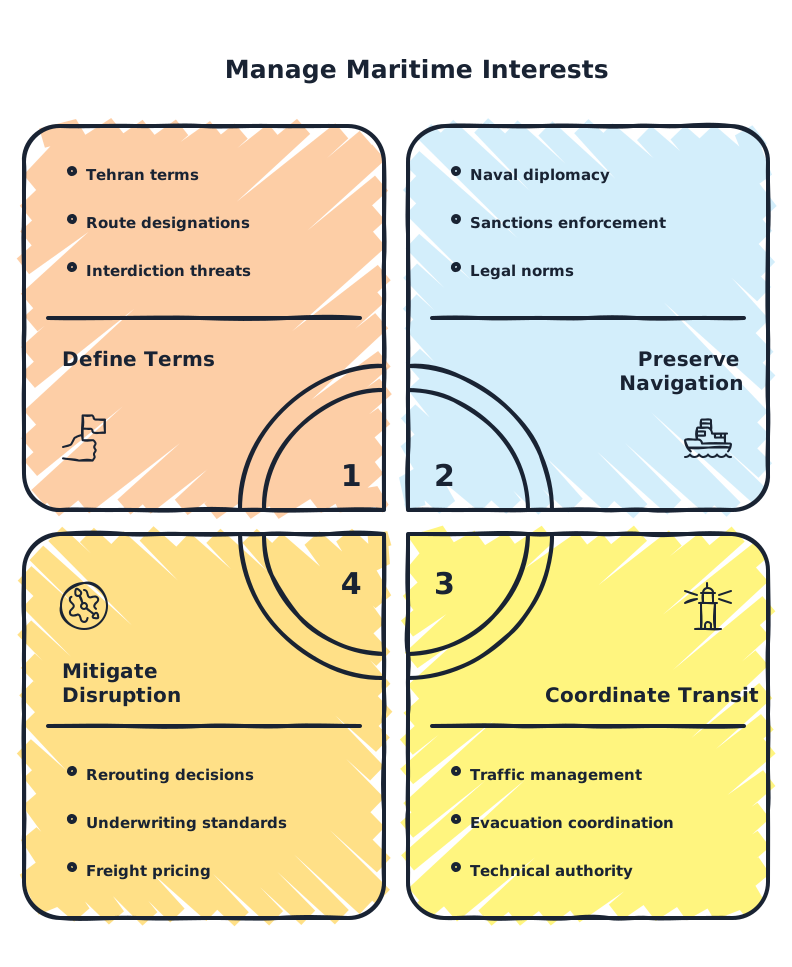
The missing treaty no one wants to write
The core instability is institutional. Unlike the Montreux Convention, which has governed the Bosphorus since 1936 with defined rules and mutual consent, the Strait of Hormuz has no conflict‑avoidance mechanism. The IMO can coordinate traffic schemes and evacuations, but it cannot confer sovereignty. That leaves real power with the states and navies that can enforce one corridor or another.
Nitya Labh, a fellow at Chatham House, noted that existing maritime law and treaties have not provided the security they were supposed to deliver. The gap has been exploited. After U.S.‑led strikes and the collapse of the short‑lived Muscat talks, Iran maintained its closure of the strait, signaling that the waterway would reopen under Iranian oversight or not at all.
Washington has publicly rejected any claim that one country can own or tariff the strait. Secretary of State Marco Rubio told a June 25 GCC meeting that the U.S. would not accept fees “under any description.” Oman’s foreign minister said any future arrangement would not involve transit fees. But those statements fall into a vacuum where no one can force compliance, and where a memorandum of understanding signed in mid‑June already collapsed.
The next IMO traffic update will be telling. If sustained normalisation appears, the evacuation corridor is working. If volumes stall again, insurers and shipowners will price in a drawn‑out standoff — and the template Iran has set for other straits will already be in circulation.
Beyond the headline
The Bigger Picture
The deeper issue is not one strait but the erosion of a shared rule that waterways are common transit spaces rather than assets to be monetized. Once a major power treats passage as something it can condition, every other chokepoint becomes easier to renegotiate as a revenue stream or coercive tool.
The Precedent
What matters is not whether this crisis ends, but whether any settlement leaves behind a usable model for permit‑based passage. If that model survives, future disputes in other straits will not start from a blank slate; they will start from a live example that governments can cite.
The Reach
The actor is the shipping‑insurance market, the mechanism is repricing risk around a precedent for controlled passage, and the implication is higher baseline costs for Western import chains that depend on Gulf energy and container traffic.
Where the financial and strategic lines intersect
With the strait’s status unsettled and a permit‑based model gaining practical force, four groups face immediate decisions.
- Western maritime shipping insurer
You need to re‑evaluate risk models for Hormuz transits and begin stress‑testing scenarios for other chokepoints. The UK government’s maritime security guidance for Gulf routes should be reviewed before fixing any cargo schedules, and premium adjustments may be necessary within weeks if the precedent holds.
- Global energy trader with Gulf exposure
Monitor IMO traffic updates and any formal statements on permits or fees through its official communications channel within the next two days. A stall in evacuation volumes or a new Iranian condition on clearance will signal a shift from crisis management to long‑term governance, forcing rapid strategy adjustments and a search for alternative supply routes.
- Western supply chain manager for goods from Asia
Assess the vulnerability of your supply chains to disruption in critical chokepoints, and explore alternative routing or modal shifts. Include a margin for higher freight costs and extended lead times in your planning, because even the perception of permit‑based passage elsewhere will raise baseline rates.
- US Navy strategic planner
The foundational mission — ensuring free transit for American vessels — now requires contingency plans that combine diplomatic pressure, sustained naval presence, and legal positioning. The Hormuz episode is a test case; failure to restore open passage would embolden rivals to institutionalise what Tehran is attempting.
FAQ
Who controls passage right now?
Reporting indicates Iran is asserting route approval and permit control, while Oman is backing a southern corridor through its own waters. The practical question for businesses is not abstract sovereignty but whether their voyage is cleared by Iranian authorities, whether insurers will accept the routing, and whether the transit remains open day to day. Those details are not yet settled.
Can Iran legally charge fees?
Under the UNCLOS transit-passage regime, states cannot simply tax passage through an international strait, but Iran is not a party to UNCLOS and instead relies on a claimed security or service framework. That leaves the issue dependent on enforcement, state practice, and whether other governments treat the arrangement as lawful.
What would make this route stable again?
The practical indicators are a sustained rise in vessel transits, a formalised traffic scheme accepted by Oman and Iran, and any written agreement on permits, insurance, or corridor rules. If those do not materialise, shipowners are likely to keep pricing in rerouting, delay, and higher war-risk premiums.
Explainer
- International Maritime Organization
- The UN agency that sets global shipping safety, security, and environmental standards. It does not have a navy and cannot enforce its rules, relying instead on member-state cooperation and technical diplomacy. In Hormuz, its traffic-separation scheme has existed since 1968, but the agency has struggled to impose order during the current standoff.
- Islamic Revolutionary Guard Corps
- An elite Iranian military force separate from the regular armed forces, reporting directly to the supreme leader. The IRGC Navy controls the country’s presence in the Persian Gulf and the Strait of Hormuz, and it has been the primary enforcer of Iran’s unilateral corridor claims. Its direct rejection of the Omani route on June 25 2026 cements its role as the gatekeeper.
- UNCLOS
- The United Nations Convention on the Law of the Sea, adopted in 1982, is the primary treaty governing maritime rights and responsibilities. Its Part III establishes the transit-passage regime for international straits, guaranteeing ships the right of unimpeded transit. Iran has signed but never ratified the convention, leaving it outside the treaty’s direct enforcement mechanisms.
- Montreux Convention
- A 1936 treaty that gives Turkey control over the Bosphorus and Dardanelles straits while preserving free passage for merchant vessels in peacetime. It limits naval presence and establishes clear rules accepted by all parties. The Strait of Hormuz has no equivalent agreement, which is why analysts cite Montreux as the kind of framework the region currently lacks.
RELATED STORIES