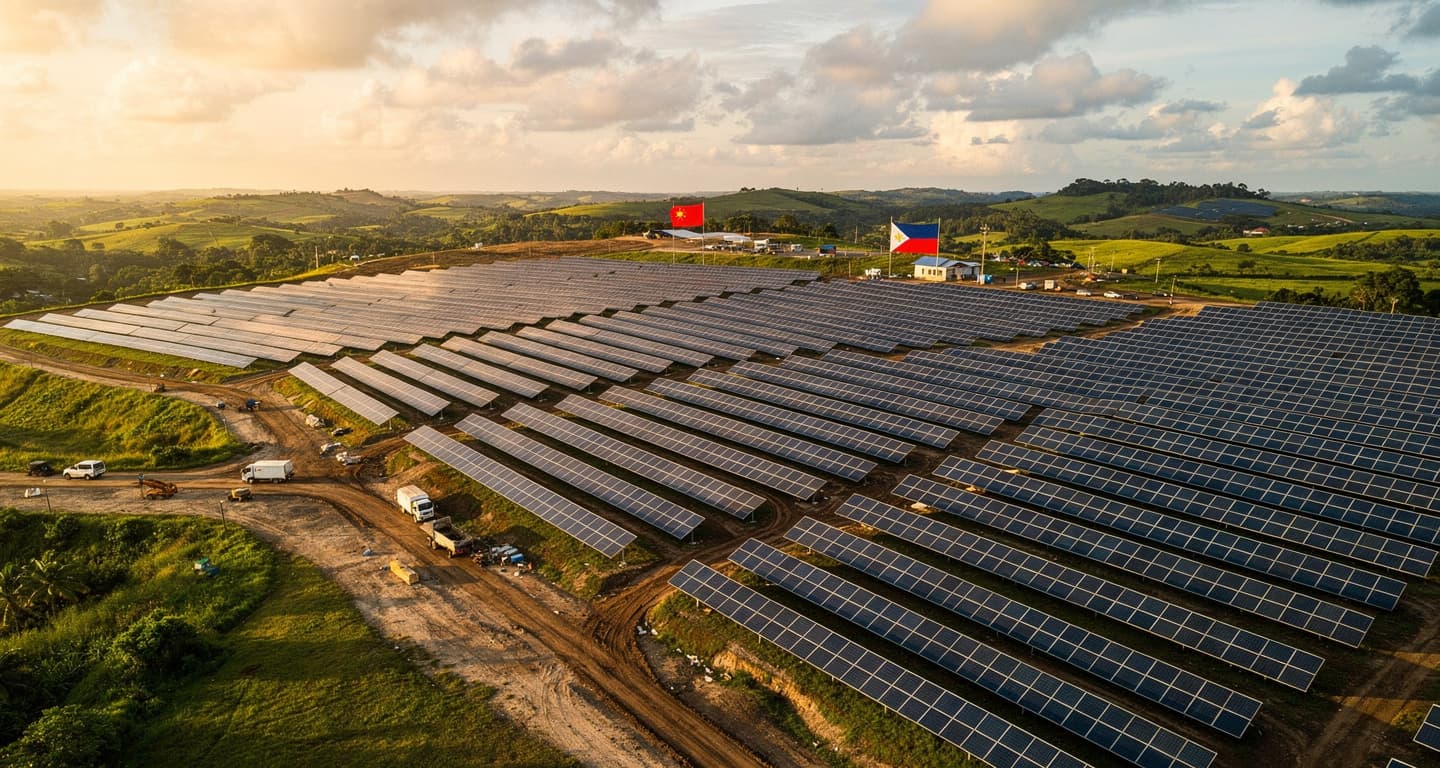
The Philippines has become the world’s largest spender on imported solar panels, buying US$407 million worth in the three months to May 2026 — a 145% jump from a year earlier. The surge is not a climate-policy success. It is a household response to the highest residential electricity prices in Southeast Asia, with no meaningful subsidy to soften them. China supplied most of the panels.
Meralco, the country’s main power distributor, raised average rates 10% since late February 2026. A median household now spends about 12% of its income keeping the lights on.
A median Philippine household now spends about 12% of its monthly income on electricity. That is the number behind the country’s sudden rise to the top of the global solar import table — and it is a number that says nothing about climate ambition.
It says the grid has become unaffordable. Across Metro Manila, residential rates sit near PHP 11 per kilowatt-hour, among the steepest in the region. Meralco, the dominant distributor, pushed average tariffs up 10% since late February 2026 as global fuel prices climbed through the Iran conflict. The country imports most of its coal and gas, so a price spike abroad lands directly on a household bill in Quezon City.
So people are buying their way off the grid. Rooftop panels, mostly Chinese, are arriving faster than anywhere else on earth. The decision is being made one roof at a time, by families doing arithmetic. What that arithmetic exposes is not progress. It is the gap between those who can afford to escape and those who cannot.
The math now favours the roof
Adrian Sabatera, a 39-year-old software engineer in Manila, spent 570,000 pesos — about US$9,300 — on a rooftop system for his home. He has said he would not be surprised if a third of the middle class eventually does the same. The figure is plausible because the calculation has shifted.
Leandro Leviste, founder of Solar Philippines, put it plainly: “The economics of rooftop solar now clearly beat grid electricity for many homes.” High retail prices and thin subsidies do the work that incentives do elsewhere.
The import data shows the response. Philippine trade statistics recorded US$1.3 billion in photovoltaic imports across 2025, now one of the fastest-growing categories in the country’s trade profile. China supplied the bulk. Its panel exports to the Philippines rose by nearly a third in May 2026, even as overall Chinese shipments fell 13% after a tax rebate was removed.
The reason the bill is so exposed sits upstream. Sara Jane Ahmed, an energy finance analyst at the Institute for Energy Economics and Financial Analysis, links the high prices to imported fossil fuels: “Rooftop solar can be a hedge against volatile imported fuel costs.” Western demand for Middle Eastern oil and gas helps set those prices. When OECD consumption and a regional conflict push global fuel up, a household in Manila pays for it — and then buys a Chinese panel to stop paying. What that mechanism does not settle is who gets to make that choice.
A subsidy gap, not a green policy win
The comparison with neighbours makes the cause clear. Singapore’s residential power prices are similar to Manila’s, but the average Singaporean’s purchasing power is nearly 13 times higher. The burden barely registers there. Indonesia and Malaysia keep consumer prices low by heavily subsidising fossil-based electricity, which slows rooftop uptake. The same panel is bought for very different reasons across the region.
The Renewable Energy Act of 2008 set up duty-free imports and tax holidays for clean equipment. But the Philippines spends little shielding households from the grid price itself. That absence is the policy.
The trade-off now runs in several directions at once. Households that install panels gain lower, steadier bills but carry the upfront cost and the performance risk. Meralco faces falling volume sales, which complicates recovery of grid investment. Jose Layug Jr., president of DREAM Philippines, warns that “our regulations and grid infrastructure are still catching up with the surge in rooftop solar.”
That last risk is the one to hold onto. The Philippines is becoming a renewable leader by accident of price, not by design. The households able to spend 570,000 pesos escape the volatility. The ones who cannot stay tied to a grid whose cost is set, in part, by fuel decisions made far from Manila. The country is decentralising its power supply — and sorting its citizens by who can afford to leave.
Beyond the headline
The human cost
Rising bills force concrete sacrifices: families trim food budgets, defer medical costs, or cut schooling expenses to keep the lights on. Those who can finance rooftop solar escape some of this pressure. Lower-income households without credit or a suitable roof stay locked into volatile grid prices, deepening an already stark energy poverty divide.
The bigger picture
The surge shows how energy transitions can be driven less by climate ambition than by exposure to global fuel markets. A system reliant on imported coal and gas leaves households at the mercy of geopolitical shocks, making distributed renewables a form of economic self-defence. It is a pattern across emerging economies where clean energy becomes a coping mechanism for structural inequities in pricing and access.
The regional split
Heavy fossil-fuel subsidies keep prices low in Indonesia and Malaysia, slowing rooftop uptake, while the Philippines’ sparse subsidies push households toward self-generation. Wealthier Singapore absorbs similar prices on much higher incomes. The same technology is adopted for very different reasons and at very different social costs.
What the solar rush asks of you
With the Department of Energy’s next Renewable Energy Roadmap update expected late 2026 and net-metering rules under review this year, three groups face decisions now.
- Philippine households weighing rooftop solar
Check current net-metering and incentive rules at the Department of Energy’s program pages on doe.gov.ph before committing capital. The economics depend on whether you can sell surplus back to the grid — rules the Energy Regulatory Commission may revise this year, changing the payback on a 570,000-peso system.
- Investors tracking Southeast Asian renewables
Watch the Roadmap update late 2026 for any rise in distributed-generation targets. Track installed-capacity and power-mix shifts through the International Energy Agency’s Philippines profile, which records how fast solar is displacing imported fuel.
- Readers following the global energy transition
The Philippines shows what household-led adoption looks like without subsidy support. The World Bank’s household energy expenditure data tracks the affordability pressure driving it — the early signal in any market where grid prices outpace incomes.
Explainer
- Meralco
- Manila Electric Company, the Philippines’ largest power distributor, serving Metro Manila and surrounding provinces. It buys electricity from generators and passes fuel costs through to consumers, which is why global price spikes appear quickly on local bills. As rooftop solar spreads, its volumetric sales fall, complicating how it recovers fixed grid investment.
- Renewable Energy Act
- Republic Act 9513 of 2008, the legal basis for solar deployment in the Philippines. It grants income tax holidays, duty-free imports of renewable equipment, and priority dispatch to clean generators. Notably, it does little to subsidise the retail electricity price itself, leaving households exposed to the tariffs that now drive self-generation.
- Solar Philippines
- A domestic solar developer founded by Leandro Leviste, active in both utility-scale and residential markets. The company has argued that high retail prices make rooftop solar competitive without further incentives. It has also pushed for large battery-paired solar plants intended to supply round-the-clock power, a model still rare in the country.
RELATED STORIES