
India’s solar generation surged 37% year-on-year to 57 billion units in the first quarter of fiscal 2026, supplying 10.9% of national electricity. In the same period, grid operators curtailed roughly 473 million units of solar output—power that could not reach consumers because transmission infrastructure lagged behind the build-out.
The arrival of a strong El Niño in the second half of 2026 threatens to widen that gap between generation and delivery. For developers already navigating narrowing margins and fading subsidies, weather forecasting has become a financial survival tool, not a technical footnote.
The economics of building a solar farm have changed faster than the industry’s toolset. Five years ago, a developer could secure a guaranteed price for every unit of power, plug in a long-term average for sunlight, and move to financing. That model is now gone. In markets from Rajasthan to Queensland, projects face merchant exposure—real-time prices, grid congestion, and no assurance that a sunny afternoon translates into revenue.
Into that tighter arithmetic arrives the 2026 Godzilla El Niño, forecast to be the most intense in a decade. For solar portfolios across the Asia-Pacific, the question is no longer whether the sun will shine. It is whether the financial models can price the difference between a cloud and a clear sky with enough precision to keep a project solvent.
The gap between generation and delivery is already measured in lost revenue
India’s solar capacity has expanded faster than the grid’s ability to absorb it. In the first quarter of fiscal 2026, 473 million units of solar power were curtailed, according to data from the Centre for Research on Energy and Clean Air. Wind plants lost another 112 million. That wasted output—enough to power millions of households—reflects a structural bottleneck that an El Niño will test further.
Manoj Kumar, CREA’s India analyst, argues that transmission and storage, not generation, now define the pace of the country’s clean-energy shift. According to Kumar’s analysis, significant solar and wind output is being curtailed, and unless storage and transmission expand quickly, more capacity will sit idle at precisely the moments irradiance swings make it most valuable.
The financial consequences flow beyond India. Western institutional investors hold large stakes in Indian utility-scale portfolios and Australian renewable hubs. When grid operators cut solar output—or when a cloudy El Niño summer depresses generation below contract thresholds—the losses travel through to pension funds and insurers in Europe and North America. The connection is direct and increasingly material.
“As little as five years ago, nobody was considering any of that,” said Marcel Suri, CEO of Solargis, a Slovakia-based solar data firm. “You just build a project, you calculate the power generation modified by some incentive and that was it.” Today, he said, with grid congestion, no one can guarantee a project will sell electricity during a summer midday—and the industry is moving toward more granular data and deeper historical analysis to understand the trends.
The shift Suri describes is the real story beneath the weather headlines. The 2026 El Niño is not creating new risks—it is exposing the ones that have been accumulating since solar moved from feed-in tariffs to merchant markets. The breakdown of those risks can be seen more clearly than described.
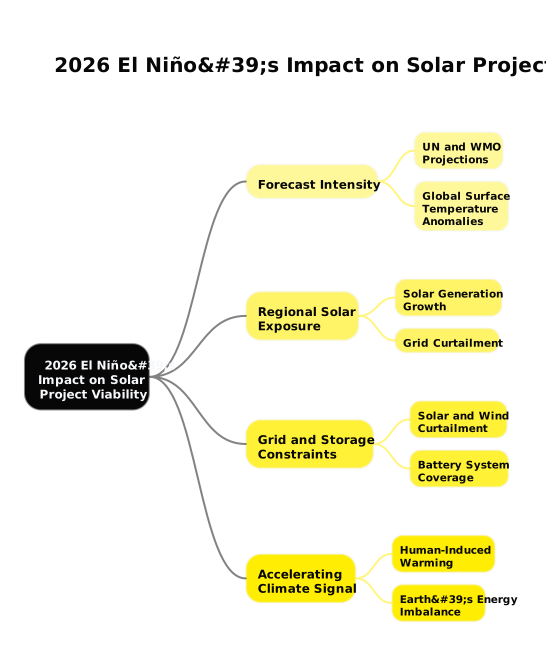
A market that grew up on guarantees now has to price uncertainty
The toolset that replaced simple averages is satellite-derived and computationally intensive. Firms like Solargis now feed meteorological inputs into radiation algorithms designed to quantify financial metrics—probability of exceedance for a given generation level, revenue-at-risk under different cloud-cover scenarios, and the value of pairing a solar plant with battery storage of a specific size and dispatch strategy.
The climate baseline is also shifting underneath every assumption. Stefan Rahmstorf, a climate scientist at the Potsdam Institute, co-authored a 2026 study that accounts for natural factors such as El Niño and volcanic eruptions, finding global warming has accelerated to roughly 0.35°C per decade. Human-induced warming already sits at about 1.37°C above pre-industrial levels. That means each successive El Niño rides on a warmer ocean, potentially amplifying the regional irradiance anomalies that project models now struggle to capture.
Imperial College’s Joeri Rogelj notes that Earth’s energy imbalance has more than doubled since the late twentieth century. According to research from the Indicators of Global Climate Change initiative, if current emissions trends continue, the world is likely to exceed 1.5°C of warming within around four years. For a solar farm financed over 25 years, the physical conditions it will operate under are not the ones used to write its original contract.
The next World Meteorological Organization outlooks for August through October 2026 are expected in the coming weeks. If they confirm a strong-to-super El Niño with Pacific sea-surface anomalies above 2.9°C, developers will need to price in multi-year weather volatility and potential contract stress. A downgrade would ease the immediate repricing pressure—but the structural weaknesses in grids and storage would remain, waiting for the next climate signal to expose them.
Beyond the headline
The Bigger Picture
The pivot toward granular irradiance modelling is less about the drama of a single El Niño than about the maturation of solar as core infrastructure. As non-fossil capacity in countries such as India crosses the 50% threshold, weather variability stops being a marginal forecasting issue and becomes a system-wide financial parameter, forcing investors and regulators to treat climate physics as seriously as balance sheets when planning capacity and contracts.
The Timing
This El Niño arrives just as multiple structural thresholds converge: human-induced warming has already reached around 1.37°C, the remaining carbon budget for 1.5°C is measured in only a few years of current emissions, and India’s solar share has crossed 10% of quarterly generation. That combination makes 2026–2027 a stress test for whether merchant-exposed renewables can weather climate volatility without triggering a political and financial backlash against further cutting emissions.
El Niño is now a credit risk—and a data opportunity
With the climate signal strengthening and solar markets exposed to real-time prices, the 2026 El Niño forces a specific set of decisions for four groups with money or policy at stake in the Asia-Pacific.
- Western investor in APAC solar projects
You need to assess your portfolio’s exposure to regions with forecast irradiance shifts and evaluate how project financing contracts and insurance products account for probabilistic weather risk. Review the latest World Meteorological Organization El Niño and seasonal climate outlooks on the WMO website to understand projected temperature and rainfall anomalies for key Asia-Pacific markets, then cross-check portfolio exposure to Indian and Australian renewable assets against those regions’ risk profiles.
- Western supply chain manager with APAC energy exposure
You should analyze the energy resilience of your Asia-Pacific supply chain, considering potential disruptions from power volatility and evaluating opportunities for localized energy solutions or diversified energy sourcing. Track India’s grid and storage policy developments by monitoring releases from the Central Electricity Authority and the Ministry of Power, particularly decisions on transmission expansion and battery storage tenders.
- European or North American solar technology provider
You should adapt your product development and sales strategies to meet the growing need for high-resolution irradiance data, advanced forecasting tools, and resilient energy storage solutions in the Asia-Pacific market. The firms that can turn granular datasets into bankable risk models will capture fee flows that rival traditional project finance margins.
- Policy professional focused on climate resilience in APAC
You should advocate for regulatory reforms and market incentives that promote grid modernization, energy storage deployment, and the mandatory integration of high-resolution climate data into solar project planning and power purchase agreements in the region. India’s electricity regulators are already adjusting rules—Tamil Nadu now treats renewable stations as must-run units, Rajasthan ruled that a GST reduction on renewable devices counts as a change-in-law event requiring developers to pass savings to consumers.
Explainer
- El Niño
- A periodic warming of central and eastern Pacific Ocean surface waters that shifts global weather patterns, occurring every two to seven years. The phenomenon’s connection to elevated Pacific temperatures was established in the mid-20th century, though its coastal effects had been recognized since the 16th century. A strong El Niño typically alters cloud cover and rainfall across the tropics, with cascading effects on solar generation, agriculture, and hydropower output.
- Curtailment
- A reduction in power output ordered by grid operators when transmission lines cannot carry all available generation or when supply exceeds demand. Curtailment wastes electricity that has already been produced, cutting developer revenue without reducing the underlying cost of the plant. In India’s first fiscal quarter of 2026, solar curtailment reached 473 million units, or roughly 0.8% of total solar generation.
- Merchant market
- A power market in which generators sell electricity at real-time wholesale prices rather than through fixed-price, long-term contracts. Merchant exposure means a solar plant’s revenue depends on the spot price at the moment it generates, making accurate forecasts of both irradiance and grid conditions essential to financial viability. The shift from guaranteed feed-in tariffs to merchant markets is a defining trend in maturing solar economies.
- Irradiance
- The power of solar radiation received per unit area, measured in watts per square metre, which directly determines how much electricity a photovoltaic panel can produce. Irradiance at a given location varies with cloud cover, atmospheric conditions, and the angle of the sun. Granular irradiance data—down to 15-minute or even 1-minute intervals—is now used by developers to model financial risk rather than just estimate annual energy yield.
RELATED STORIES


