On July 22, 2026, Dubai’s Department of Economy and Tourism launched the “A Dubai Invite” scheme, paying residents a benefits package of over AED 3,000 for each international visitor they bring. The emergency measure follows a collapse in tourist arrivals after Iranian missile strikes hit the city in February, part of the wider US-Israel war on Iran.
The scheme offers up to three packages per resident. But it is a direct response to a crisis that has halved airline capacity and gutted hotel revenues by more than 50%.
Dubai sold itself as a place where the region’s conflicts did not reach. A luxury bubble on the Gulf. That story broke on a February night when Iranian drones and missiles hit the Fairmont, the airport, and the iconic Burj Al Arab. Almost six months later, the city is using cash to try and remake the story, paying residents to invite the tourists back.
The “A Dubai Invite” scheme is the public, polished face of a hard landing. Before the war, Dubai drew a record 19.59 million international visitors in 2025. Now, with seat capacity cut in half and hotels reporting revenue losses exceeding 50%, the government is trying a different kind of marketing. It has turned its own residents into a sales force, offering them stays, meals, and attraction access worth over AED 3,000 per guest. The question is whether a resident’s reassurance can override a missile’s memory.
The scheme behind the subsidy
The mechanics are simple. Any resident with a valid Emirates ID can nominate up to five friends or relatives online via the Visit Dubai portal. Only non-UAE tourists holding a valid visitor visa qualify. When the guest lands and passes immigration, the system automatically verifies the entry. Within about 72 hours, the resident gets an email with digital vouchers. The package includes discounted hotel stays, dining, and free entry to water parks and theme parks. Up to three packages can be claimed per resident. Nominations close on September 30, 2026, though visitor arrivals are accepted through October 31, 2026. Redemption runs through year-end.
The scale of the damage is easier seen than read below.
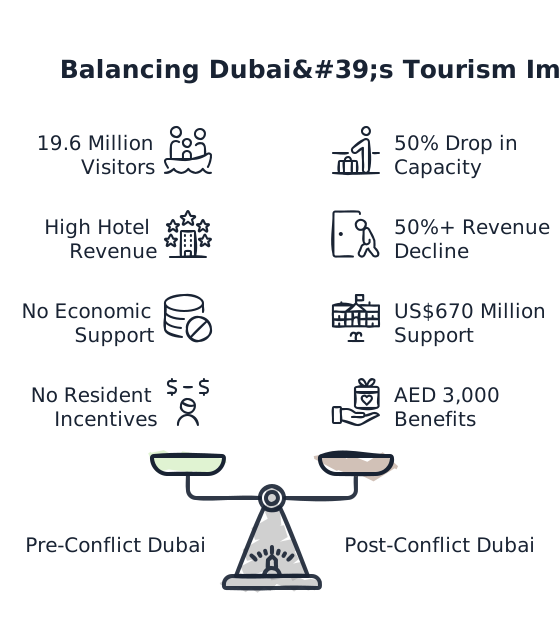
The referral push is one part of a far larger repair job. In late March, the Dubai government approved a $270 million support package for businesses and families. In May, it followed with more than $400 million more. The relief includes municipal-fee waivers for hotels and restaurants, lower customs fines, and reduced civil aviation permit fees. Combined, the injections cross $670 million. Issam Kazim, CEO of the Dubai Corporation for Tourism and Commerce Marketing, calls the invite campaign a way to turn residents into “ambassadors.” Fahad Iqbal, a regional economic commentator, sees the blunt mechanics: GCC hubs like Dubai are “highly exposed to perception shocks,” where bookings vanish even when the physical infrastructure is intact.
| Entity | Current rule | New rule | Effective date |
|---|---|---|---|
| Dubai Invite scheme | No resident referral reward | AED 3,000+ benefits per nominated visitor (max 3 per resident) | July 20, 2026 |
| Hotels and restaurants | Standard municipal fees | Municipal-fee exemption | Late March 2026 |
| Customs violations | Standard fine schedule | Reduced fines | Late March 2026 |
| Civil aviation permits | Standard fee schedule | Lowered fees | Late March 2026 |
| Second business support package | First package of $270 million | Additional $400 million+ in support | May 2026 |
| Source: Government of Dubai, Dubai Department of Economy and Tourism | |||
For the Western holder of a US, EU, or Australian passport, the entry rules remain straightforward. A short-stay visit visa or visa-on-arrival is typically granted. But details on fees, permitted stay duration, and processing times shift by passport and carrier. Check the official UAE eVisa portal and your airline’s visa page immediately before booking. Rules change without notice.
A tourism model held together by perception
The invite scheme is not just a promotion. It is a stress test of how well a non-oil economy can recover from a security shock that does not need to physically destroy it. The IMF’s Middle East director, Jihad Azour, warns the Iran-US conflict is weighing on all Gulf non-oil sectors by depressing confidence and disrupting air links. For Dubai, the danger is a slump that feeds on itself: fewer tourists mean emptier malls, then smaller retail rents, then lower real-estate values, then less reason to visit.
Travel advisories from the US, UK, and EU urge heightened caution in the region but do not ban UAE travel. Major airlines still fly into Dubai, though many have cut frequencies or rerouted around conflict zones, pushing up fares. The reset moment will come when Dubai releases official visitor statistics for the first half of 2026, expected in the third quarter. If arrivals hold within 10-15% of last year’s pace, the emergency subsidies are working.
What is not yet clear is whether a resident’s text message home — “come, it’s safe, and we’ll all get a free dinner” — can undo weeks of images of a city under a missile alert. The cheap rates and referral perks are real. The pressure to restore a sense of safety before the next winter high season is more acute. If the invite scheme works, expect copies in Abu Dhabi and Ras Al Khaimah. If it does not, the discounts will deepen — and the subsidies will too.
Beyond the headline
The Bigger Picture
Dubai’s resident-referral push is not just a quirky marketing tactic; it reflects how tightly Gulf diversification plans are now bound to geopolitical risk. A city that spent decades selling itself as insulated from regional volatility must suddenly pay its own residents to reassure the world it remains safe. That illustrates how perception shocks can unravel even carefully engineered tourism brands when hard security events pierce the narrative of stability.
The Money Trail
Behind the discounts and free nights sits a sizeable public and private subsidy. Dubai has already deployed hundreds of millions of dollars in fee waivers and support for hospitality, while hotels surrender margin through deep promotions to keep occupancy from collapsing. The real beneficiaries are the systemically important landlords, mall operators and developers whose balance sheets depend on tourist cash flows continuing to service debt and fund new projects.
The Timing
The invite scheme lands at a precarious moment: just after winter’s peak season was abruptly cut short by strikes and before airlines and tour operators finalise their 2026–27 schedules. Acting now lets Dubai test whether resident-led reassurance can salvage the upcoming high season and major events calendar. Waiting until year-end would risk ceding future bookings to competitors that look marginally less exposed to the Iran–US confrontation.
What this means for your ticket, your booking, and your portfolio
With the conflict still unsettling travel patterns, anyone with a stake in Dubai — whether a visitor, an investor, or a tour operator — now needs to calculate a new set of risks against the deep discounts on offer.
- Western resident of Dubai with family abroad
The scheme is a genuine short-term financial boost for hosting. Before nominating a relative, check the latest UK or US travel advisory — not for a ban, but for insurance implications. If your home government later upgrades its advisory, non-refundable guest bookings may fall through a policy gap many standard travel insurance plans treat as a conflict exclusion.
- European tour operator with Middle East packages
The severe capacity cuts and ongoing fare premiums mean bundle pricing for a Dubai package now needs a wider margin of error. Check with your airline partner whether current winter 2026 schedules are firm or provisional. If you are considering alternative hubs, compare Abu Dhabi and Doha — both are picking up some rerouted traffic but also carry a similar regional risk premium.
- US-based investor with UAE hospitality sector exposure
The revenue declines and the Burj Al Arab’s extended closure are a signal, not a one-off. Review your REIT or direct investment exposure to luxury hotel assets in Dubai. The occupancy recovery is directly tied to the ceasefire in place since April 8; any escalation will hit the sector again. The invite scheme’s early numbers — over 10,000 registrations in 48 hours — gauge sentiment but not booked stays.
- Western traveler considering a luxury holiday in the Middle East
The discounts are real: up to 45% off some top-tier properties and free access to major attractions. The trade-off is a city that is visibly quieter and a flight that may cost more and take a longer route, avoiding Iranian airspace. If the savings still pencil out, book with a card or insurance that explicitly covers cancellation if your country’s advisory level for the UAE changes after purchase.
FAQ
Is it safe to travel to Dubai right now?
Recent travel and regional reporting confirms that daily life and core tourism infrastructure in Dubai function normally. Airports and malls remain open with tightened security. No systemic breakdowns are reported. However, travellers should monitor official advisories for the wider Gulf region and be aware that airline routings may skirt conflict zones, adding flight time.
How do I actually claim the A Dubai Invite benefits?
A resident nominates you via the Visit Dubai portal before your trip, entering your passport details and arrival date. When you clear immigration, the system verifies your entry automatically. Within 72 hours, the resident receives an email with digital vouchers. The resident then shares these with you. Packages are redeemable from August through December 31, 2026, subject to partner terms.
Will my travel insurance cover a cancellation if I change my mind?
Because the downturn is tied to a conflict, many insurers treat it under war or government-advisory clauses. Policies differ sharply: some exclude war-related claims entirely, others cover cancellation only if your home government upgrades its advisory after you buy the policy. Before booking any non-refundable Dubai trip, read your policy’s specific wording on conflict-related disruption and airspace rerouting.
Explainer
- A Dubai Invite
- Dubai’s resident-referral scheme, launched in July 2026, that rewards locals with a benefits package for each international visitor they bring. The package includes hotel discounts, dining vouchers, and free attraction access. It is a direct emergency response to a tourism crisis triggered by Iranian missile strikes on the city.
- Visit Dubai
- The official tourism website and portal for the Dubai Department of Economy and Tourism. Residents use it to nominate guests for the invite scheme. It also serves as the central booking and information hub for the city’s marketing campaigns aimed at international visitors.
- Burj Al Arab
- Dubai’s iconic sail-shaped luxury hotel, operated by Jumeirah Group. It was struck during the Iranian attacks in February 2026 and subsequently closed for an 18-month restoration, accelerating pre-existing renovation plans. The closure removed one of the world’s most photographed hotels from the market at the city’s worst moment for tourism.
RELATED STORIES